
News
- Home
- AAPM TG-270 | Radiology Display Quality Assurance Guide
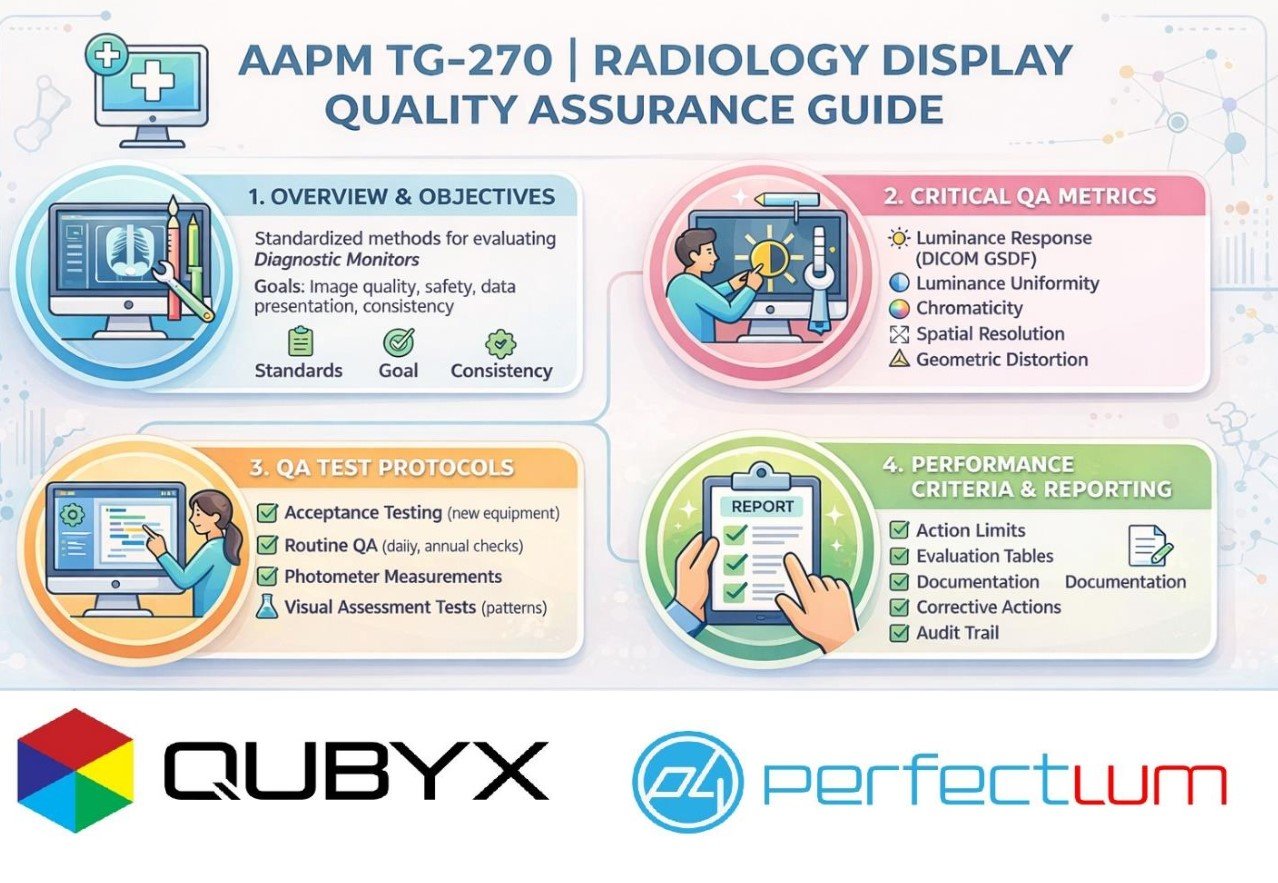
AAPM TG-270 | Radiology Display Quality Assurance Guide
- March 14, 2026
- Sam
AAPM TG-270: The Modern Standard for Radiology Display Quality Assurance
Medical imaging has become the backbone of modern healthcare diagnostics. Radiologists rely heavily on high-precision displays to interpret CT scans, MRIs, mammograms, and other medical images. Even minor inaccuracies in display calibration can influence diagnostic interpretation.
To address these challenges, the American Association of Physicists in Medicine (AAPM) developed AAPM TG-270, a comprehensive framework designed to standardize display quality assurance (QA) in medical imaging environments.
In this article, we explore what AAPM TG-270 is, why it matters, and how modern QA solutions such as QUBYX PerfectLum help radiology departments achieve reliable compliance.
What Is AAPM TG-270?
American Association of Physicists in Medicine developed AAPM Task Group 270 (TG-270) to provide a practical and unified framework for medical display quality assurance.
Before TG-270, healthcare facilities relied on various standards and fragmented QA practices. TG-270 consolidated best practices into a structured methodology covering:
-
Display acceptance testing
-
Routine performance monitoring
-
Calibration verification
-
Ambient lighting control
-
Documentation and compliance procedures
The objective is simple: ensure radiologists view images exactly as intended by imaging modalities and PACS systems.
Why AAPM TG-270 Matters in Modern Radiology
Radiology workloads have increased dramatically worldwide. As image volumes grow, the reliability of diagnostic displays becomes increasingly critical.
AAPM TG-270 helps healthcare organizations:
1. Protect Diagnostic Accuracy
Subtle grayscale differences can indicate disease. Proper display calibration ensures radiologists see the full diagnostic range.
2. Standardize QA Across Workstations
Hospitals may operate hundreds of displays across radiology, cardiology, pathology, and teleradiology networks. TG-270 establishes consistent testing procedures.
3. Improve Regulatory Compliance
Many regulatory frameworks reference display QA standards aligned with TG-270.
4. Reduce Risk in Distributed Reading Environments
With teleradiology expanding, TG-270 ensures remote workstations maintain consistent diagnostic quality.
Key Components of AAPM TG-270
AAPM TG-270 focuses on several critical elements of display performance.
1. Acceptance Testing
When a new medical display is installed, it must undergo initial acceptance testing to confirm it meets manufacturer specifications and clinical requirements.
Typical tests include:
-
Maximum luminance
-
Minimum luminance
-
Luminance ratio
-
Grayscale response
-
Uniformity
These measurements establish a baseline for future QA monitoring.
2. DICOM GSDF Calibration
Diagnostic displays must follow the DICOM Grayscale Standard Display Function.
DICOM Part 14 GSDF ensures grayscale tones appear perceptually linear to the human eye.
Calibration ensures:
-
Consistent grayscale rendering
-
Improved detection of subtle abnormalities
-
Standardized image interpretation across monitors
3. Routine Quality Assurance
TG-270 recommends regular testing schedules to detect performance drift.
Typical QA checks include:
-
Luminance measurements
-
Display uniformity
-
Visual test patterns
-
Ambient lighting verification
-
Calibration validation
Automated QA software can significantly simplify this process.
4. Ambient Lighting Control
Environmental lighting plays a major role in diagnostic accuracy.
TG-270 defines recommended lighting levels for different display environments such as:
-
Diagnostic reading rooms
-
Clinical review workstations
-
Operating rooms
Proper lighting reduces reflections and improves contrast perception.
5. Documentation and Audit Readiness
Hospitals must maintain documentation demonstrating compliance with QA procedures.
TG-270 emphasizes:
-
QA logs
-
Calibration records
-
Performance trend analysis
-
Audit-ready reporting
Automated systems can generate compliance reports instantly.
Challenges in Implementing TG-270
While TG-270 provides a robust framework, implementation can be complex for large healthcare organizations.
Common challenges include:
Large Display Networks
Hospitals may operate hundreds of displays across departments.
Manual Testing Burden
Manual QA workflows require significant time from medical physicists.
Calibration Drift
Displays naturally degrade over time, requiring continuous monitoring.
Remote Reading Environments
Teleradiology introduces additional complexity in ensuring consistent display performance.
These challenges make automated display QA systems essential.
How QUBYX PerfectLum Helps Achieve AAPM TG-270 Compliance
PerfectLum developed by QUBYX provides a powerful solution for implementing AAPM TG-270 display QA workflows.
PerfectLum offers features specifically designed for radiology environments.
Automated Calibration
Ensures displays follow DICOM GSDF standards with minimal manual intervention.
Network-Wide QA Monitoring
Monitor hundreds of displays across hospitals and teleradiology networks.
Compliance Reporting
Generate documentation required for audits and regulatory inspections.
Sensor-Based Measurement
Compatible with professional luminance sensors for precise measurements.
Remote Management
Centralized dashboard allows physicists and administrators to monitor display health across the entire network.
This automation significantly reduces the workload required to maintain TG-270 compliance.
TG-270 and the Future of Imaging Quality Assurance
Medical imaging is evolving rapidly with AI-assisted diagnostics, remote radiology, and increasing imaging volumes.
Standards such as AAPM TG-270 ensure that despite technological changes, image interpretation remains consistent, reliable, and safe for patients.
Future developments in display QA will likely include:
-
AI-driven QA monitoring
-
Predictive display failure detection
-
Automated compliance verification
-
Cloud-based QA management platforms
Software solutions such as PerfectLum already provide many of these capabilities.
Conclusion
AAPM TG-270 represents one of the most important frameworks for ensuring diagnostic display accuracy in modern radiology.
By standardizing acceptance testing, calibration procedures, environmental conditions, and routine quality assurance, TG-270 helps healthcare organizations maintain consistent diagnostic quality across all imaging workstations.
However, implementing TG-270 manually can be complex, particularly for large imaging networks.
Advanced QA solutions such as QUBYX PerfectLum enable healthcare providers to automate compliance, monitor display performance in real time, and maintain audit-ready documentation.
Ultimately, TG-270 is not just about technology—it is about protecting diagnostic confidence and improving patient care.
Tags:
AAPM TG-270, radiology display quality assurance, AAPM TG270 guidelines, medical display QA standards, diagnostic monitor calibration, DICOM GSDF compliance, radiology monitor testing, PACS display QA, QUBYX PerfectLum, medical imaging display standards
Read More:
DICOM Display Calibration in Remote Reporting | QUBYX
Related Posts
- May 24, 2026
- News
- May 16, 2026
- News
- May 14, 2026
- News