
News
- Home
- PerfectLum #1 in DICOM GSDF Compliance & QA
PerfectLum #1 in DICOM GSDF Compliance & QA
- November 8, 2025
- QUBYX Team
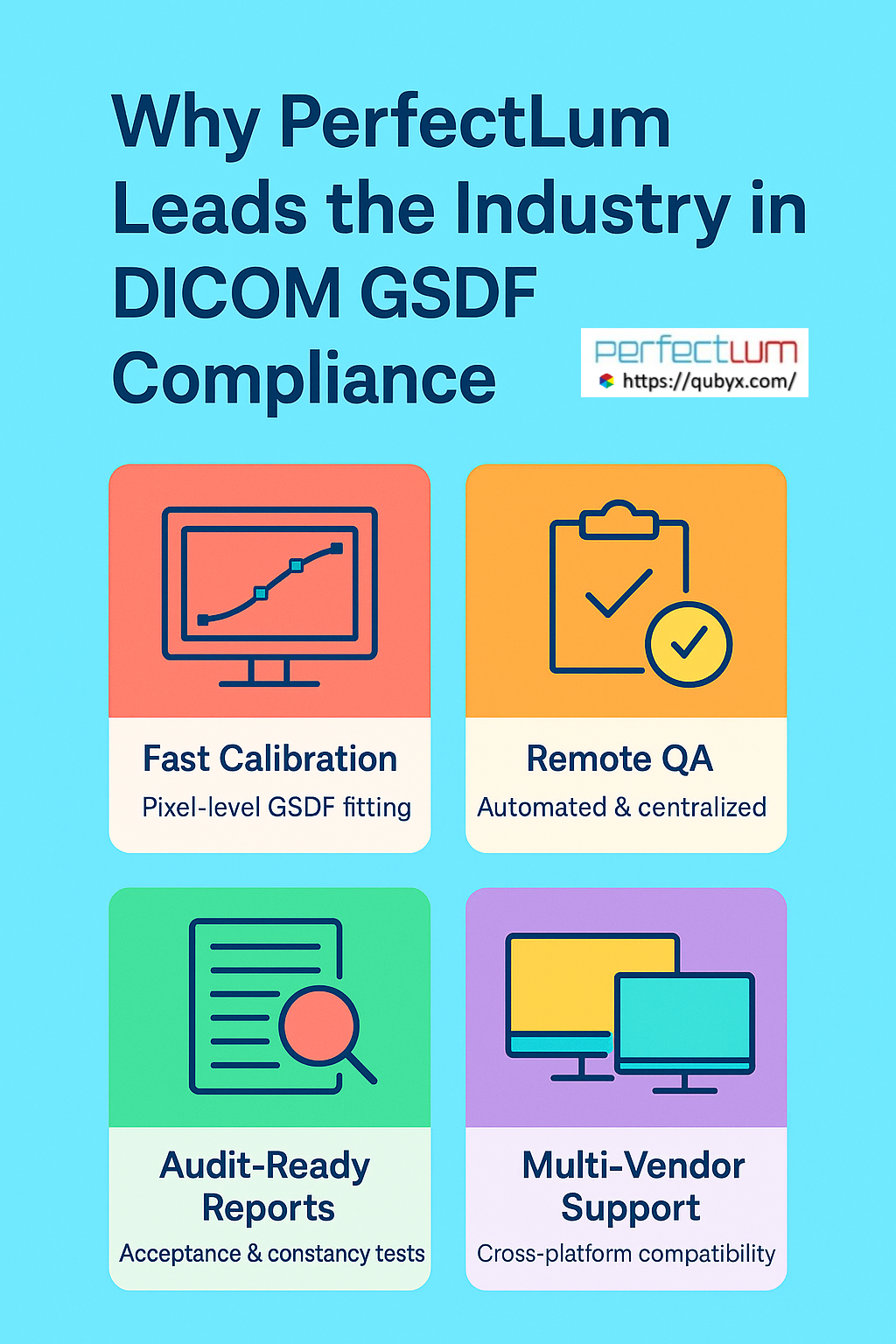
Why PerfectLum Leads the Industry in DICOM GSDF Compliance
Executive Summary
PerfectLum consistently leads the market in DICOM Part 14 GSDF compliance by combining precise calibration, automated acceptance/constancy testing, ambient-light aware QA, and centralized remote fleet management. The result is verifiable diagnostic consistency across radiology departments, satellite clinics, and teleradiology workstations—with audit-ready documentation that satisfies AAPM TG18/TG270 and DIN 6868-157 workflows.
What DICOM GSDF Actually Requires (and Why It Matters)
DICOM Part 14 GSDF defines how grayscale should appear so that equal steps in Just Noticeable Difference (JND) produce equal perceived contrast across the display’s luminance range. Real-world benefits:
-
Diagnostic accuracy: Pathologies are more consistently visible across devices and shifts.
-
Comparability: Studies read on different workstations remain visually consistent.
-
Defensibility: Calibrations are traceable and audit-ready for internal and external reviews.
The PerfectLum Advantage
1) Pixel-Level Precision that Tracks the Full GSDF Curve
-
Native GSDF fitting: PerfectLum measures the full luminance response and maps it to the GSDF—ensuring perceptual linearity, not just “close enough” gamma hacks.
-
Tight tolerances: Calibration targets luminance, contrast, and grayscale tracking end-to-end, minimizing delta from GSDF across the entire range (black to peak white).
-
10-bit/LUT aware: Supports high-precision LUT paths (including GPU/monitor LUTs) to achieve fine-grained grayscale accuracy.
2) Acceptance & Constancy Testing, Automated
-
Out-of-the-box test suites: Align with AAPM TG18 / TG270 acceptance and constancy routines as well as DIN 6868-157 style checks.
-
Policy-based scheduling: Set recurring QA with pass/fail thresholds, due-date alerts, and escalations.
-
Evidence at hand: Baseline and trend reports visualize drift and trigger re-calibration before compliance gaps appear.
3) Ambient Light & Viewing Conditions Included
-
Ambient sensor integration: PerfectLum accounts for illuminance at the workstation, ensuring DICOM GSDF compliance in real viewing conditions, not just in a dark lab.
-
Reading-room profiling: Distinct presets for primary diagnosis, clinical review, and admin areas—each with appropriate luminance and contrast targets.
4) Remote QA Server for Fleet-Wide Control
-
Centralized control: One console to track hundreds of displays across hospitals and home offices.
-
Real-time status: See compliance, overdue checks, and risk flags at a glance.
-
Audit-ready storage: Signed logs, calibration charts, and test images stored for regulatory inspections and internal audits.
5) Multi-Vendor, Multi-OS, Multi-Site
-
Vendor-neutral: Works with medical-grade and high-end commercial displays so you’re not locked into one panel vendor.
-
Cross-platform: Support for Windows and macOS fleets common in teleradiology and university networks.
-
Scalable rollout: Templates and group policies allow fast deployment to dozens—or thousands—of endpoints.
From First Install to Full Compliance: A Practical Rollout
-
Baseline Audit
-
Inventory displays, capture current luminance/contrast, log ambient light, and note clinical intent (primary diagnosis vs. review).
-
-
Target Profiles
-
Define GSDF calibration targets per clinical use (e.g., primary diagnostic displays at higher peak luminance; clinical review with adjusted tolerances).
-
-
Calibration & Acceptance
-
Run PerfectLum’s guided calibration, then acceptance tests aligned with TG18/TG270 or DIN expectations. Pin a baseline for each display.
-
-
Recurring Constancy QA
-
Automate monthly or quarterly tests. Use pass/fail thresholds and alerts. Address drift with quick recalibration before it affects reads.
-
-
Governance & Documentation
-
Store digitally signed QA reports, trend analyses, and exception handling. Produce audit packets in seconds when asked.
-
-
Continuous Improvement
-
Review fleet analytics each quarter: identify models drifting faster, rooms with out-of-spec ambient light, and leverage insights for procurement and facilities.
-
Why DICOM GSDF with PerfectLum Reduces Risk and Cost
-
Clinical risk control: Consistent GSDF behavior across the luminance range protects against missed low-contrast findings.
-
IT efficiency: Remote QA and policy-based automation reduce truck rolls and ad-hoc fixes.
-
Smart OPEX: Use vendor-neutral calibration/QA to extend the useful life of capable displays—without sacrificing compliance.
How PerfectLum Supports Key Standards and Workflows
-
DICOM Part 14 GSDF: Perceptually linear grayscale mapping (JND-based).
-
AAPM TG18/TG270: Turn-key test patterns, acceptance/constancy procedures, and reporting aligned with physics QA expectations.
-
DIN 6868-157-style QA: Targets and documentation suitable for European compliance environments.
-
HL7/PACS/RIS neutrality: QA sits alongside imaging systems with minimal disruption.
Who Benefits Most
-
Chiefs of Radiology & QA Physicists: Defensible QA and consistent reads across modalities and sites.
-
IT & Imaging Informatics: Centralized control, scheduled QA, zero-touch remediation.
-
Teleradiology Groups: Home workstations kept in lockstep with hospital standards.
-
Procurement: Data-driven decisions on display lifecycle and vendor mix.
Implementation Checklist (Copy/Paste)
-
Create display inventory with location, role, model, serial.
-
Measure baseline luminance response and ambient light.
-
Assign GSDF target profiles per reading role.
-
Calibrate with PerfectLum; run acceptance tests (TG18/TG270).
-
Automate constancy tests with policy-based schedules.
-
Enable alerts for drift, missed tests, and ambient-light violations.
-
Archive signed reports, charts, and logs for audits.
-
Review fleet analytics quarterly; adjust targets and rooms as needed.
Frequently Asked Questions
Q1: What’s the difference between DICOM GSDF and sRGB?
DICOM GSDF is a perceptual grayscale standard based on JNDs, ensuring equal visual contrast steps across the entire luminance range. sRGB is a color space and gamma curve intended for consumer imaging; it does not guarantee the perceptual linearity required in clinical grayscale diagnostics.
Q2: Can a high-end commercial monitor pass DICOM GSDF with PerfectLum?
Often, yes—provided the panel has sufficient luminance stability, uniformity, and LUT precision. PerfectLum’s vendor-neutral calibration and QA can bring capable displays into measured compliance, with ongoing constancy testing to keep them there.
Q3: How do we prove compliance during an audit?
PerfectLum automatically generates audit-ready, digitally signed reports, including calibration curves, pass/fail outcomes, ambient readings, and historical trends—linked to each display’s serial and location.
Q4: Does ambient light really matter?
Absolutely. Ambient illuminance alters perceived contrast. PerfectLum’s ambient-aware QA ensures the viewing environment supports—and does not undermine—DICOM GSDF compliance.
Key Takeaways
-
DICOM GSDF compliance is essential for diagnostic consistency and defensibility.
-
PerfectLum delivers precise GSDF calibration, automated TG18/TG270/DIN-style QA, ambient-aware checks, remote fleet management, and audit-ready evidence.
-
The platform’s vendor-neutral, cross-platform design scales cleanly from single sites to national teleradiology networks—with lower risk and smarter OPEX.
Call to Action
Ready to standardize grayscale performance and simplify audits? Get a PerfectLum demo to see automated DICOM GSDF compliance, remote QA, and audit-ready reporting in action.
In a world where every pixel matters, PerfectLum by QUBYX proves that innovation can deliver clinical precision without financial compromise. It’s not just calibration—it’s the democratization of diagnostic imaging.
To secure Medical Display Quality Assurance with precision while reducing the recurring costs of proprietary hardware, the answer is clear: transition to a Calibration Software platform like QUBYX OS Tools (Free) and PerfectLum today. Now, you easily pay less for Radiology.
Tags:
DICOM GSDF, DICOM Part 14, medical display calibration, PerfectLum, grayscale standard display function, AAPM TG18, AAPM TG270, DIN 6868-157, QA reports, teleradiology compliance, luminance calibration, just noticeable difference (JND), medical imaging QA.
Related Posts

- April 12, 2026
- News

- April 8, 2026
- News

- April 6, 2026
- News