
News
- Home
- Why Organizations Choose PerfectLum for Imaging QA
Why Organizations Choose PerfectLum for Imaging QA
- January 28, 2026
- QUBYX Team
Why Organizations Choose PerfectLum
Modern radiology and teleradiology environments depend on consistent, trustworthy image presentation. Yet as diagnostic reading expands across locations, devices, and vendors, maintaining uniform display performance becomes increasingly complex. Variability in luminance, grayscale response, and ongoing drift can silently erode diagnostic confidence and create audit risk.
This is precisely why organizations choose PerfectLum. Rather than treating calibration and quality assurance (QA) as isolated technical tasks, PerfectLum supports a structured, repeatable, and governance-ready approach to imaging quality—purpose-built for clinical environments and aligned with real-world operational needs.
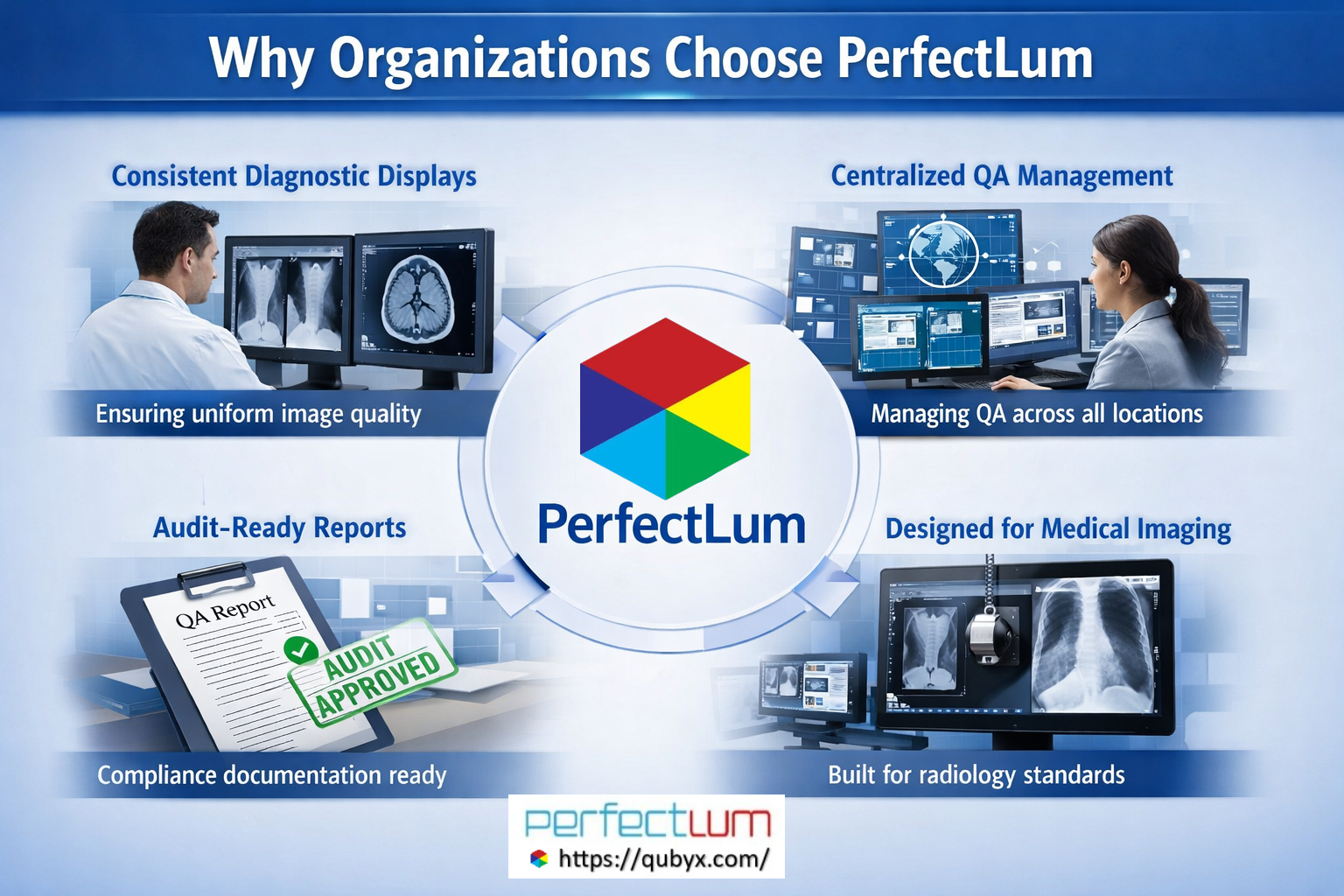
This article explains why organizations choose PerfectLum, focusing on four core drivers: reduced variability in diagnostic image presentation, support for quality governance in distributed environments, improved audit readiness without operational burden, and design specificity for medical imaging rather than generic color tools.
The Growing Challenge of Display Variability in Diagnostic Imaging
Why display consistency matters clinically
Diagnostic interpretation relies on subtle grayscale and contrast cues. When displays differ—even slightly—radiologists may not be seeing equivalent representations of the same study. Over time, unmanaged variability can lead to:
-
Inconsistent diagnostic confidence across workstations
-
Increased interpretation fatigue
-
Greater reliance on subjective adjustments
-
Difficulty defending image quality during audits or reviews
Organizations increasingly recognize that acquisition quality alone does not guarantee diagnostic reliability. Display performance is an integral part of the diagnostic chain.
The limits of ad-hoc calibration approaches
Many facilities still rely on manual or fragmented calibration practices, such as:
-
One-time calibration during installation
-
Vendor-specific tools with limited oversight
-
Irregular checks performed only when issues are noticed
These approaches fail to address gradual display drift and do not scale well in multi-site or remote reading environments. As a result, leadership teams lack visibility into actual imaging quality across the organization.
Reducing Variability in Diagnostic Image Presentation
Standardized calibration across workstations
A primary reason why organizations choose PerfectLum is its ability to reduce variability in diagnostic image presentation. PerfectLum enables consistent calibration of medical displays to defined luminance and grayscale targets, ensuring that images appear as intended—regardless of workstation or location.
Key capabilities include:
-
Accurate calibration aligned with clinical performance targets
-
Support for consistent grayscale response across displays
-
Repeatable workflows that remove guesswork from calibration
This standardization supports clinical confidence by ensuring radiologists interpret images under controlled, predictable viewing conditions.
Ongoing verification to prevent drift
Calibration alone is not sufficient. Displays naturally degrade over time, often without obvious visual cues. PerfectLum incorporates verification processes that allow organizations to:
-
Confirm calibration stability on a scheduled basis
-
Detect early signs of performance drift
-
Address issues proactively before image quality is compromised
By treating display performance as a continuously managed parameter, organizations reduce reliance on reactive troubleshooting.
Supporting Quality Governance in Distributed Environments
The reality of distributed radiology
Teleradiology, hybrid reading models, and multi-site imaging networks are now standard. However, distributed environments introduce new governance challenges:
-
Hundreds of workstations across sites and homes
-
Mixed display vendors and hardware generations
-
Limited direct oversight by central IT or QA teams
Without centralized visibility, quality governance becomes fragmented.
Centralized QA management
Another critical reason why organizations choose PerfectLum is its support for centralized QA management. When deployed in server-based or coordinated configurations, PerfectLum enables:
-
Central scheduling of calibration and QA tasks
-
Visibility into display performance across sites
-
Consistent policy enforcement without manual follow-ups
This governance model aligns with how modern healthcare organizations manage risk—through oversight, documentation, and accountability rather than informal processes.
Enabling leadership-level oversight
Quality governance is not solely a technical concern. Clinical leadership, compliance teams, and IT management all require reliable insight into imaging quality. PerfectLum provides structured data that supports informed oversight and cross-departmental alignment.
Improving Audit Readiness Without Operational Burden
Audit pressure in regulated imaging environments
Accreditation bodies and internal compliance programs increasingly expect objective evidence of imaging quality controls. During audits, organizations are often asked to demonstrate:
-
That displays are calibrated to defined standards
-
That QA checks are performed regularly
-
That historical records are complete and traceable
Manual documentation and ad-hoc screenshots rarely meet these expectations.
Automatically generated QA documentation
A major reason why organizations choose PerfectLum is its ability to produce audit-ready documentation without disrupting daily operations. The system automatically generates:
-
Calibration records with timestamps and parameters
-
Verification results linked to specific displays
-
Traceable histories suitable for internal review or external audits
This reduces administrative burden while strengthening compliance posture.
Reducing operational friction
Importantly, PerfectLum is designed to integrate into existing workflows. Calibration and QA activities can be scheduled to minimize clinical disruption, ensuring that audit readiness does not come at the expense of productivity.
Designed Specifically for Imaging—Not Generic Color Tools
Why generic tools fall short in healthcare
Generic color calibration tools are often designed for photography, design, or consumer displays. While effective in those domains, they typically lack:
-
Clinical luminance targets
-
Medical grayscale response support
-
QA workflows aligned with healthcare standards
-
Reporting suitable for regulated environments
Using such tools in diagnostic contexts can create false confidence without meeting clinical or regulatory expectations.
Purpose-built for medical imaging
Organizations choose PerfectLum because it is designed specifically for imaging. Its workflows, measurements, and outputs reflect the realities of diagnostic environments rather than creative industries.
This specialization supports:
-
Alignment with medical display performance expectations
-
Objective, repeatable QA processes
-
Clear separation between clinical and non-clinical calibration needs
PerfectLum’s design philosophy recognizes that diagnostic imaging demands a higher level of rigor and accountability.
Alignment With Standards and Best Practices
Supporting standards-based QA strategies
While organizations differ in regulatory requirements by region, there is broad consensus around the need for standards-aligned imaging QA. PerfectLum supports structured QA strategies that align with widely recognized best practices in medical imaging.
This standards-aware approach helps organizations:
-
Establish defensible QA policies
-
Maintain consistency across accreditation cycles
-
Adapt to evolving regulatory expectations
Enabling continuous improvement
Rather than positioning QA as a one-time compliance exercise, PerfectLum supports continuous quality improvement. Historical data enables organizations to analyze trends, identify systemic issues, and refine policies over time.
Who Benefits Most From PerfectLum
Radiology departments and imaging centers
For hospital-based radiology and outpatient imaging centers, PerfectLum provides a scalable way to maintain consistent image presentation across growing fleets of diagnostic displays.
Teleradiology providers
Distributed reading models benefit from centralized QA oversight, ensuring that remote workstations meet the same quality expectations as on-site systems.
IT and clinical engineering teams
PerfectLum reduces manual effort while improving visibility, allowing technical teams to focus on proactive quality management rather than reactive support.
Compliance and governance teams
Clear documentation and traceable records simplify audit preparation and support defensible compliance narratives.
Why Organizations Choose PerfectLum Over Alternatives
When evaluating imaging QA solutions, organizations increasingly prioritize systems that deliver:
-
Reduced variability in diagnostic image presentation
-
Strong support for quality governance across distributed environments
-
Improved audit readiness without adding operational burden
-
Purpose-built design for medical imaging, not generic color workflows
PerfectLum addresses these priorities directly, making it a strategic choice rather than a tactical tool.
Developed by QUBYX LLC, PerfectLum reflects deep domain expertise in medical display calibration and imaging QA. Its adoption is driven not by marketing claims, but by operational outcomes that matter to clinical, technical, and governance stakeholders alike.
Conclusion: A Governance-First Approach to Imaging Quality
The reasons why organizations choose PerfectLum extend beyond calibration accuracy alone. In an era of distributed diagnostics and heightened regulatory scrutiny, imaging quality must be governed, documented, and sustained.
PerfectLum enables organizations to move from fragmented, reactive practices to structured, continuous imaging QA—supporting diagnostic confidence, operational efficiency, and audit readiness at scale. For healthcare organizations seeking a purpose-built solution that aligns with modern imaging realities, PerfectLum represents a deliberate and defensible choice.
Start the conversation with our calibration experts today.
In a world where every Pixel accuracy matters, PerfectLum by QUBYX proves that innovation can deliver clinical precision without financial compromise. It’s not just calibration—it’s the democratization of diagnostic imaging.
PerfectLum is Medical Display Calibration & QA Software by QUBYX LLC delivers consistent, audit-ready display performance through standardized calibration, verification, and centralized quality assurance for radiology and teleradiology environments.
Tags:
organizations choose PerfectLum, why organizations choose PerfectLum, medical display calibration software, imaging quality assurance, diagnostic display QA, centralized QA management, audit-ready imaging compliance, teleradiology display standardization
About the Author:
Shamsul Islam is a strategy and growth professional focused on regulated B2B technology markets. He supports QUBYX LLC and its medical imaging solutions through product positioning, go-to-market strategy, and end-to-end digital content development, including website, social media, and educational video initiatives aligned with quality, compliance, and governance-driven environments.
Related Posts

- April 12, 2026
- News
- April 8, 2026
- News

- April 6, 2026
- News