
News
- Home
- Why Hospitals Worldwide Choose PerfectLum Calibration
Why Hospitals Worldwide Choose PerfectLum Calibration
- November 15, 2025
- QUBYX Team
Why Hospitals Worldwide Choose PerfectLum for Display Calibration
In modern healthcare, a single misread pixel can change a diagnosis.
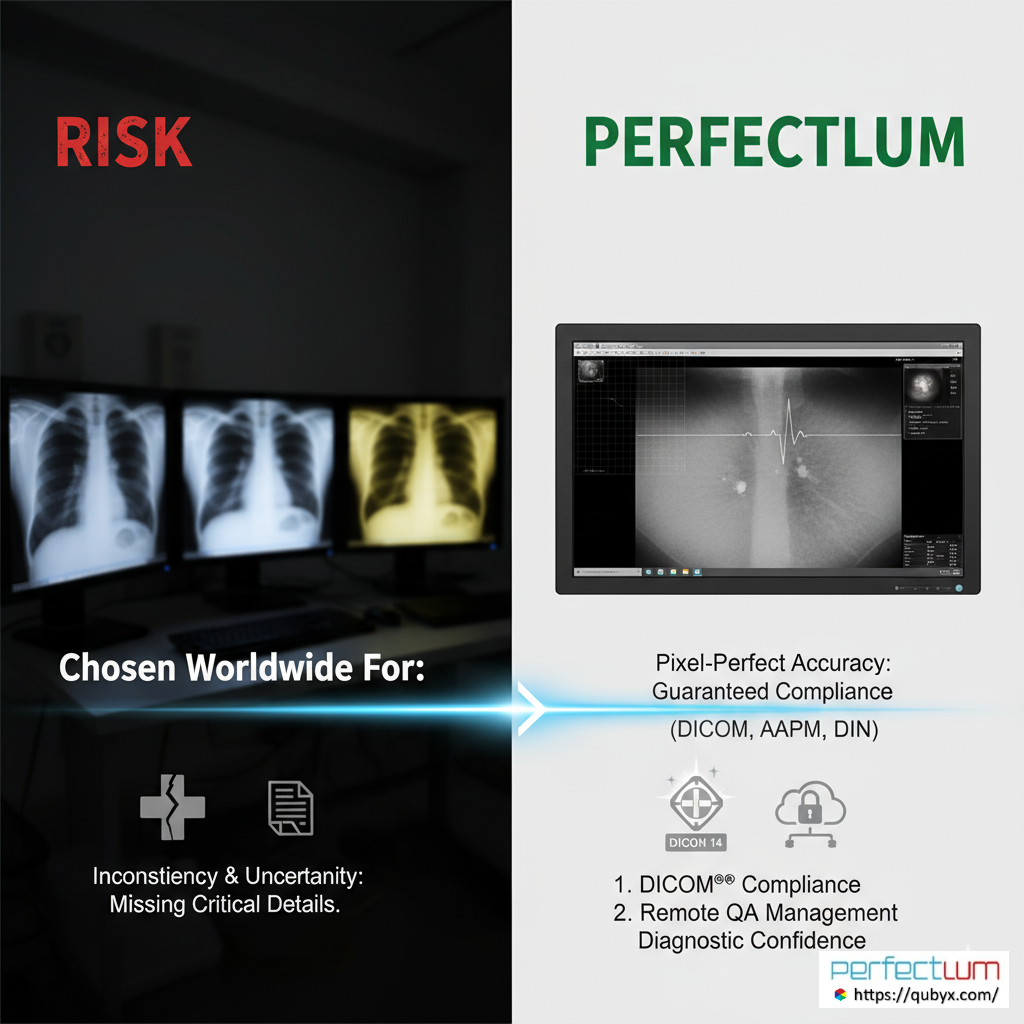
Radiologists, cardiologists, oncologists, and surgeons depend on one thing every day: trustworthy images. CT, MRI, mammography, PET, ultrasound, and X-ray scans are only as reliable as the displays used to interpret them. That’s why hospitals around the world are re-thinking their approach to display calibration and quality assurance (QA) — and increasingly choose PerfectLum as their standard solution.
PerfectLum is a professional display calibration and QA software that helps medical facilities standardize image quality, simplify compliance, and extend the life of their displays. Instead of relying only on expensive, vendor-locked hardware monitors, hospitals are moving to a smarter, software-driven strategy — and PerfectLum is at the center of that shift.
In this article, we’ll explore the key reasons why hospitals worldwide choose PerfectLum for display calibration and how it helps them improve quality, compliance, and ROI.
1. From “Nice to Have” to Mission-Critical: Why Display Calibration Matters
For years, display calibration was often treated as a technical detail or a one-time setup. Today, with the rise of teleradiology, remote reading, and multi-site healthcare networks, it has become mission-critical.
Uncalibrated or poorly calibrated displays can lead to:
-
Subtle lesions being missed
-
Inconsistent brightness and contrast between reading rooms
-
Different diagnosis outcomes from different workstations
-
Non-compliance with medical imaging standards
Hospitals are under pressure from regulators, accreditors, and internal QA teams to show that:
-
Displays are calibrated regularly
-
QA tests are documented and traceable
-
Standards such as DICOM GSDF and other guidelines are followed
If you use PerfectLum, it addresses all of this in a centralized, automated, and auditable way, making it far more than just a calibration utility — it’s a full display quality management platform.
2. DICOM GSDF Compliance Made Practical
The gold standard for medical imaging displays is the DICOM Part 14 Grayscale Standard Display Function (GSDF), which ensures a consistent visual response from dark to bright tones. Without a DICOM-compliant calibration, even a high-end monitor may show incorrect grayscale levels, affecting diagnostic confidence.
Hospitals are switching to choose PerfectLum because it:
-
Calibrates displays precisely to DICOM GSDF
-
Performs luminance and grayscale corrections using a supported colorimeter
-
Creates custom LUTs (Look-Up Tables) to match the monitor to the DICOM curve
-
Provides visual and numeric verification that the target curve has been reached
This means radiologists can move between workstations and trust that the grayscale response is consistent, no matter where they are reading — at the main hospital, in a satellite clinic, or at a home office.
3. Simplifying Compliance with QA Standards and Audits
Whether a hospital works under AAPM, DIN, IEC, or national QA guidelines, the pressure to prove compliance is growing. Auditors don’t just ask, “Are your displays calibrated?” — they want evidence:
-
When was each display last calibrated?
-
Which test patterns and procedures were used?
-
Did the display pass or fail specific QA criteria?
-
How are issues tracked and resolved?
When admin choose PerfectLum, it helps hospitals answer these questions instantly by:
-
Running automated acceptance and constancy tests
-
Storing detailed calibration and QA logs
-
Generating reports for each device, department, or time period
-
Providing clear pass/fail results based on configured thresholds
Instead of scrambling to collect screenshots, local logs, and manual records, QA managers can choose PerfectLum and export clean, audit-ready reports in a few clicks. That’s a major reason so many hospitals are moving away from ad-hoc tools and adopting a professional, centralized solution.
4. Centralized Control for Multi-Site and Teleradiology Workflows
Modern hospitals rarely operate under a single roof:
-
Large health systems run multiple hospitals and imaging centers
-
Radiologists read from home workstations and remote offices
-
Outsourced or partner teleradiology services may join the workflow
Managing display quality manually in this environment is almost impossible.
When you choose PerfectLum, it solves this with a central server & remote client architecture (or cloud-style deployment, depending on configuration), allowing IT and medical physics teams to:
-
View the status of every calibrated display from a single dashboard
-
Schedule automatic calibration and QA tests during off-hours
-
Push policies and settings to all connected workstations
-
Receive alerts when a display fails, drifts, or misses a scheduled test
This centralized control is a key reason hospitals choose PerfectLum: it turns a chaotic, workstation-by-workstation process into a managed, predictable quality system.
5. Extending the Life of Existing Displays and Reducing CAPEX
Buying only top-tier, vendor-locked medical monitors for every use case is expensive and often unnecessary. Many hospitals are experimenting with:
-
High-quality professional displays from reputable brands
-
Re-using existing monitors by bringing them into compliance
-
Budget-friendly displays for secondary or non-primary reading tasks
The challenge is making sure these displays still meet the necessary performance and QA requirements.
When they choose PerfectLum, it helps hospitals:
-
Calibrate and validate a wider range of displays, including off-the-shelf models
-
Identify which displays are still fit for diagnostic use and which should be downgraded or retired
-
Extend the usable life of installed displays by correcting drift over time instead of replacing devices early
The result is a clear CAPEX reduction: rather than replacing monitors simply because “they might be out of spec,” hospitals can make decisions based on measured performance data provided by PerfectLum.
6. Vendor-Neutral, Hardware-Agnostic Approach
One of the biggest reasons hospitals choose PerfectLum is that it is vendor-neutral and hardware-agnostic:
-
It supports multiple display brands and models
-
It works with standard medical-grade colorimeters and sensors
-
It avoids proprietary lock-in tied to a single monitor manufacturer
Choose Perfectlum as it gives hospitals strategic flexibility:
-
They can mix and match display vendors based on quality and pricing
-
They can keep using existing probes and sensors where compatible
-
They can standardize on one QA software platform across the entire imaging workflow
In other words, PerfectLum enables a software-first strategy where hospitals control their own QA standards and procurement decisions, rather than being forced into a single hardware ecosystem.
7. Supporting Both Diagnostic and Clinical Review Displays
Not every screen in a hospital is a primary diagnostic display, but many still need good, consistent image quality:
-
Review stations in the ER and ICU
-
Clinician workstations in wards and clinics
-
OR displays used for image-guided procedures
-
Workstations used for 3D reconstructions, PET/CT fusion, and more
If you choosePerfectLum, it is flexible enough to handle this entire spectrum:
-
High-precision calibration and QA for primary diagnostic displays
-
Appropriate QA profiles for secondary and review displays
-
Custom configurations based on department workflows and risk levels
This allows hospitals to right-size their QA efforts: invest more testing where risk is highest, and maintain reasonable quality everywhere else — all within the same software environment.
8. Made for IT, Medical Physics, and Radiology Teams Alike
Another major reason for PerfectLum’s growing adoption is that it speaks the language of all stakeholders:
-
IT teams appreciate the centralized management, automation, network deployment, and logging
-
Medical physicists and QA experts rely on the detailed measurements, standards alignment, and reporting
-
Radiologists care about consistent image quality and minimal disruption to reading workflows
PerfectLum offers:
-
Scheduled calibrations during low-usage hours to avoid interrupting radiologists
-
Simple on-screen guidance when local interaction is needed
-
Clear result dashboards so QA teams can prioritize issues
This alignment across departments makes it much easier for hospitals to standardize on PerfectLum as their enterprise solution.
9. Enabling Safe and Reliable Teleradiology
Teleradiology isn’t just a trend anymore; it’s a core part of modern healthcare. But remote reading is only safe if home or satellite workstations meet the same quality standards as hospital reading rooms.
Hospitals are switching to choose PerfectLum because it:
-
Allows remote calibration and QA of home workstations
-
Ensures DICOM-compliant grayscale performance even outside the hospital
-
Provides central reporting that includes remote and internal displays
-
Helps satisfy policy and accreditation requirements for tele-imaging
That means hospitals can expand teleradiology coverage with confidence, knowing that the same QA framework applies everywhere.
10. Lowering Total Cost of Ownership (TCO) Without Cutting Corners
Every hospital faces financial pressure. Upgrading PACS, RIS, modalities, and displays all at once is not always possible. They can choose PerfectLum as it provides a way to protect image quality while optimizing budgets:
-
Reduce unnecessary early monitor replacements
-
Use a more diverse mix of display hardware while maintaining QA
-
Decrease manual QA labor through automation and centralized control
-
Avoid multiple overlapping vendor tools with one unified platform
The result is a lower Total Cost of Ownership (TCO) for the entire display fleet — without compromising diagnostic quality or compliance.
11. Future-Ready: Preparing for AI and Advanced Imaging
As AI grows in medical imaging — from detection algorithms to workflow triage — display quality will matter even more. Subtle differences in grayscale, contrast, or color could influence how both humans and AI interpret images.
Hospitals choose PerfectLum today are effectively:
-
Standardizing their visual environment for both radiologists and AI tools
-
Building traceable QA baselines that will be essential when validating AI workflows
-
Ensuring that advanced imaging applications run on reliable, calibrated displays
By switching to PerfectLum, hospitals help future-proof their imaging environment for the next generation of digital diagnostics.
Conclusion: Why PerfectLum Is Becoming the Global Choice
Hospitals worldwide choose PerfectLum because it offers a complete answer to the display calibration challenge:
-
DICOM GSDF-compliant calibration for accurate diagnostic imaging
-
Centralized QA and reporting for easy audits and standards compliance
-
Vendor-neutral flexibility to avoid hardware lock-in and control costs
-
Support for multi-site and remote workflows, including teleradiology
-
Automation and centralized management that make IT and QA teams’ lives easier
-
Longer display lifespans and lower TCO, without cutting corners on quality
In a world where every pixel can influence a diagnosis, choose PerfectLum gives hospitals a powerful way to protect image integrity, meet regulatory demands, and build a smarter, more sustainable display strategy.
If your hospital is still relying on manual calibration, vendor-specific tools, or outdated QA processes, now is the time to explore how a professional, software-driven solution can transform your display quality management and ultimately, support better patient care. You need to choose PerfectLum software developed by QUBYX.
In a world where every Pixel accuracy matters, PerfectLum by QUBYX proves that innovation can deliver clinical precision without financial compromise. It’s not just calibration—it’s the democratization of diagnostic imaging.
To secure Medical Display Quality Assurance with precision while reducing the recurring costs of proprietary hardware, the answer is clear: transition to a Calibration Software platform like QUBYX OS Tools (Free) and PerfectLum today. Now, you easily pay less for Radiology.
Tags:
Choose PerfectLum, PerfectLum, PerfectLum calibration, medical display calibration software, DICOM GSDF compliance, hospital display QA, medical imaging display calibration, radiology monitor calibration, diagnostic display QA software, teleradiology workstation calibration, healthcare display management, medical monitor quality assurance, AAPM TG18 TG270 compliance, display calibration for hospitals, centralized QA software, medical imaging accuracy tools, clinical review display calibration, remote calibration software for radiology, vendor-neutral calibration tools
Related Posts
- April 12, 2026
- News
- April 8, 2026
- News
- April 6, 2026
- News