
News
- Home
- Why Display Quality Still Fails in Distributed Imaging
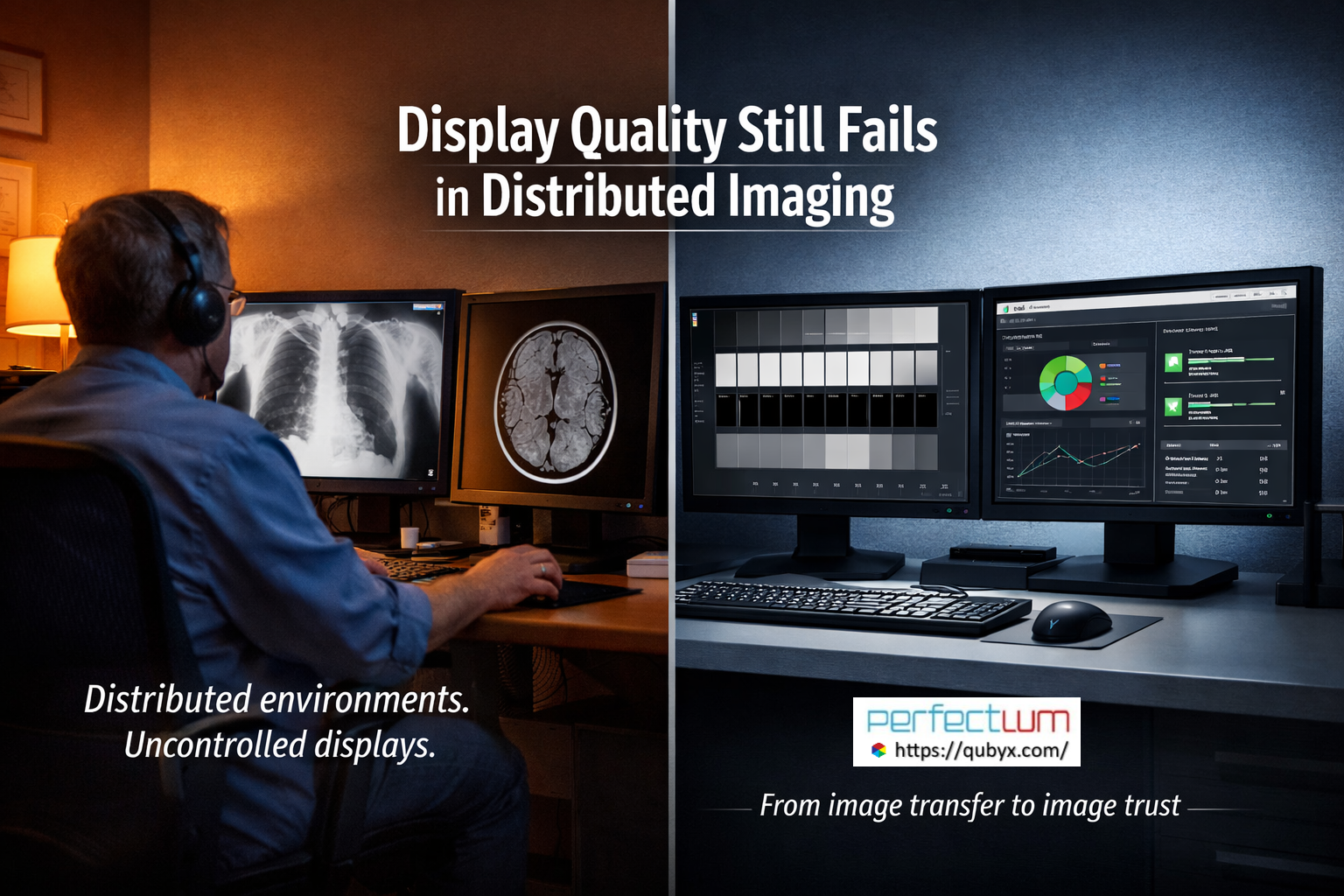
Why Display Quality Still Fails in Distributed Imaging
- January 29, 2026
- QUBYX Team
Why Display Quality Still Fails in Distributed Imaging
Introduction
Display quality in distributed imaging remains one of the most persistent—and underestimated—challenges in modern radiology and teleradiology. While healthcare organizations have invested heavily in image acquisition systems, PACS, VNAs, and secure image transfer, diagnostic accuracy ultimately depends on how images are presented at the point of interpretation.
In distributed imaging environments, radiologists interpret studies across multiple sites, devices, time zones, and conditions. This operational flexibility has improved access to care and reporting efficiency. However, it has also introduced a fundamental problem: display quality variability that image transfer alone cannot solve.
This article examines why display quality in distributed imaging still fails, what structural factors drive inconsistency, and how modern imaging organizations must rethink quality assurance as a centralized, continuous discipline rather than a local, ad-hoc task.
The False Assumption: Image Transfer Equals Image Quality
Digital Perfection Ends at the Display
A common misconception in distributed imaging is that if images are transferred without data loss, diagnostic quality is preserved. In reality, image fidelity stops being guaranteed the moment pixel data reaches a display.
Display quality in distributed imaging is influenced by far more than transmission accuracy. The same image can appear meaningfully different depending on:
-
monitor luminance behavior
-
grayscale response curve alignment
-
ambient lighting conditions
-
display aging and drift
-
local calibration practices
Without control at the display level, perfect image transfer does not equate to consistent image presentation.
Core Reasons Display Quality Still Fails
1. Heterogeneous Monitor Ecosystems
Distributed imaging environments rarely operate with a single display model or vendor. Instead, they include:
-
diagnostic-grade monitors of varying generations
-
secondary clinical displays
-
hybrid setups in home or satellite reading rooms
Each display model has unique luminance capabilities, backlight behavior, and aging characteristics. Over time, this heterogeneity creates unavoidable divergence in display quality across sites.
Without normalization, display quality in distributed imaging becomes inherently inconsistent.
2. Display Aging and Unmonitored Drift
All displays change over time. Luminance output declines, contrast behavior shifts, and grayscale accuracy drifts. In centralized reading rooms, these changes may be detected during scheduled maintenance. In distributed environments, they often go unnoticed.
Key risks include:
-
gradual luminance loss below diagnostic thresholds
-
silent grayscale non-conformance
-
inconsistent contrast perception between readers
When aging behavior is not centrally monitored, display quality in distributed imaging degrades invisibly—undermining diagnostic confidence without triggering alerts.
3. Inconsistent Calibration Practices
Calibration is frequently treated as a local technical task, not a system-level quality process. In distributed imaging, this leads to:
-
irregular calibration schedules
-
different calibration targets across sites
-
manual workflows prone to human error
-
lack of verification after calibration
Even when calibration is performed, the absence of standardization means results vary widely. Display quality in distributed imaging cannot be stabilized without uniform calibration policies enforced across the enterprise.
4. Uncontrolled Viewing Environments
Environmental factors significantly affect perceived image quality. Distributed radiology introduces variability in:
-
ambient light intensity
-
wall color and reflections
-
workstation ergonomics
-
screen positioning
A display calibrated correctly in one environment may perform inadequately in another. Without environmental awareness integrated into QA processes, display quality in distributed imaging remains context-dependent and unreliable.
5. Lack of Centralized QA Visibility
Perhaps the most critical failure point is the absence of centralized visibility.
Many organizations cannot answer basic questions such as:
-
Which displays are currently compliant?
-
Which sites are overdue for QA checks?
-
Which monitors are trending toward failure?
Without centralized oversight, issues are discovered only after quality has already been compromised. Display quality in distributed imaging cannot be managed effectively when QA data is fragmented or unavailable.
Why Localized QA Models No Longer Work
The Limits of Site-Based Quality Control
Traditional QA models evolved for single-site radiology departments. They assume:
-
physical access to displays
-
manual inspection and adjustment
-
periodic rather than continuous verification
These assumptions break down in distributed imaging. Radiologists may be reading from home offices, remote hospitals, or partner facilities where IT teams lack direct control.
As a result, display quality in distributed imaging requires a fundamentally different governance model—one that treats displays as managed assets rather than isolated endpoints.
Display Quality as a Clinical Governance Issue
From Technical Detail to Diagnostic Risk
Inconsistent display quality is not merely a technical inconvenience. It introduces:
-
interpretive variability
-
increased reader fatigue
-
subtle diagnostic bias
-
audit and compliance exposure
Modern imaging governance frameworks increasingly recognize display quality as part of clinical quality assurance—not just IT infrastructure.
To support this shift, organizations need systems that provide defensible, repeatable, and auditable control over display behavior across all locations.
The Role of Standardized Display QA Frameworks
Centralization Without Centralization of Location
Effective management of display quality in distributed imaging does not require physical centralization. It requires logical centralization—a unified framework that enforces consistency regardless of where displays are located.
Such frameworks typically provide:
-
standardized calibration targets
-
automated compliance verification
-
continuous monitoring of display performance
-
centralized reporting and audit trails
This approach transforms QA from a reactive activity into a proactive quality system.
How PerfectLum Addresses Distributed Display Variability
A practical example of this framework-based approach is PerfectLum, which was designed specifically for regulated and distributed imaging environments.
Rather than functioning as a generic calibration utility, PerfectLum provides a controlled ecosystem that supports:
-
uniform calibration and verification policies
-
centralized visibility across sites and users
-
defensible QA records aligned with audit requirements
-
reduced operational burden for IT and clinical teams
By standardizing how displays are managed—not just calibrated—PerfectLum helps stabilize display quality in distributed imaging environments where variability would otherwise persist.
Reframing the Problem: From Image Transfer to Image Trust
Why Image Trust Depends on Display Control
Healthcare organizations often focus on image transfer reliability. Yet diagnostic trust depends equally on how images are rendered for interpretation.
Image trust requires confidence that:
-
grayscale response is consistent
-
luminance levels are appropriate and stable
-
displays remain within defined tolerances
-
deviations are detected before impacting diagnosis
Without these assurances, display quality in distributed imaging remains an unresolved risk—regardless of how advanced image transport systems become.
Regulatory and Audit Implications
Documentation Matters as Much as Performance
In regulated or audit-driven environments, undocumented QA is effectively nonexistent. Distributed imaging organizations must demonstrate:
-
consistent QA processes
-
traceable calibration history
-
objective verification results
-
timely corrective actions
Centralized QA systems make this documentation inherent rather than manual—supporting both compliance and operational efficiency.
Future Directions in Distributed Imaging QA
Continuous, Data-Driven Quality Assurance
The future of display quality in distributed imaging lies in:
-
continuous monitoring rather than periodic checks
-
data-driven thresholds and alerts
-
predictive identification of failing displays
-
integration with broader imaging governance systems
As imaging networks expand, QA maturity will increasingly differentiate organizations that maintain diagnostic confidence from those that rely on assumptions.
Conclusion
Display quality in distributed imaging continues to fail—not because technology is insufficient, but because quality assurance models have not kept pace with operational reality.
Monitor variability, aging behavior, inconsistent calibration, uncontrolled environments, and fragmented visibility all contribute to a systemic problem that image transfer alone cannot resolve.
Addressing this challenge requires a shift from localized, manual QA practices to standardized, centralized frameworks designed for distributed environments. Solutions like PerfectLum demonstrate how display quality can be governed consistently, transparently, and defensibly—restoring confidence where variability once prevailed.
In modern radiology and teleradiology, diagnostic excellence depends not just on acquiring and transferring images—but on trusting how they are displayed, everywhere they are read.
Start the conversation with our calibration experts today.
In a world where every Pixel accuracy matters, PerfectLum by QUBYX proves that innovation can deliver clinical precision without financial compromise. It’s not just calibration—it’s the democratization of diagnostic imaging.
PerfectLum is Medical Display Calibration & QA Software by QUBYX LLC delivers consistent, audit-ready display performance through standardized calibration, verification, and centralized quality assurance for radiology and teleradiology environments.
Tags:
Display quality, display quality in distributed imaging, teleradiology display quality, diagnostic display calibration, imaging quality assurance, centralized display QA, distributed radiology workflows, medical display consistency
About the Author:
Shamsul Islam is a strategy and growth professional focused on regulated B2B technology markets. He supports QUBYX LLC and its medical imaging solutions through product positioning, go-to-market strategy, and end-to-end digital content development, including website, social media, and educational video initiatives aligned with quality, compliance, and governance-driven environments.
Related Posts

- April 12, 2026
- News
- April 8, 2026
- News

- April 6, 2026
- News