
News
- Home
- Why Display Calibration Matters in AI Radiology
Why Display Calibration Matters in AI Radiology
- November 23, 2025
- QUBYX Team
Why Display Calibration Matters More Than Ever in the Age of AI Diagnostics
As AI sweeps through radiology and diagnostics, everyone is talking about algorithms, datasets, and models. But there’s a silent partner in every AI-assisted diagnosis that often gets ignored:
The medical display.
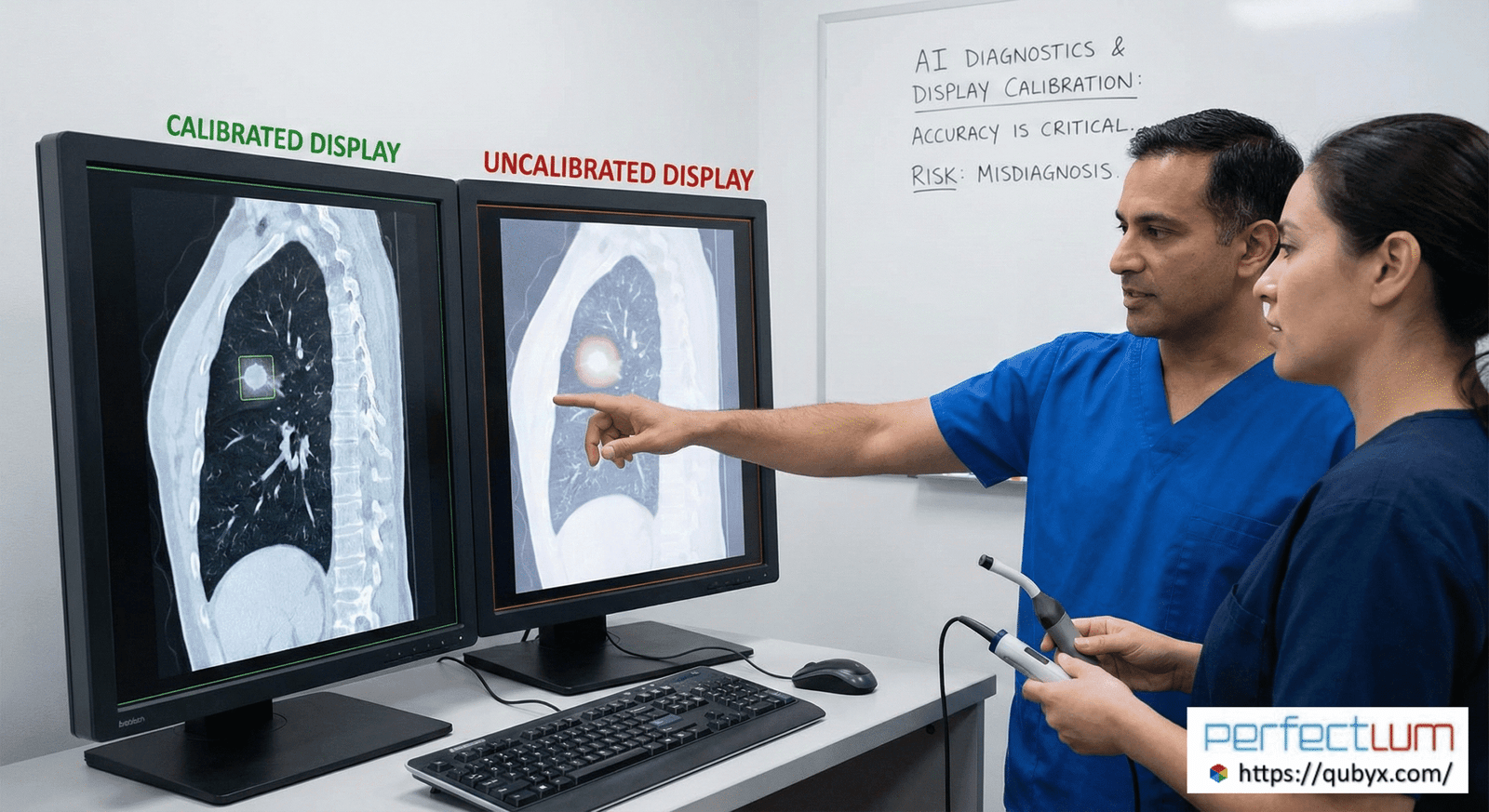
No matter how sophisticated your AI radiology platform is, the final judgment still happens on a screen—by a human. If that display isn’t calibrated correctly, you’re literally asking radiologists to make life-changing decisions on distorted or inconsistent images.
This is why medical display calibration matters more than ever in the age of AI diagnostics—and why standards like GSDF and tools such as PerfectLum AI are quickly becoming essential, not optional.
1- AI radiology is only as good as what you can see
AI radiology models are trained on carefully acquired, standardized images. Contrast, luminance, grayscale steps, and noise are controlled as much as possible during training.
But in real-world hospitals and imaging centers:
-
Displays age
-
Backlight uniformity changes
-
Ambient light varies day to night
-
Different rooms use different monitors and vendors
If a chest CT looks slightly darker on one workstation and slightly washed out on another, an AI heatmap or subtle lesion may appear:
-
Invisible
-
Less suspicious than it actually is
-
Or, conversely, more alarming than it should be
So you get inconsistent human interpretation of the same AI output—just because the monitors are not standardized.
Bottom line:
Uncalibrated displays = unpredictable image perception = inconsistent clinical decisions.
2- Why GSDF is still the gold standard for medical displays
In medical imaging, our eyes don’t respond linearly to changes in luminance. That’s why the DICOM Grayscale Standard Display Function (GSDF) exists: to create a consistent, perceptually uniform grayscale response from black to white.
In practical terms, GSDF-compliant calibration ensures that:
-
Each step in grayscale is equally “visible” to the human eye
-
Very subtle differences in soft tissue are easier to distinguish
-
Images look consistent across different calibrated displays
For AI radiology, this consistency is crucial:
-
AI models highlight tiny density differences or subtle patterns
-
If the display is not GSDF-compliant, those subtle cues may be:
-
Under-represented
-
Over-emphasized
-
Or lost entirely in noise or poor contrast
-
When your medical display calibration targets GSDF:
-
Radiologists see what the AI “saw” during training
-
Multi-site AI deployments behave more consistently
-
QA teams can trust that image appearance is controlled, not random
3- Human + AI: why calibration is the bridge between them
The future of diagnostics is not “AI vs human”—it’s AI + human.
Radiologists:
-
Validate or overrule AI suggestions
-
Catch edge cases, rare patterns, and context AI may miss
-
Communicate findings, uncertainty, and next steps to clinicians
But the interface between AI and radiologist is the display:
-
AI outputs: probability maps, bounding boxes, overlays, color-coded risk
-
Radiologist inputs: visual inspection, pattern recognition, prior experience
If your display is too bright, too dim, or has poor grayscale tracking:
-
AI overlays may be hard to distinguish from background tissue
-
Noise may hide faint nodules, microbleeds, or early pathology
-
Subtle changes across follow-up exams may be misjudged
In other words, display calibration is the bridge that keeps human–AI collaboration reliable.
4- Compliance, audits, and medico-legal risk
Regulators and professional bodies increasingly recognize that display quality is part of the diagnostic chain, especially in digital radiology and teleradiology.
Many frameworks and guidelines (e.g., DICOM, AAPM, national radiology societies) require or strongly recommend:
-
Regular display quality assurance (QA)
-
Documented luminance and GSDF conformance tests
-
Acceptance and constancy testing schedules
In an AI-driven environment, this becomes even more important:
-
If an AI-assisted diagnosis is challenged in court, lawyers will ask:
-
Was the device certified?
-
Was the display calibrated to GSDF?
-
Are QA logs available?
-
-
If the answer is “no,” then even a correct AI suggestion can be legally undermined because the viewing conditions were not controlled.
So medical display calibration is not just a technical nice-to-have; it’s a risk-reduction strategy in AI radiology.
5- Why manual or ad-hoc calibration isn’t enough anymore
In the early days of PACS, some sites tried to get away with:
-
Basic vendor test patterns once in a while
-
Manual tweaking of brightness/contrast by “feel”
-
Occasional service visits when someone complained
In the age of AI diagnostics, that approach is dangerously outdated:
-
AI workflows run 24/7
-
Imaging volumes and exam complexity are increasing
-
Teleradiology and home reporting setups are more common
-
Different monitors (medical and non-medical) may be used inconsistently
You now need:
-
Automated, scheduled calibration so no workstation gets “forgotten”
-
Centralized QA reporting to prove compliance and identify outliers
-
Remote management for multi-site and teleradiology environments
That’s where specialized software like PerfectLum AI comes into play.
6- How PerfectLum AI supports modern AI radiology workflows
PerfectLum AI is designed specifically for environments where AI radiology and human expertise intersect and where display performance must be continuously controlled.
Here’s how tools like PerfectLum AI help:
6.1 GSDF-compliant calibration
PerfectLum AI can calibrate medical displays to follow GSDF with high precision:
-
Ensures consistent grayscale perception across different displays
-
Aligns viewing conditions with how AI models were trained and validated
-
Reduces the risk of missing low-contrast lesions or subtle findings
6.2 Automated QA and constancy testing
Instead of relying on ad-hoc checks, PerfectLum AI:
-
Schedules regular constancy tests
-
Logs results for each display over time
-
Alerts you when performance drifts below your thresholds
This continuous QA is essential when you’re deploying AI radiology solutions at scale.
6.3 Multi-site and teleradiology readiness
Modern radiology doesn’t live in one control room anymore:
-
Radiologists read from hospital workstations, satellite clinics, or home offices
-
AI tools may run centrally but display outputs on multiple endpoints
PerfectLum AI supports:
-
Centralized management of all connected displays
-
Standardized medical display calibration policies across locations
-
Consistent image appearance regardless of where the radiologist logs in
6.4 Documentation for audits and certifications
With AI entering the regulated medical device ecosystem, documentation matters:
-
PerfectLum AI provides detailed calibration and QA reports
-
These reports can be used during audits, vendor assessments, or legal reviews
-
You can demonstrate that your AI radiology environment is supported by properly calibrated, GSDF-compliant displays
7- Real-world impact: what happens when displays drift?
Let’s make this concrete. A non-calibrated or drifting display can cause:
-
Missed microcalcifications:
On mammography, poor contrast and incorrect luminance can make tiny white specks practically invisible. -
Under-estimated lung nodules:
On CT, subtle ground-glass opacities may blend into the background, especially if the low-end grayscale steps are compressed or clipped. -
False positives from noisy overlays:
AI-generated heatmaps on uncalibrated displays may emphasize noise or artifacts, leading to unnecessary follow-up or anxiety. -
Inconsistent second opinions:
Two radiologists looking at the same AI-flagged case on differently calibrated monitors may disagree—because they’re not actually seeing the same image.
All of these scenarios directly impact:
-
Diagnostic accuracy
-
Workflow efficiency
-
Patient trust
-
The perceived reliability of your AI radiology system
8- Building a calibration-first culture in AI diagnostics
To truly leverage AI in radiology, organizations need to treat display calibration as a strategic, not tactical, topic.
Here’s how to start:
-
Define display standards:
-
GSDF-compliant display calibration
-
Minimum/maximum luminance and contrast ratio
-
Ambient lighting recommendations
-
-
Deploy calibration software like PerfectLum:
-
Automate GSDF calibration
-
Schedule and centralize QA
-
Integrate with your PACS/RIS/AI infrastructure where possible
-
-
Train radiologists and IT teams together:
-
Explain why AI radiology depends on stable viewing conditions
-
Encourage them to report visual issues early
-
Share QA reports so everyone sees the impact
-
-
Include displays in AI project planning:
-
When budgeting for AI tools, include calibration and QA software
-
Validate AI models on calibrated displays during trials and pilots
-
-
Monitor, review, and improve:
-
Use QA data to identify problematic rooms or devices
-
Update policies as guidelines evolve and AI usage grows
-
9- Conclusion: AI needs calibrated eyes
AI is transforming radiology—but it doesn’t remove the human from the loop. It changes the loop.
-
AI detects, prioritizes, and flags.
-
Humans interpret, contextualize, and decide.
-
Displays connect the two.
If that connection is weak—because your medical displays are not properly calibrated, not GSDF-compliant, or not continuously monitored—you risk undermining the value of your entire AI investment.
By embracing medical display calibration, aligning with GSDF, and using specialized solutions like PerfectLum AI, you:
-
Make AI radiology more reliable
-
Protect patients and clinicians
-
Strengthen compliance and legal defensibility
-
Build a high-confidence diagnostic environment where humans and AI truly work together
In the age of AI diagnostics, display calibration is no longer optional. It’s mission-critical.
In a world where every Pixel accuracy matters, PerfectLum by QUBYX proves that innovation can deliver clinical precision without financial compromise. It’s not just calibration—it’s the democratization of diagnostic imaging.
To secure Medical Display Quality Assurance with precision while reducing the recurring costs of proprietary hardware, the answer is clear: transition to a Calibration Software platform like QUBYX OS Tools (Free) and PerfectLum today. Now, you easily pay less for Radiology.
FAQ Section — “People Also Ask”
1. Why is display calibration important in AI radiology?
Display calibration ensures that medical images are shown with accurate contrast, luminance, and grayscale levels. In AI radiology, subtle features identified by algorithms can be missed or misinterpreted on an uncalibrated display, affecting diagnostic accuracy.
2. What is GSDF and why does it matter?
GSDF (Grayscale Standard Display Function) is a DICOM standard that ensures each grayscale step is perceptually uniform to the human eye. GSDF compliance reduces visual distortion and ensures consistent interpretation across radiologists and AI-assisted workflows.
3. Can AI diagnostics work correctly without calibrated displays?
AI may perform correctly internally, but radiologists can misinterpret AI findings if the display is inaccurate or drifting. Calibration ensures that what AI “sees” matches what the human radiologist sees on-screen.
4. How often should medical displays be calibrated?
Professional guidelines recommend:
-
Acceptance testing before clinical use
-
Monthly or quarterly constancy tests
-
Annual full calibration
Automated tools like PerfectLum help enforce these schedules reliably.
5. What happens if a medical display is not GSDF-compliant?
Non-GSDF displays may compress or exaggerate grayscale differences. This can hide subtle findings—like microcalcifications, ground-glass opacities, or early lesions—and can distort AI heatmaps or overlays.
6. Is PerfectLum suitable for multi-site and teleradiology environments?
Yes. PerfectLum provides centralized QA management, remote display calibration scheduling, audit-ready reporting, and GSDF-compliant calibration across hospitals, clinics, and home-reporting setups.
7. Does display calibration affect medico-legal risk?
Absolutely. If a diagnosis is challenged, missing calibration logs or non-GSDF displays can undermine the credibility of both AI and radiologist findings. Consistent, documented Display Calibration reduces legal risk and strengthens compliance.
8. Can non-medical monitors be used for AI radiology?
It is not recommended. Consumer-grade monitors lack medical-grade luminance stability, uniformity, and grayscale accuracy. Even with partial calibration, they rarely reach GSDF compliance required for diagnostic imaging.
9. Does AI replace the need for display QA?
No. AI enhances radiology, but the final image evaluation still depends on human vision. Display QA ensures both human and AI operate in aligned visual conditions.
10. How does PerfectLum improve AI-driven diagnostic workflows?
PerfectLum provides:
- Accurate Display Calibration
-
GSDF calibration
-
Automated constancy tests
-
Centralized QA dashboards
-
Audit logs
-
Multi-site device control
Together, these ensure a stable, reliable environment for AI radiology.
Tags:
Display Calibration, AI radiology, medical display calibration, DICOM GSDF, diagnostic imaging QA, AI diagnostics, PACS display calibration, PerfectLum AI, radiology workstation quality, teleradiology display standards, medical monitor calibration software
Related Posts
- April 12, 2026
- News
- April 8, 2026
- News

- April 6, 2026
- News