
News
- Home
- Why DICOM GSDF Compliance Is Non-Negotiable in Teleradiology
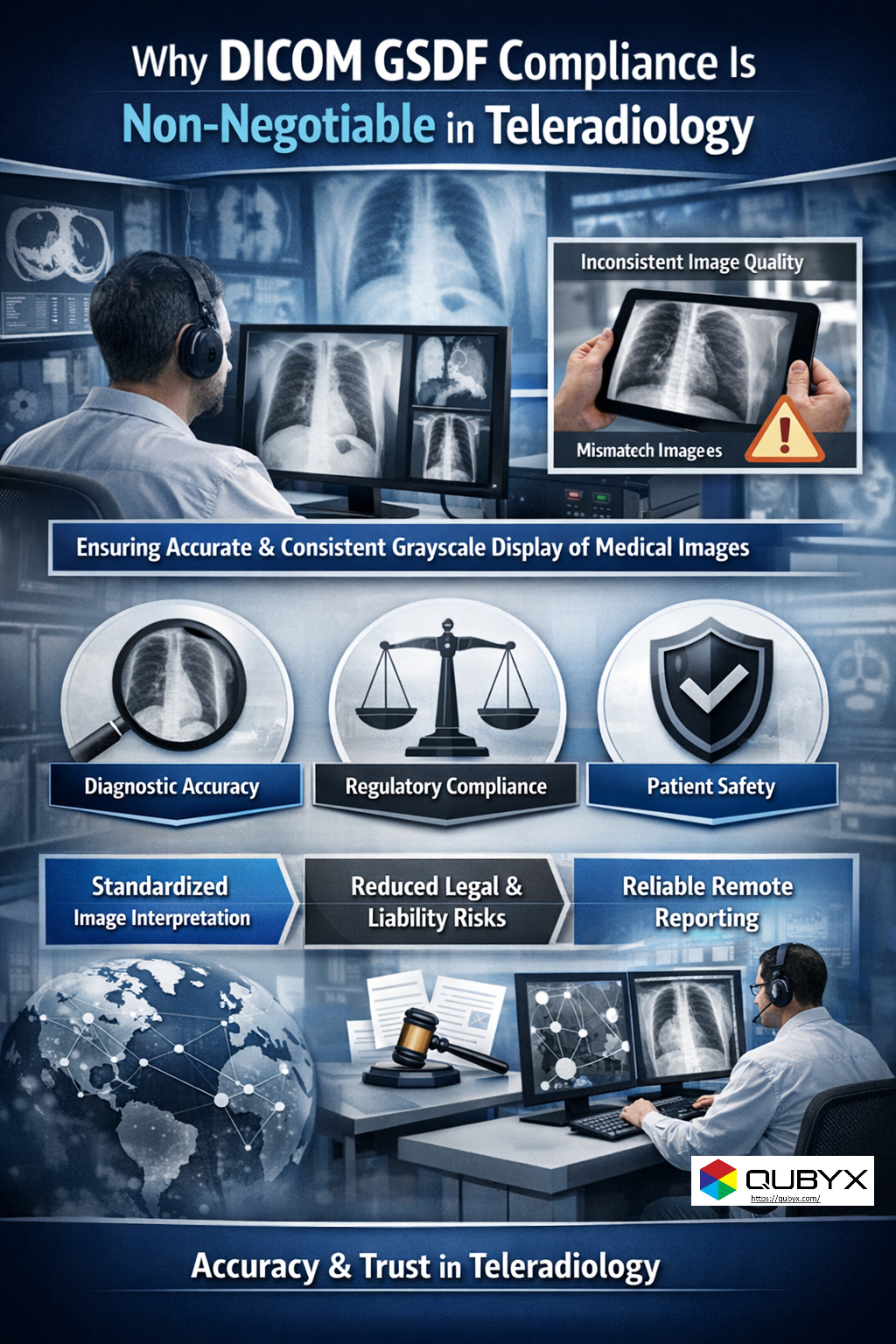
Why DICOM GSDF Compliance Is Non-Negotiable in Teleradiology
- January 6, 2026
- Shamsul
Why DICOM GSDF Compliance Is Non-Negotiable in Teleradiology
Teleradiology has transformed diagnostic imaging by enabling radiologists to interpret studies remotely, often across borders, time zones, and healthcare systems. While image acquisition and network delivery receive significant attention, one critical factor is frequently underestimated: display performance.
At the center of display performance lies DICOM GSDF compliance in teleradiology, a requirement that directly determines whether grayscale medical images are rendered accurately and consistently. Without DICOM GSDF compliance in teleradiology, even perfectly acquired images can be misinterpreted, placing diagnostic integrity and patient safety at risk.
This article explains why DICOM GSDF compliance in teleradiology is non-negotiable, how it affects clinical accuracy, and why healthcare organizations must treat it as a foundational standard rather than a technical afterthought.
Understanding DICOM GSDF in Simple Terms
The DICOM Grayscale Standard Display Function (GSDF) defines how grayscale values in medical images should be displayed to the human eye. It is based on the concept of Just Noticeable Differences (JNDs)—ensuring that each step in grayscale change is perceptually uniform to a radiologist.
In practical terms, DICOM GSDF compliance in teleradiology ensures that:
-
A lung nodule, fracture line, or subtle lesion appears with the same contrast relationship on different displays
-
Brightness and contrast remain perceptually consistent across workstations
-
Diagnostic interpretation is based on anatomy and pathology, not display variability
Without DICOM GSDF compliance in teleradiology, grayscale rendering becomes subjective, unpredictable, and clinically unsafe.
Why Teleradiology Amplifies Display Risk
In traditional hospital reading rooms, displays are often:
-
Centrally procured
-
Professionally calibrated
-
Routinely quality-checked
Teleradiology environments are fundamentally different. Radiologists may read from:
-
Home offices
-
Temporary workstations
-
Multiple geographic locations
-
Mixed hardware environments
This decentralization dramatically increases risk. DICOM GSDF compliance in teleradiology becomes essential because it is the only reliable method to standardize grayscale perception across distributed systems.
Without enforced DICOM GSDF compliance in teleradiology, two radiologists reviewing the same study may literally see different images.
Diagnostic Accuracy Depends on GSDF Compliance
Medical imaging relies on detecting subtle grayscale differences. Small deviations in luminance response can lead to:
-
Missed early-stage disease
-
Incorrect lesion characterization
-
Reduced diagnostic confidence
DICOM GSDF compliance in teleradiology ensures that grayscale contrast follows a defined perceptual curve, preserving diagnostic visibility regardless of display brand or location.
Clinical studies consistently show that non-GSDF-compliant displays reduce observer performance, particularly in:
-
Chest radiography
-
Mammography
-
CT soft-tissue windowing
-
Low-contrast lesion detection
Thus, DICOM GSDF compliance in teleradiology is not a technical preference—it is a diagnostic necessity.
Regulatory and Legal Implications
Healthcare regulations increasingly recognize display performance as part of the diagnostic chain. While specific enforcement varies by region, failure to maintain DICOM GSDF compliance in teleradiology can expose organizations to:
-
Accreditation risk
-
Legal liability in malpractice cases
-
Audit failures
-
Contractual breaches with healthcare providers
In legal proceedings, poor display calibration undermines the defensibility of radiology reports. A diagnosis made on a non-compliant display may be challenged as clinically unreliable.
From a governance perspective, DICOM GSDF compliance in teleradiology supports:
-
Clinical accountability
-
Quality assurance documentation
-
Risk mitigation strategies
GSDF Compliance Is Not a One-Time Event
A common misconception is that DICOM GSDF compliance in teleradiology is achieved once and remains permanent. In reality, displays drift over time due to:
-
Backlight aging
-
Environmental lighting changes
-
Temperature variation
-
Usage intensity
As a result, continuous monitoring and recalibration are required to maintain DICOM GSDF compliance in teleradiology environments.
Without automated or scheduled calibration processes, compliance degrades silently—often without the radiologist’s awareness.
The Role of Ambient Light in Teleradiology
Teleradiology workspaces vary widely in ambient lighting. Unlike controlled reading rooms, home offices may include:
-
Daylight fluctuations
-
Uncontrolled reflections
-
Inconsistent room lighting
These factors directly affect perceived contrast. True DICOM GSDF compliance in teleradiology must account for ambient conditions to ensure that grayscale rendering remains perceptually accurate.
Ignoring environmental factors undermines GSDF adherence and compromises diagnostic reliability.
Operational Benefits of GSDF Compliance
Beyond clinical safety, DICOM GSDF compliance in teleradiology delivers measurable operational advantages:
-
Reduced report discrepancies
-
Improved radiologist confidence
-
Lower re-read and second-opinion rates
-
Stronger institutional credibility
For large teleradiology providers, standardized GSDF compliance enables scalable operations without sacrificing quality.
Why “Consumer Displays” Are a Risk
Many remote radiologists rely on high-resolution consumer monitors. While these displays may appear visually impressive, they often:
-
Lack stable luminance control
-
Drift rapidly over time
-
Do not natively follow the GSDF curve
Without calibration, consumer displays cannot maintain DICOM GSDF compliance in teleradiology. Resolution alone does not equal diagnostic suitability.
True compliance requires:
-
Measured luminance response
-
Controlled grayscale mapping
-
Continuous validation
GSDF Compliance and Clinical Trust
Teleradiology is built on trust—trust between healthcare providers, radiologists, and patients. DICOM GSDF compliance in teleradiology reinforces that trust by ensuring:
-
Reports are based on standardized visualization
-
Diagnostic decisions are defensible
-
Patient outcomes are not compromised by technology gaps
As teleradiology volumes grow, display compliance becomes a core pillar of clinical governance.
Future-Proofing Teleradiology Operations
Teleradiology is expanding into:
-
AI-assisted diagnostics
-
Cross-border reporting
-
24/7 global reading networks
Each of these trends increases reliance on consistent image presentation. DICOM GSDF compliance in teleradiology provides a future-proof foundation that supports:
-
Interoperability
-
AI training consistency
-
Multi-vendor environments
Organizations that invest early in GSDF compliance are better positioned for long-term scalability and regulatory resilience.
Key Takeaways
DICOM GSDF compliance in teleradiology is non-negotiable because it:
-
Preserves diagnostic accuracy
-
Reduces clinical and legal risk
-
Standardizes grayscale perception across locations
-
Supports scalable, high-quality teleradiology operations
In remote radiology, the display is not a peripheral device—it is a diagnostic instrument. Ensuring DICOM GSDF compliance in teleradiology is essential to protecting patients, radiologists, and healthcare organizations alike.
Start the conversation with our calibration experts today.
In a world where every Pixel accuracy matters, PerfectLum by QUBYX proves that innovation can deliver clinical precision without financial compromise. It’s not just calibration—it’s the democratization of diagnostic imaging.
To secure Medical Display Quality Assurance with precision while reducing the recurring costs of proprietary hardware, the answer is clear: transition to a Calibration Software platform with QUBYX OS Tools (Free) and PerfectLum today. Now, you easily pay less for Radiology.
Tags:
DICOM GSDF compliance, DICOM GSDF compliance in teleradiology, teleradiology display standards, diagnostic display calibration, GSDF grayscale accuracy, remote radiology compliance, medical imaging display QA
Related Posts
- January 8, 2026
- News
PerfectLum in Mammography & High-Precision Teleradiology Why Display Accuracy Is

- January 8, 2026
- News
Why PerfectLum Is Essential for Multi-Site Teleradiology Operations A
- January 7, 2026
- News
How Inconsistent Display Calibration Can Undermine Teleradiology Accuracy The Hidden