
News
- Home
- Teleradiology Viewing Software | The Role of QUBYX Viewer
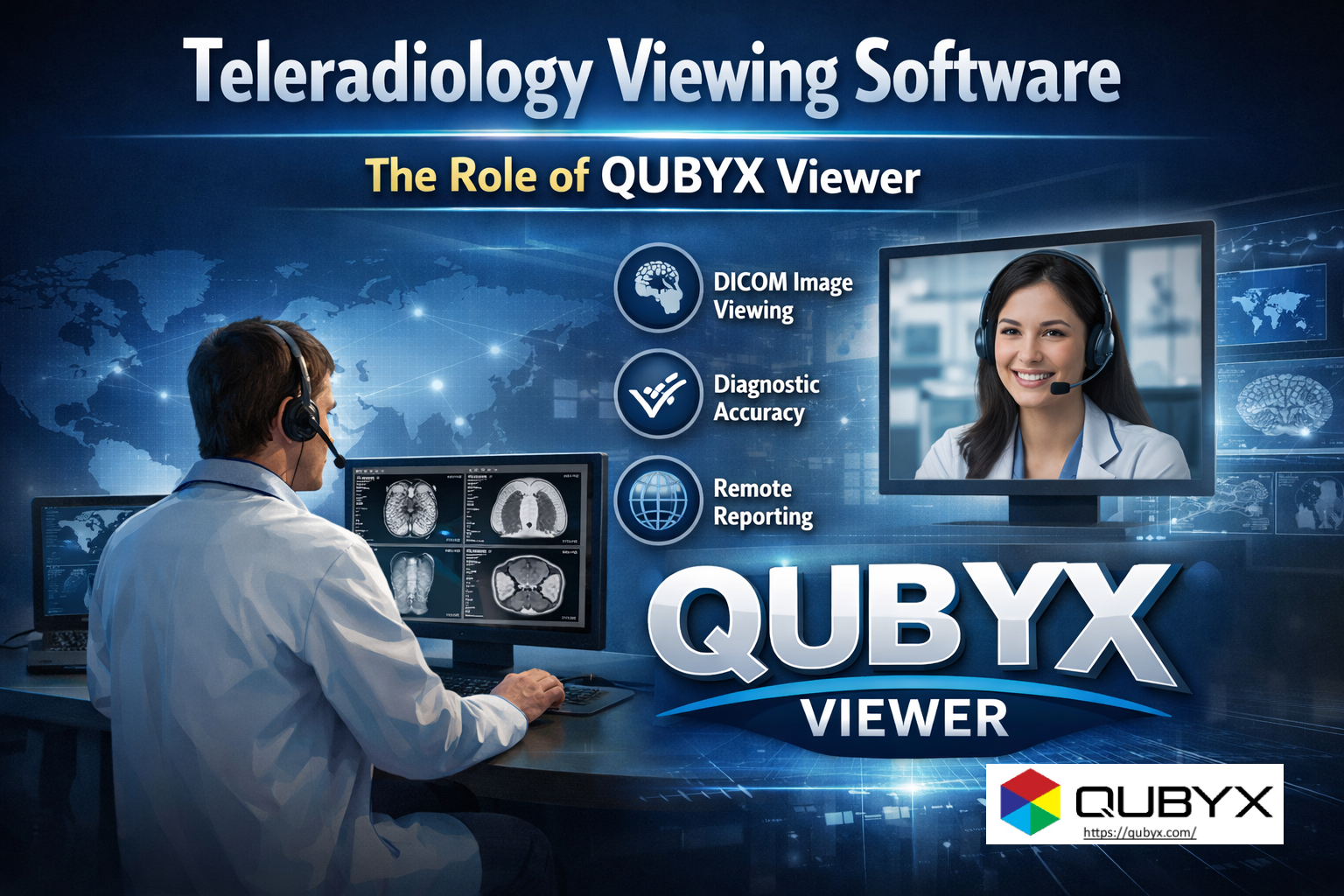
Teleradiology Viewing Software | The Role of QUBYX Viewer
- January 4, 2026
- Shamsul
Diagnostic Visualization in Teleradiology | Teleradiology Viewing Software
The Role of QUBYX Viewer in Consistent, High-Confidence Remote Diagnosis
1. The Visualization Challenge in Teleradiology
Teleradiology depends entirely on visualization. Radiologists do not interact with patients or scanners—they interact with images rendered on a screen. In distributed diagnostic environments, even minor inconsistencies in how images are displayed or viewed can significantly affect interpretation.
While PACS systems manage image storage and distribution, they do not guarantee how images are perceived. Visualization quality depends on:
-
Display calibration
-
Viewing software behavior
-
Rendering accuracy
-
Human visual perception
In teleradiology, where reading conditions vary widely, visualization becomes a primary risk factor rather than a technical detail.
2. Why Viewing Software Matters as Much as PACS
Many organizations assume that once images reach the workstation, the diagnostic task is complete. In reality, viewing software is the final translation layer between image data and human perception.
Viewing software controls:
-
How pixel values are mapped to the display
-
Windowing and leveling behavior
-
Contrast handling
-
Consistency across modalities
If this layer behaves inconsistently—or is not aligned with calibrated displays—diagnostic accuracy suffers.
3. Common Visualization Failures in Teleradiology
Visualization problems often go unnoticed because they are subtle and cumulative.
3.1 Inconsistent Rendering Across Workstations
Different viewers or configurations may render the same study differently, leading to interpretation variability.
3.2 Viewer-Display Mismatch
Even a perfectly calibrated display cannot compensate for poorly implemented rendering algorithms.
3.3 Modality-Specific Limitations
Some viewers handle CT, MRI, X-ray, and mammography differently, introducing inconsistency in multi-modality reading.
3.4 User-Dependent Adjustments
Without standardized visualization behavior, radiologists rely heavily on manual adjustments—introducing subjectivity.
4. The Importance of Visualization Consistency in Teleradiology
Consistency is the foundation of diagnostic confidence.
In distributed environments, visualization consistency ensures that:
-
The same image appears the same way everywhere
-
Diagnostic thresholds are stable
-
Interpretation variability is minimized
-
Clinical decisions are defensible
This consistency is particularly critical in:
-
Night coverage
-
Subspecialty consultation
-
Cross-border reporting
-
Second-opinion workflows
5. What Is QUBYX Viewer?
QUBYX Viewer is a diagnostic-grade viewing solution designed to ensure accurate, consistent visualization of medical images—especially in distributed and remote environments.
Its purpose is not to replace PACS, but to:
-
Complement existing imaging infrastructure
-
Provide a consistent visualization layer
-
Align viewing behavior with calibrated displays
QUBYX Viewer focuses on how images are seen, not just how they are accessed.
6. QUBYX Viewer and Display Calibration: A Critical Synergy
Visualization accuracy cannot be achieved by software or hardware alone.
6.1 The Display Alone Is Not Enough
Even a GSDF-compliant display can produce inconsistent perception if the viewer does not render images correctly.
6.2 The Viewer Alone Is Not Enough
Accurate rendering algorithms lose meaning if the display output is unstable or drifting.
QUBYX Viewer is designed to work in synergy with PerfectLum®, ensuring that:
-
Image rendering aligns with calibrated luminance
-
Perceptual accuracy is preserved end-to-end
-
Visualization remains consistent over time
7. Supporting Multi-Modality Teleradiology
Modern teleradiology workflows involve multiple imaging modalities, each with unique visualization requirements.
QUBYX Viewer supports:
-
CT: Precise grayscale mapping and contrast handling
-
MRI: Consistent rendering of subtle signal differences
-
X-ray: Accurate luminance and low-contrast visibility
-
Mammography: High-precision visualization where regulatory scrutiny is highest
By maintaining consistent visualization behavior across modalities, QUBYX Viewer reduces cognitive load and interpretation variability.
8. Reducing Interpretation Variability Across Radiologists
One of the most underestimated challenges in teleradiology is inter-reader variability.
Different radiologists may:
-
Use different viewers
-
Adjust windowing differently
-
Work in different environments
QUBYX Viewer helps standardize visualization by:
-
Providing consistent default rendering behavior
-
Reducing reliance on subjective adjustments
-
Aligning image appearance across users and locations
This standardization supports:
-
Quality assurance
-
Peer review
-
Subspecialty collaboration
9. Use Cases in Real-World Teleradiology
9.1 Home-Based Reading
Radiologists working from home benefit from consistent visualization regardless of location.
9.2 Night and Emergency Coverage
Visualization consistency reduces fatigue-related variability during high-pressure shifts.
9.3 Global Teleradiology Providers
Cross-border providers maintain consistent diagnostic standards across regions.
9.4 OEM and Integrated Workflows
QUBYX Viewer integrates seamlessly into OEM and enterprise environments, ensuring consistent visualization within standardized platforms.
10. QUBYX Viewer as Part of a Future-Ready Teleradiology Stack
Teleradiology is evolving rapidly, with increasing reliance on:
-
AI-assisted diagnostics
-
Advanced visualization
-
High-resolution imaging
-
Cloud-based workflows
QUBYX Viewer provides a stable visualization foundation that:
-
Supports emerging technologies
-
Ensures human-perceptual accuracy
-
Preserves diagnostic integrity as workflows evolve
11. Integration Within the QUBYX Ecosystem
QUBYX Viewer completes the end-to-end diagnostic visualization chain:
-
PerfectLum® ensures continuous display calibration
-
QUBYX OS Tools provide centralized governance and monitoring
-
QUBYX Viewer ensures accurate image rendering and perception
Together, they form a closed-loop system that controls:
Image data → rendering → display → perception → compliance
This holistic approach is essential in teleradiology, where fragmented solutions introduce hidden risk.
12. Internal Topic Clusters (Supporting Articles)
This pillar page should internally link to:
-
Viewing software in teleradiology
-
Multi-modality visualization challenges
-
Display-viewer integration best practices
-
Reducing interpretation variability
-
Visualization in remote diagnostics
These clusters reinforce topical authority and SEO performance.
13. Conclusion: Visualization Is the Final Safeguard in Teleradiology
In teleradiology, diagnostic accuracy is determined not only by image quality or network reliability—but by how images are seen.
Visualization is the final safeguard before clinical decisions are made.
By combining:
-
Calibrated displays
-
Centralized governance
-
Diagnostic-grade viewing software
QUBYX Viewer ensures that every diagnostic image is rendered accurately, consistently, and confidently—wherever it is read.
In an increasingly distributed radiology landscape, visualization consistency is not optional.
It is the foundation of trust, quality, and safe patient care.
Start the conversation with our calibration experts today.
In a world where every Pixel accuracy matters, PerfectLum by QUBYX proves that innovation can deliver clinical precision without financial compromise. It’s not just calibration—it’s the democratization of diagnostic imaging.
To secure Medical Display Quality Assurance with precision while reducing the recurring costs of proprietary hardware, the answer is clear: transition to a Calibration Software platform with QUBYX OS Tools (Free) and PerfectLum today. Now, you easily pay less for Radiology.
The source code for QubyxViewer is freely available on GitHub as an open-source project released under the GNU GPL v3 license.
Repository Link: https://github.com/QUBYX-LLC/Qubyx3DLUTGenerator
Tags:
Teleradiology Viewing Software, QUBYX Viewer, diagnostic visualization, radiology image interpretation, display-viewer integration, multi-modality teleradiology
Related Posts
- January 9, 2026
- News
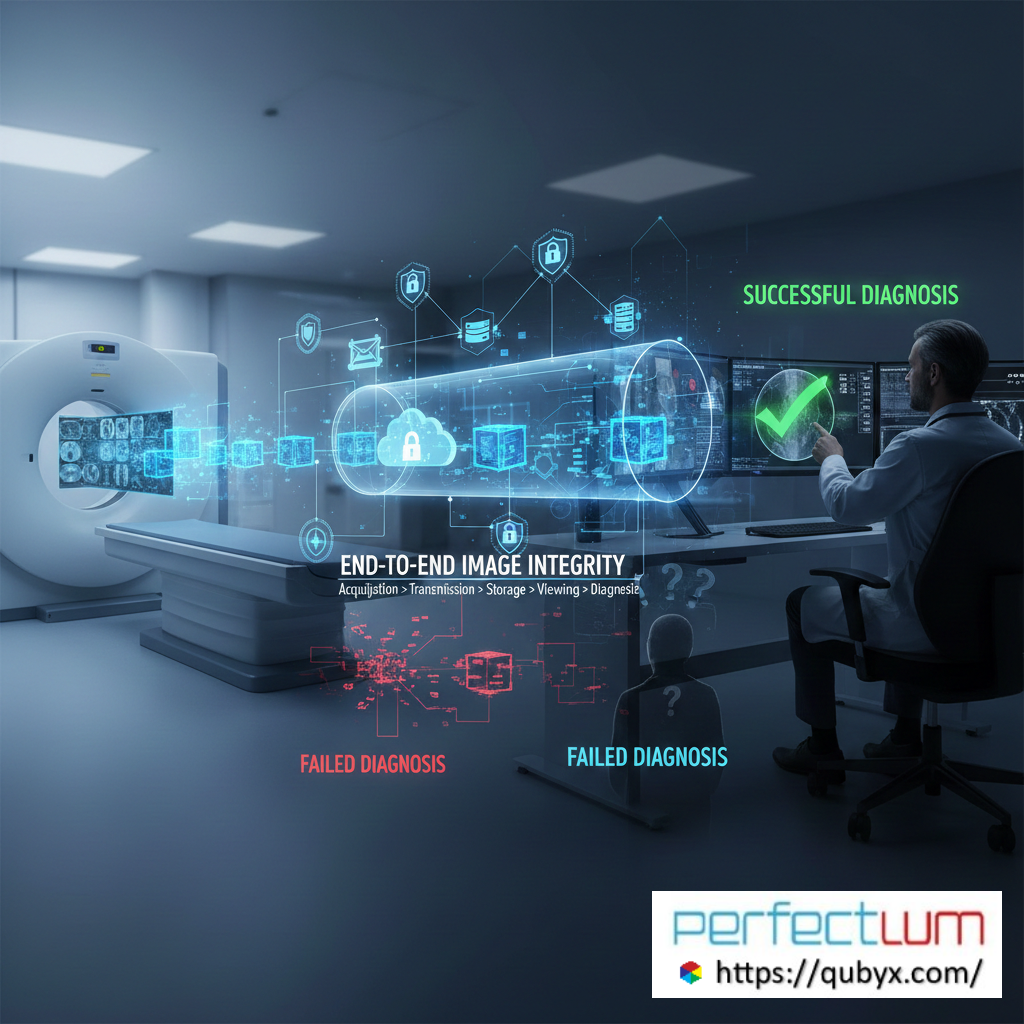
End-to-End Image Integrity | The Key to Teleradiology Success
- January 8, 2026
- News
PerfectLum in Mammography & High-Precision Teleradiology Why Display Accuracy Is

- January 8, 2026
- News
Why PerfectLum Is Essential for Multi-Site Teleradiology Operations A