
News
- Home
- Teleradiology Display Calibration | The Missing Link
Teleradiology Display Calibration | The Missing Link
- January 7, 2026
- Shamsul
Why Teleradiology Display Calibration Can No Longer Be Ignored
Teleradiology has transformed diagnostic imaging by enabling radiologists to interpret studies from anywhere in the world. However, as healthcare organizations invest heavily in PACS, network bandwidth, and cybersecurity, one foundational element is often overlooked: teleradiology display calibration. Without consistent and standards-compliant displays, even the most advanced imaging systems can produce unreliable diagnostic outcomes.
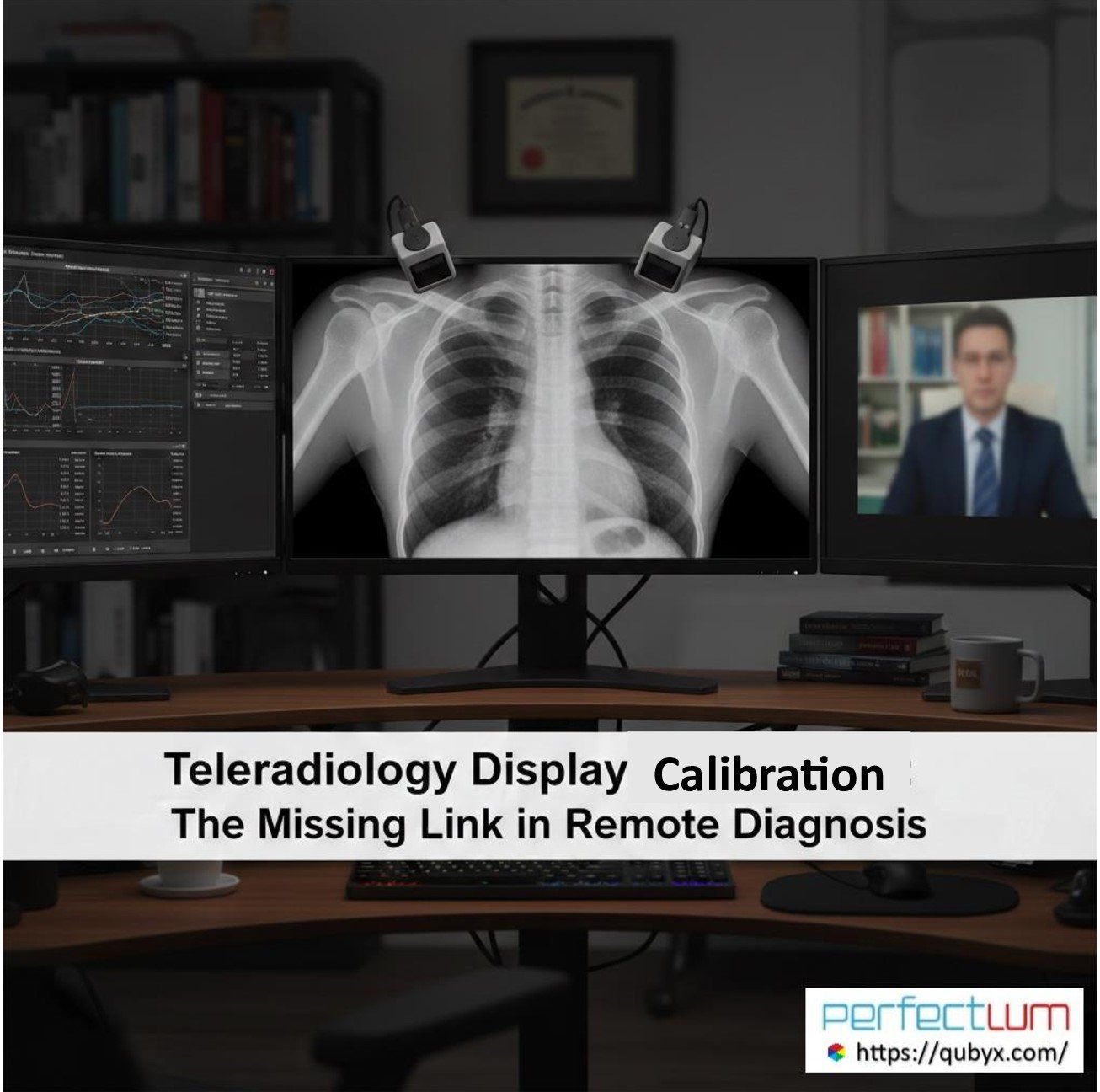
In remote diagnosis, image interpretation quality is inseparable from display performance. Teleradiology display calibration ensures that grayscale accuracy, luminance response, and contrast visibility remain consistent across locations, devices, and time. Without it, diagnostic variability increases, regulatory risk rises, and patient safety may be compromised.
Understanding Teleradiology Display Calibration
At its core, teleradiology display calibration is the process of aligning a medical display’s luminance and grayscale response with recognized standards—most notably the DICOM Grayscale Standard Display Function (GSDF). This guarantees that subtle anatomical details appear the same whether the image is viewed in a hospital reading room or on a remote workstation.
Key objectives of teleradiology display calibration include:
-
Ensuring perceptual linearity of grayscale images
-
Maintaining consistent luminance and contrast over time
-
Reducing observer variability between radiologists
-
Supporting clinical accuracy in primary diagnosis
Without teleradiology display calibration, identical images can look meaningfully different on different screens—introducing diagnostic risk.
The Clinical Risks of Uncalibrated Remote Displays
Many remote radiology environments rely on commercial-grade monitors or inconsistently maintained medical displays. This creates several risks when teleradiology display calibration is absent:
1. Missed or Delayed Diagnoses
Subtle findings—such as early lung nodules or faint fractures—may be invisible on improperly calibrated displays.
2. Diagnostic Inconsistency
Radiologists interpreting the same study on different displays may reach different conclusions due to luminance drift or gamma mismatch.
3. Non-Compliance Exposure
Accreditation bodies increasingly expect documented evidence of teleradiology display calibration, particularly for primary diagnostic reads.
4. Legal and Quality Assurance Gaps
In the event of diagnostic disputes, the absence of calibration records weakens institutional defensibility.
Why Teleradiology Makes Display Calibration More Critical Than Ever
Unlike centralized reading rooms, teleradiology environments are highly decentralized. Radiologists may read from:
-
Home offices
-
Regional diagnostic hubs
-
Cross-border reporting centers
-
Temporary or mobile workstations
Each location introduces variability. Teleradiology display calibration acts as the equalizer—ensuring that diagnostic image presentation remains uniform regardless of geography.
In distributed environments, calibration must also be:
-
Automated, not manual
-
Remote, not on-site
-
Continuously monitored, not periodic
This is where enterprise-grade calibration platforms become essential.
DICOM GSDF and the Foundation of Display Accuracy
DICOM GSDF defines how grayscale values should be rendered so that each perceptual step is visually uniform to the human eye. Teleradiology display calibration aligns displays to this curve, preserving diagnostic intent.
Benefits of DICOM-aligned teleradiology display calibration include:
-
Predictable image appearance across devices
-
Reduced eye strain for radiologists
-
Improved confidence in subtle grayscale interpretation
-
Standardized quality assurance processes
Without GSDF compliance, remote diagnosis becomes visually inconsistent—even if the source images are perfect.
The Role of QUBYX in Teleradiology Display Calibration
QUBYX has become a global reference point for medical display quality assurance. In teleradiology environments, QUBYX solutions address the exact challenges that remote diagnosis introduces.
QUBYX enables healthcare organizations to implement teleradiology display calibration at scale by providing:
-
Centralized calibration control
-
Remote deployment across global workstations
-
Automated compliance reporting
-
Vendor-neutral support for medical and commercial displays
This enterprise-level approach ensures that teleradiology quality is not dependent on individual users or manual workflows.
Why PerfectLum Is Critical for Quality Calibration
PerfectLum, developed by QUBYX, is specifically designed to support medical-grade teleradiology display calibration. It goes beyond basic calibration tools by delivering continuous quality assurance.
PerfectLum supports remote diagnosis by offering:
-
Automated DICOM GSDF calibration without user intervention
-
Real-time luminance drift detection
-
Audit-ready calibration logs for regulatory inspections
-
Enterprise dashboards for IT and QA teams
In teleradiology networks, PerfectLum ensures that calibration is not a one-time event but an ongoing quality process.
Operational Benefits of Teleradiology Display Calibration
Implementing robust teleradiology display calibration delivers tangible operational value:
Consistency Across the Network
Radiologists experience identical image presentation regardless of workstation location.
Reduced IT Burden
Automated calibration minimizes manual troubleshooting and site visits.
Regulatory Readiness
Documented calibration supports accreditation and clinical audits.
Radiologist Confidence and Efficiency
Accurate displays reduce uncertainty and reading fatigue.
Teleradiology Display Calibration as a Patient Safety Imperative
Patient safety is directly tied to diagnostic accuracy. Teleradiology display calibration ensures that imaging data is faithfully represented, preserving the clinical integrity of each study.
When calibration is neglected:
-
Lesions may be overlooked
-
Follow-up imaging may be delayed
-
Clinical decision-making becomes less reliable
When calibration is embedded into teleradiology workflows, patient outcomes improve and diagnostic confidence rises.
Future-Proofing Remote Diagnosis with Calibration-First Strategy
As teleradiology continues to expand in 2026 and beyond, display calibration will become a baseline expectation rather than a differentiator. AI-assisted diagnostics, higher-resolution modalities, and cross-border reporting all increase the importance of teleradiology display calibration.
Organizations that adopt calibration-first strategies today will be better positioned to:
-
Scale remote reading services
-
Meet evolving regulatory standards
-
Integrate AI and advanced visualization tools
-
Maintain consistent diagnostic quality globally
Conclusion: Closing the Gap in Remote Diagnosis
Teleradiology display calibration is no longer optional—it is the missing link that connects advanced imaging systems with reliable diagnostic outcomes. Without it, remote diagnosis remains vulnerable to inconsistency and risk.
By leveraging QUBYX solutions and PerfectLum for continuous quality assurance, healthcare providers can ensure that every remote read meets the same standards as a centralized reading room. In modern teleradiology, calibration is not just a technical task—it is a clinical responsibility.
Start the conversation with our calibration experts today.
In a world where every Pixel accuracy matters, PerfectLum by QUBYX proves that innovation can deliver clinical precision without financial compromise. It’s not just calibration—it’s the democratization of diagnostic imaging.
To secure Medical Display Quality Assurance with precision while reducing the recurring costs of proprietary hardware, the answer is clear: transition to a Calibration Software platform with QUBYX OS Tools (Free) and PerfectLum today. Now, you easily pay less for Radiology.
Tags:
teleradiology display calibration, remote radiology diagnosis, DICOM GSDF calibration, medical display quality, diagnostic monitor calibration, QUBYX PerfectLum
Related Posts
- January 8, 2026
- News
PerfectLum in Mammography & High-Precision Teleradiology Why Display Accuracy Is

- January 8, 2026
- News
Why PerfectLum Is Essential for Multi-Site Teleradiology Operations A
- January 7, 2026
- News
How Inconsistent Display Calibration Can Undermine Teleradiology Accuracy The Hidden