
News
- Home
- Teleradiology Display Accuracy | A Complete Diagnostic Guide
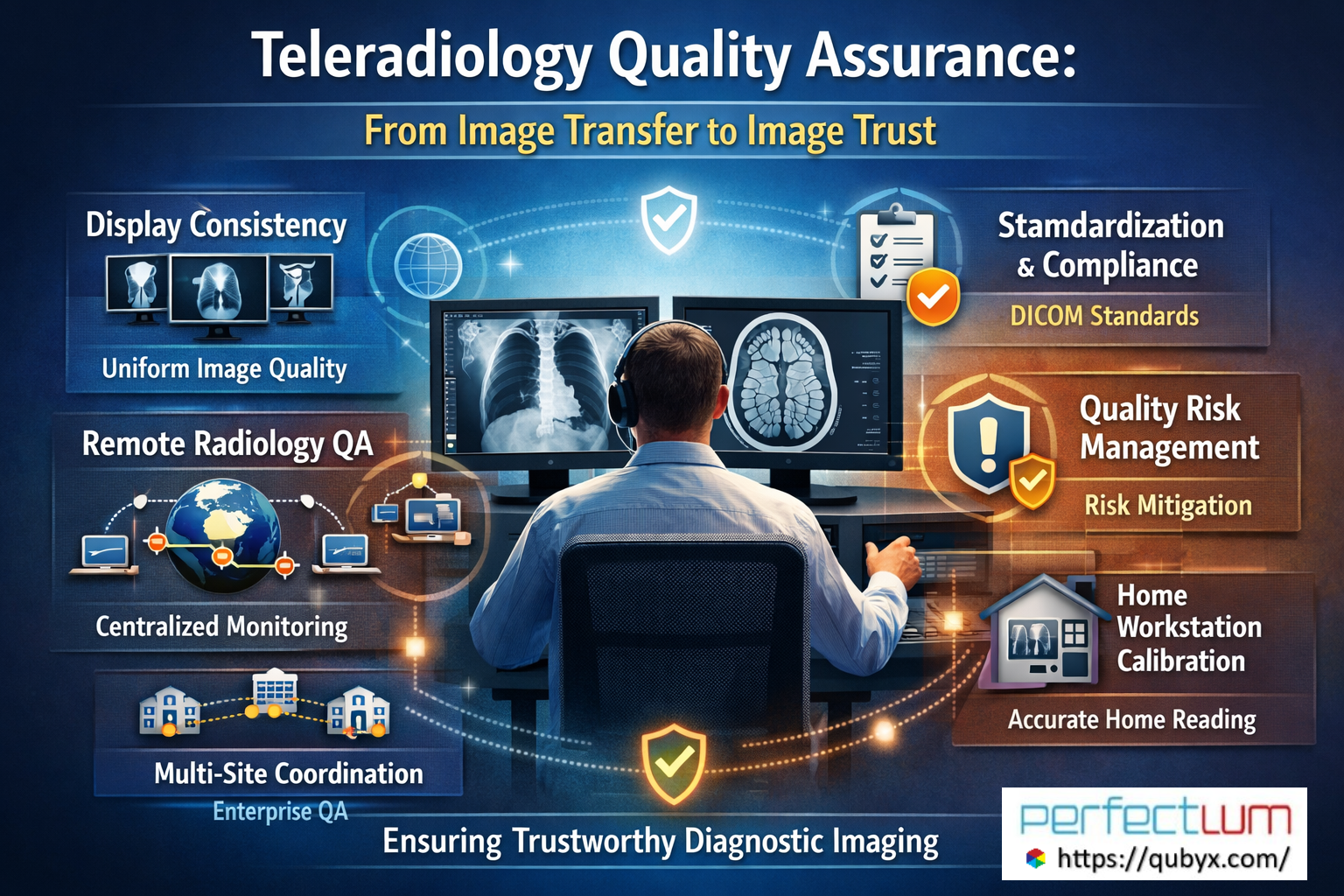
Teleradiology Display Accuracy | A Complete Diagnostic Guide
- January 23, 2026
- QUBYX Team
The Complete Guide to Teleradiology & Display Accuracy
1. Why Display Accuracy Defines Teleradiology Success
Teleradiology has transformed modern healthcare. What was once a localized, hospital-centric activity is now a globally distributed diagnostic service, enabling radiologists to read studies from anywhere in the world. Hospitals, imaging centers, and teleradiology providers increasingly rely on remote reporting to address radiologist shortages, ensure 24/7 coverage, and scale diagnostic capacity.
However, while significant attention is paid to image acquisition, PACS infrastructure, and network bandwidth, one critical component is still underestimated: display accuracy.
In teleradiology, diagnostic decisions are made entirely through pixels. If those pixels are displayed inaccurately—if grayscale response is distorted, luminance drifts over time, or contrast is inconsistent—then even the highest-quality medical images can lead to incorrect interpretations. In this sense, display accuracy is not an IT detail; it is a clinical determinant.
This guide explains:
-
Why teleradiology display accuracy is central to diagnostic integrity
-
Where display quality fits into the remote radiology workflow
-
Why teleradiology is more vulnerable to display-related risks than on-site radiology
-
How standardized display control enables safe, scalable teleradiology
-
The role of QUBYX in establishing diagnostic-grade display ecosystems for remote radiology
2. What Is Teleradiology? A Brief but Strategic Overview
It refers to the transmission of radiological images—such as X-rays, CT scans, MRIs, and mammograms—from one location to another for interpretation by a qualified radiologist.
Originally developed to provide after-hours coverage, teleradiology has evolved into a core component of modern diagnostic services. Today, it supports:
-
Cross-border reporting
-
Subspecialty access (e.g., neuroradiology, musculoskeletal imaging)
-
Rural and underserved regions
-
Load balancing for high-volume imaging centers
In a traditional radiology environment, image acquisition, viewing, and reporting occur within a controlled clinical setting. In contrast, teleradiology introduces distributed environments, heterogeneous hardware, and variable ambient conditions—all of which directly affect how images are perceived.
3. The End-to-End Teleradiology Workflow
To understand why display accuracy matters, it is essential to view teleradiology as an end-to-end diagnostic workflow.
3.1 Image Acquisition
Images are captured using modalities such as CT, MRI, X-ray, ultrasound, or mammography. At this stage, strict quality controls exist for resolution, dose, and acquisition protocols.
3.2 Image Processing & Transmission
Images are encoded in DICOM format and transmitted through PACS, VNAs, or cloud-based systems. Compression, encryption, and routing ensure data integrity and security.
3.3 Image Viewing & Interpretation
This is where the human visual system becomes part of the diagnostic chain. Radiologists rely on subtle grayscale differences, contrast transitions, and luminance levels to detect pathology.
3.4 Reporting & Archiving
Findings are documented, reports are issued, and images are archived for future reference and audit.
Display accuracy directly impacts Step 3, but its influence extends backward and forward—affecting diagnostic confidence, report reliability, and medico-legal defensibility.
4. Where Display Accuracy Fits into the Workflow
Medical images are numerical datasets. Displays translate these datasets into visible light. Any deviation in this translation process alters what the radiologist sees.
Key factors influencing display accuracy include:
-
Grayscale response
-
Maximum and minimum luminance
-
Contrast ratio
-
Uniformity
-
Ambient light compensation
-
Calibration drift over time
In teleradiology, these factors are often uncontrolled or inconsistently managed, creating variability that undermines diagnostic reliability.
5. Diagnostic Risks of Poor Display Control
Inaccurate displays introduce clinical risks that are often invisible until harm occurs.
5.1 Missed or Delayed Findings
Subtle lesions, microcalcifications, or low-contrast abnormalities may not be perceptible on poorly calibrated displays.
5.2 False Positives
Over-enhanced contrast or incorrect luminance can exaggerate normal anatomical structures, leading to unnecessary follow-up procedures.
5.3 Diagnostic Variability
Different radiologists viewing the same image on different displays may reach different conclusions—undermining consistency.
5.4 Legal and Regulatory Exposure
In litigation or audits, inconsistent display environments weaken diagnostic defensibility, particularly when compliance cannot be demonstrated.
6. Why Teleradiology Is More Vulnerable Than On-Site Radiology
Teleradiology introduces unique challenges that amplify display-related risks.
6.1 Uncontrolled Reading Environments
Home offices, shared workspaces, and variable lighting conditions affect image perception.
6.2 Mixed Hardware Fleets
Radiologists may use different monitor brands, models, and ages—often without standardized calibration.
6.3 Decentralized IT Oversight
Unlike hospital reading rooms, teleradiology workstations are harder to monitor, audit, and control.
6.4 Scale and Growth
As teleradiology providers scale rapidly, manual display quality control becomes impractical.
7. The Case for Standardized Display Quality in Teleradiology
To mitigate these risks, teleradiology providers must treat displays as medical devices, not commodity peripherals.
Standardization delivers:
-
Consistent diagnostic quality
-
Reduced interpretation variability
-
Improved radiologist confidence
-
Regulatory compliance
-
Operational scalability
At the heart of standardization is adherence to DICOM GSDF (Grayscale Standard Display Function)—the globally recognized standard for diagnostic grayscale display see response.
8. Display Accuracy as a Clinical and Strategic Asset
Display accuracy should not be viewed as a technical afterthought. In teleradiology, it is a clinical safeguard and a business enabler.
From a clinical perspective, it protects diagnostic integrity.
From an operational perspective, it enables scalable, distributed reporting.
From a strategic perspective, it differentiates high-quality teleradiology providers from low-cost, high-risk alternatives.
9. How QUBYX Enables Diagnostic-Grade Teleradiology
QUBYX provides a vendor-neutral ecosystem designed reminds created specifically for diagnostic display accuracy.
9.1 Vendor-Neutral Display Control
QUBYX solutions work across different display manufacturers, operating systems, and hardware generations—ideal for heterogeneous teleradiology environments.
9.2 Continuous Calibration & Monitoring
With PerfectLum®, displays are not just calibrated once but continuously monitored to maintain compliance over time.
9.3 Centralized Management
QUBYX OS Tools enable centralized oversight of distributed workstations, ensuring visibility, control, and audit readiness.
9.4 End-to-End Visualization
QUBYX Viewer ensures that calibrated displays are paired with see accurate viewing software, closing the loop between image data and visual perception.
Together, these tools transform display accuracy from a risk into a managed, measurable asset.
10. Internal Topic Clusters (Supporting Articles)
This pillar page should internally link to the following cluster topics:
-
Display accuracy in teleradiology
-
Teleradiology workflows explained
-
Diagnostic errors caused by display inconsistency
-
Distributed radiology teams
-
Image integrity in remote diagnostics
These clusters deepen topical authority and strengthen SEO performance.
11. Conclusion: Display Accuracy Is the Foundation of Trust in Teleradiology
It is no longer an auxiliary service—it is a cornerstone of modern diagnostic medicine. As imaging volumes grow and radiology becomes increasingly distributed, display accuracy becomes the foundation of trust between clinicians, patients, and providers.
In this environment:
-
Network speed alone is insufficient
-
PACS reliability is necessary but not complete
-
Display accuracy is the final, decisive step
Organizations that treat displays as part of their clinical infrastructure—not as generic IT hardware—will deliver safer diagnoses, scale with confidence, and lead the future of remote radiology.
QUBYX enables that future by ensuring that what radiologists see is what the image truly contains—every time, everywhere.
Start the conversation with our calibration experts today.
In a world where every Pixel accuracy matters, PerfectLum by QUBYX proves that innovation can deliver clinical precision without financial compromise. It’s not just calibration—it’s the democratization of diagnostic imaging.
PerfectLum is Medical Display Calibration & QA Software by QUBYX LLC delivers consistent, audit-ready display performance through standardized calibration, verification, and centralized quality assurance for radiology and teleradiology environments.
Tags:
teleradiology display accuracy, teleradiology, diagnostic display quality, remote radiology workflows, image integrity, radiology workstations, DICOM GSDF,
About the Author:
Shamsul Islam is a strategy and growth professional focused on regulated B2B technology markets. He supports QUBYX LLC and its medical imaging solutions through product positioning, go-to-market strategy, and end-to-end digital content development, including website, social media, and educational video initiatives aligned with quality, compliance, and governance-driven environments.
Related Posts


- March 31, 2026
- News
- March 29, 2026
- News
- March 27, 2026
- News