
News
- Home
- Radiology Monitor Calibration | Accuracy, Compliance & QA
Radiology Monitor Calibration | Accuracy, Compliance & QA
- February 7, 2026
- QUBYX Team
Radiology Monitor Calibration | The Foundation of Diagnostic Accuracy
Radiology is a discipline where diagnostic confidence depends on visual precision. Even the most advanced imaging modalities cannot compensate for poor image presentation at the point of interpretation. This is why radiology monitor calibration is not a technical afterthought—it is a clinical necessity.
Radiologists rely on subtle grayscale differences, low-contrast details, and consistent luminance to detect pathology accurately. Without proper radiology monitor calibration, image fidelity degrades over time, introducing variability, risk, and potential diagnostic error. As healthcare systems expand across multi-site and remote reading environments, ensuring consistent display performance has become a strategic quality imperative.
What Is Radiology Monitor Calibration?
It is the process of adjusting and verifying diagnostic displays so they conform to recognized medical imaging standards—most notably the DICOM Grayscale Standard Display Function (GSDF).
Proper calibration ensures that:
-
Pixel values are displayed consistently and predictably
-
Luminance response matches the DICOM GSDF curve
-
Contrast perception remains uniform across displays
-
Ambient lighting influences are compensated
Unlike consumer display tuning, radiology monitor calibration is a measured, traceable, and auditable process that directly affects diagnostic outcomes.
Why Radiology Monitor Calibration Is Clinically Critical
1. Diagnostic Accuracy
Uncalibrated or drifting monitors can obscure subtle findings such as lung nodules, microcalcifications, or soft-tissue contrasts. It preserves grayscale linearity, so clinical intent is faithfully displayed.
2. Consistency Across Workstations
Radiologists frequently read studies across multiple monitors, locations, and institutions. Without standardized radiology monitor calibration, the same image may appear differently on each screen—undermining diagnostic consistency.
3. Regulatory & Accreditation Compliance
Many national and international guidelines—including ACR, MQSA, DIN, and local health authorities—require documented calibration and ongoing quality assurance of diagnostic displays.
4. Risk Management & Audit Readiness
Calibration records form part of the medico-legal defense chain. Properly implemented radiology monitor calibration supports defensible, traceable imaging practices.
Calibration Alone Is Not Enough
A common misconception is that one-time calibration equals long-term compliance. In reality:
-
Displays drift due to panel aging
-
Luminance output degrades gradually
-
Ambient conditions change
-
User interventions affect settings
This is why modern radiology monitor calibration must be embedded within a continuous Quality Assurance (QA) lifecycle, not treated as a periodic manual task.
The Role of Quality Assurance in Radiology Monitor Calibration
True best practice integrates calibration with:
-
Acceptance testing at installation
-
Scheduled consistency checks
-
Automated conformity verification
-
Centralized reporting and audit trails
Radiology monitor calibration without QA oversight provides only temporary assurance. Sustainable diagnostic quality requires automation, monitoring, and documentation.
How PerfectLum by QUBYX Elevates Radiology Monitor Calibration
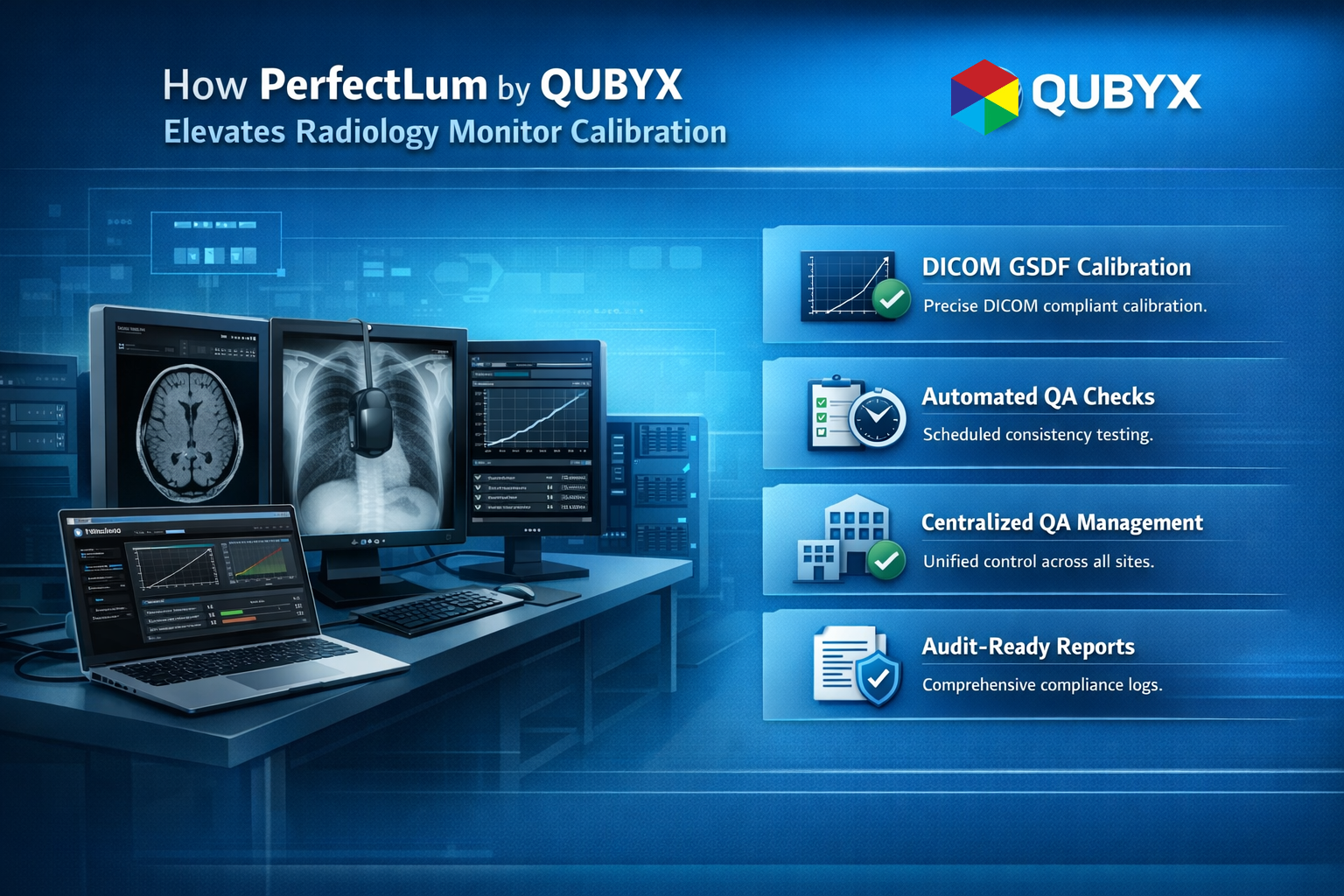
PerfectLum, developed by QUBYX, is designed specifically to meet the real-world demands of medical imaging environments. It transforms radiology monitor calibration from a manual obligation into a structured, compliance-ready QA process.
Key Contributions of PerfectLum
1. DICOM GSDF-Validated Calibration
PerfectLum ensures precise alignment with the DICOM GSDF curve, maintaining luminance and grayscale accuracy required for diagnostic interpretation.
2. Automated Consistency Checks
Rather than relying on sporadic manual checks, PerfectLum schedules and executes automated QA tasks—ensuring radiology monitor calibration remains valid over time.
3. Centralized QA Management
Multi-department and multi-site organizations benefit from centralized oversight, enabling consistent calibration policies across all diagnostic displays.
4. Audit-Ready Documentation
PerfectLum maintains complete calibration histories, test results, and compliance reports—supporting inspections, audits, and accreditation requirements.
5. Clinical Workflow Compatibility
Designed for radiology environments, PerfectLum operates with minimal disruption, allowing calibration and QA tasks to run without interfering with reading sessions.
Radiology Monitor Calibration in Teleradiology & Remote Reading
As teleradiology expands, monitor calibration faces new challenges:
-
Non-uniform hardware environments
-
Varying ambient lighting
-
Distributed responsibility
PerfectLum addresses these challenges by enabling remote QA supervision, ensuring that off-site diagnostic monitors meet the same standards as hospital-based workstations.
Best Practices for Radiology Monitor Calibration Programs
To achieve sustainable compliance and diagnostic confidence, organizations should:
-
Standardize calibration protocols across all radiology displays
-
Use certified sensors and validated software
-
Automate calibration and QA schedules
-
Maintain centralized records and reporting
-
Periodically review performance trends
Implementing radiology monitor calibration as a structured program—rather than an ad-hoc task—significantly reduces risk and operational burden.
The Strategic Value of Radiology Monitor Calibration
Beyond compliance, it delivers measurable organizational benefits:
-
Reduced diagnostic variability
-
Improved radiologist confidence
-
Lower audit risk
-
Extended display lifespan
-
Stronger clinical governance
In an era of outcome-driven healthcare, display quality assurance is a strategic asset, not merely a technical requirement.
Conclusion: Radiology Monitor Calibration as a Clinical Standard
Radiology monitor calibration sits at the intersection of technology, clinical accuracy, and regulatory responsibility. As imaging volumes grow and workflows decentralize, maintaining consistent, validated display performance is no longer optional.
By combining robust calibration with continuous quality assurance, PerfectLum developed by QUBYX enables healthcare organizations to meet today’s diagnostic demands while preparing for tomorrow’s regulatory and operational challenges.
In modern radiology, what you see truly determines what you diagnose—and radiology monitor calibration ensures that vision remains trustworthy, consistent, and defensible.
Start the conversation with our calibration experts today.
In a world where every Pixel accuracy matters, PerfectLum by QUBYX proves that innovation can deliver clinical precision without financial compromise. It’s not just calibration—it’s the democratization of diagnostic imaging.
PerfectLum is Medical Display Calibration & QA Software by QUBYX LLC that delivers consistent, audit-ready display performance through standardized calibration, verification, and centralized quality assurance for radiology and teleradiology environments.
Tags:
radiology monitor calibration, medical display calibration, diagnostic monitor QA, DICOM GSDF calibration, radiology display quality assurance, PerfectLum, QUBYX,
About the Author:
Shamsul Islam is a strategy and growth professional focused on regulated B2B technology markets. He supports QUBYX LLC and its medical imaging solutions through product positioning, go-to-market strategy, and end-to-end digital content development, including website, social media, and educational video initiatives aligned with quality, compliance, and governance-driven environments.
Related Posts
- April 12, 2026
- News
- April 8, 2026
- News

- April 6, 2026
- News