
News
- Home
- How PerfectLum Is Redefining Teleradiology Quality Assurance
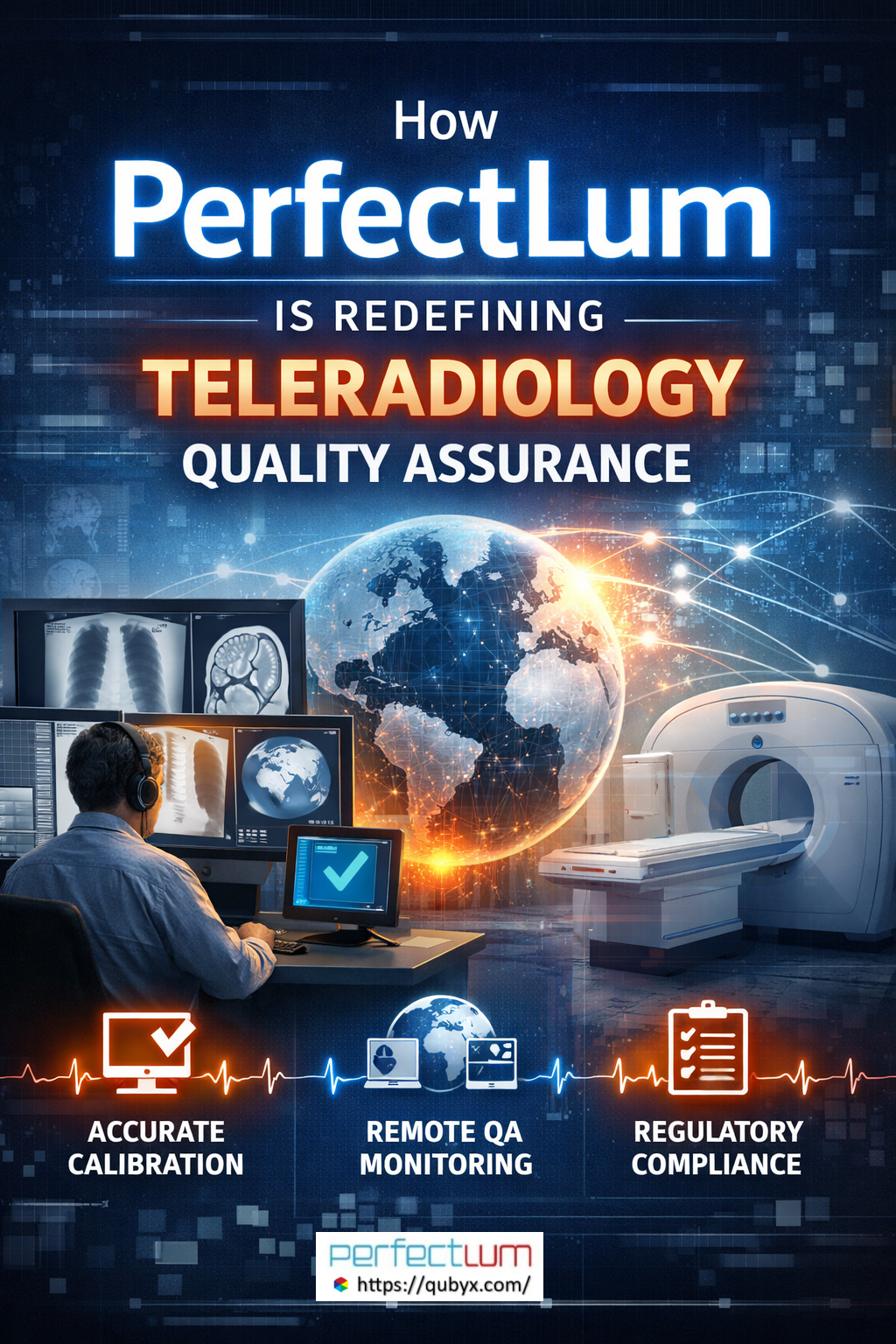
How PerfectLum Is Redefining Teleradiology Quality Assurance
- January 24, 2026
- Shamsul
How PerfectLum Is Redefining Teleradiology Quality Assurance
Why Quality Assurance Is Now a Teleradiology Imperative
Teleradiology has solved the challenge of distance. Medical images now move instantly across hospitals, countries, and time zones. Yet the clinical reliability of those images remains uneven.
In this environment, teleradiology quality assurance must evolve beyond image delivery toward image trust—a concept centered on verified visual accuracy, consistency, and compliance.
This is precisely where QUBYX and its flagship solution PerfectLum redefine the quality paradigm for global teleradiology providers.
Image Transfer Is a Solved Problem—Image Trust Is Not
Most PACS and VNA systems excel at secure image transfer. Files arrive intact, on time, and without corruption.
However, teleradiology quality assurance fails if:
-
Displays are uncalibrated
-
Grayscale response is inconsistent
-
Viewing environments vary
-
Compliance is assumed, not verified
PerfectLum addresses the last mile of diagnostic accuracy—how images are actually perceived by the radiologist.
PerfectLum: Purpose-Built for Teleradiology Quality Assurance
PerfectLum is not generic display software. It is engineered specifically for medical imaging environments where diagnostic precision is non-negotiable.
At its core, PerfectLum enables:
-
DICOM GSDF–compliant calibration
-
Continuous quality monitoring
-
Centralized enterprise control
-
Audit-ready reporting
This transforms teleradiology quality assurance from an operational afterthought into a governed clinical process.
Pillar 1: Enforcing DICOM GSDF Compliance at Scale
DICOM Part 14 defines the grayscale display function required for diagnostic imaging. Yet many remote reading environments drift out of compliance unnoticed.
PerfectLum ensures:
-
Precise GSDF calibration across all displays
-
Automated verification against standard curves
-
Early detection of luminance drift
By enforcing perceptual consistency, PerfectLum restores confidence in teleradiology quality assurance regardless of location.
Pillar 2: Centralized Quality Control for Distributed Radiologists
Modern teleradiology organizations may manage hundreds or thousands of displays worldwide.
PerfectLum enables centralized oversight by:
-
Monitoring all diagnostic displays remotely
-
Applying uniform calibration policies
-
Generating compliance dashboards
This centralized architecture is essential for scalable teleradiology quality assurance in enterprise and multi-site networks.
Pillar 3: Continuous Calibration, Not Periodic Guesswork
Display performance degrades gradually. Without continuous monitoring, image trust erodes silently.
PerfectLum introduces:
-
Scheduled recalibration cycles
-
Automated quality checks
-
Historical performance tracking
This proactive model replaces reactive troubleshooting with continuous teleradiology quality assurance.
Pillar 4: Audit-Ready Compliance for Regulatory Confidence
Regulators increasingly expect documented evidence of diagnostic display compliance.
PerfectLum provides:
-
Timestamped calibration logs
-
Display performance history
-
Exportable audit reports
For teleradiology providers, this shifts teleradiology quality assurance from informal practice to defensible compliance.
Why QUBYX Focuses on Image Trust, Not Just Technology
QUBYX’s philosophy is simple:
If radiologists cannot trust what they see, technology has failed—regardless of speed or resolution.
PerfectLum operationalizes this philosophy by aligning:
-
Human visual perception
-
Medical imaging standards
-
Enterprise IT governance
The result is image trust—a higher standard than image transfer.
Strategic Benefits for Teleradiology Providers
Organizations adopting PerfectLum as part of their teleradiology quality assurance strategy gain:
-
Reduced inter-reader variability
-
Higher diagnostic consistency
-
Lower medicolegal risk
-
Stronger regulatory posture
-
Increased clinician confidence
Quality becomes measurable, defensible, and repeatable.
From Infrastructure Metrics to Clinical Confidence
Traditional metrics measure:
-
Network uptime
-
Data throughput
-
Storage reliability
PerfectLum enables a perceptual quality model—where teleradiology quality assurance is judged by how reliably clinicians interpret images.
This represents a structural shift in how quality is defined.
The Future: Image Trust as the New Global Standard
As teleradiology continues to expand globally, image trust will separate mature providers from commodity services.
QUBYX and PerfectLum position organizations for this future by:
-
Embedding quality into daily workflows
-
Scaling trust across borders
-
Making compliance continuous, not episodic
Conclusion: PerfectLum as the Backbone of Image Trust
Teleradiology no longer competes on image transfer. It competes on diagnostic confidence.
PerfectLum enables that confidence by transforming teleradiology quality assurance into a controlled, measurable, and enterprise-ready discipline.
In the next generation of teleradiology, image trust is quality—and PerfectLum is its foundation.
Start the conversation with our calibration experts today.
In a world where every Pixel accuracy matters, PerfectLum by QUBYX proves that innovation can deliver clinical precision without financial compromise. It’s not just calibration—it’s the democratization of diagnostic imaging.
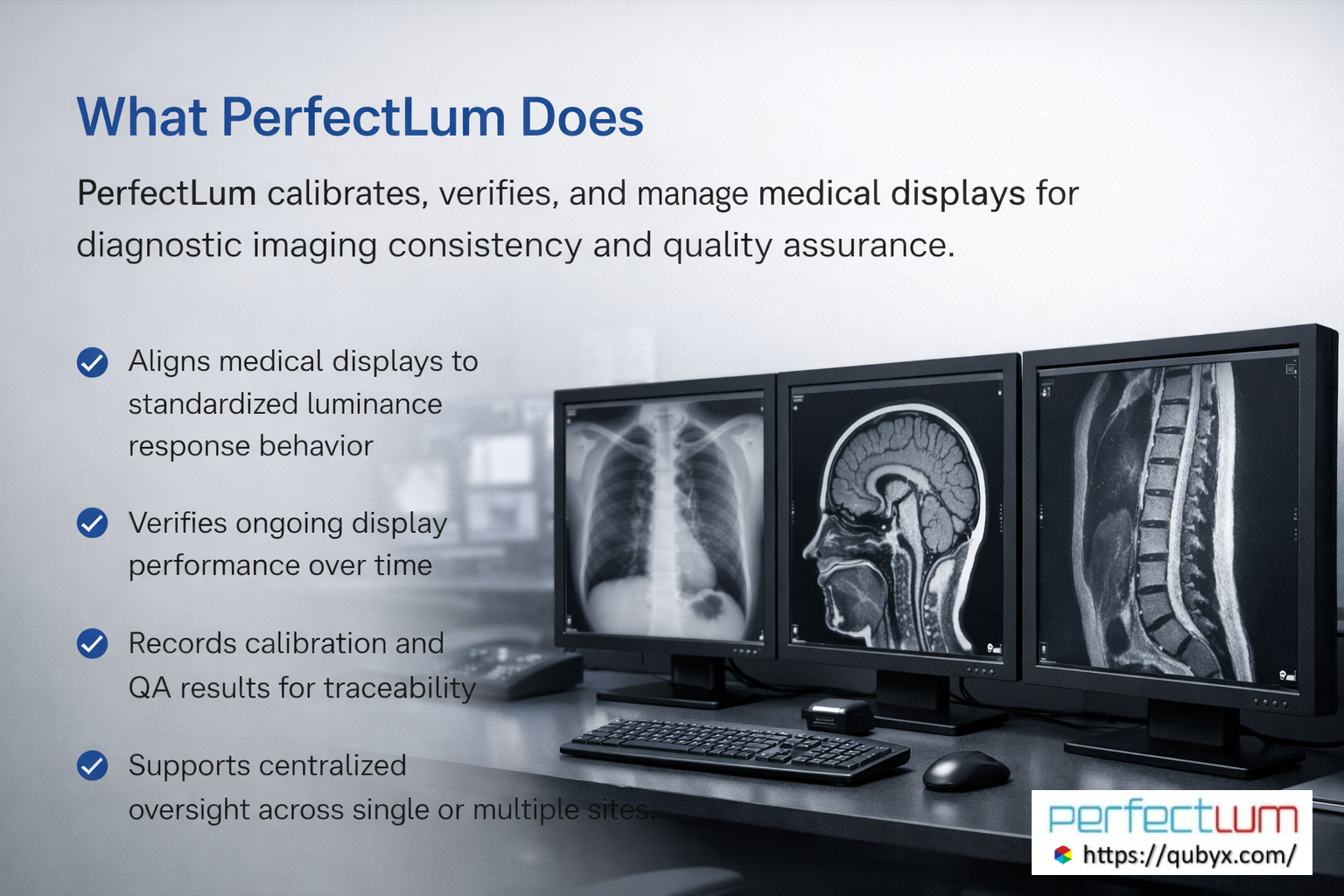
PerfectLum is Medical Display Calibration & QA Software by QUBYX LLC delivers consistent, audit-ready display performance through standardized calibration, verification, and centralized quality assurance for radiology and teleradiology environments.
Tags:
teleradiology quality assurance, PerfectLum calibration software, QUBYX teleradiology solutions, image trust in radiology, DICOM GSDF compliance, medical display calibration, centralized radiology QA, remote radiology quality control
About the Author:
Shamsul Islam is a strategy and growth professional focused on regulated B2B technology markets. He supports QUBYX LLC and its medical imaging solutions through product positioning, go-to-market strategy, and end-to-end digital content development, including website, social media, and educational video initiatives aligned with quality, compliance, and governance-driven environments.
Related Posts
- January 25, 2026
- News
Display Standardization in Global Teleradiology Global teleradiology has transformed
- January 24, 2026
- News
How PerfectLum Is Redefining Teleradiology Quality Assurance Why Quality
- January 24, 2026
- News
PerfectLum Display Calibration & Quality Assurance for Regulated Imaging