
News
- Home
- PerfectLum for Remote Radiology Display Automation
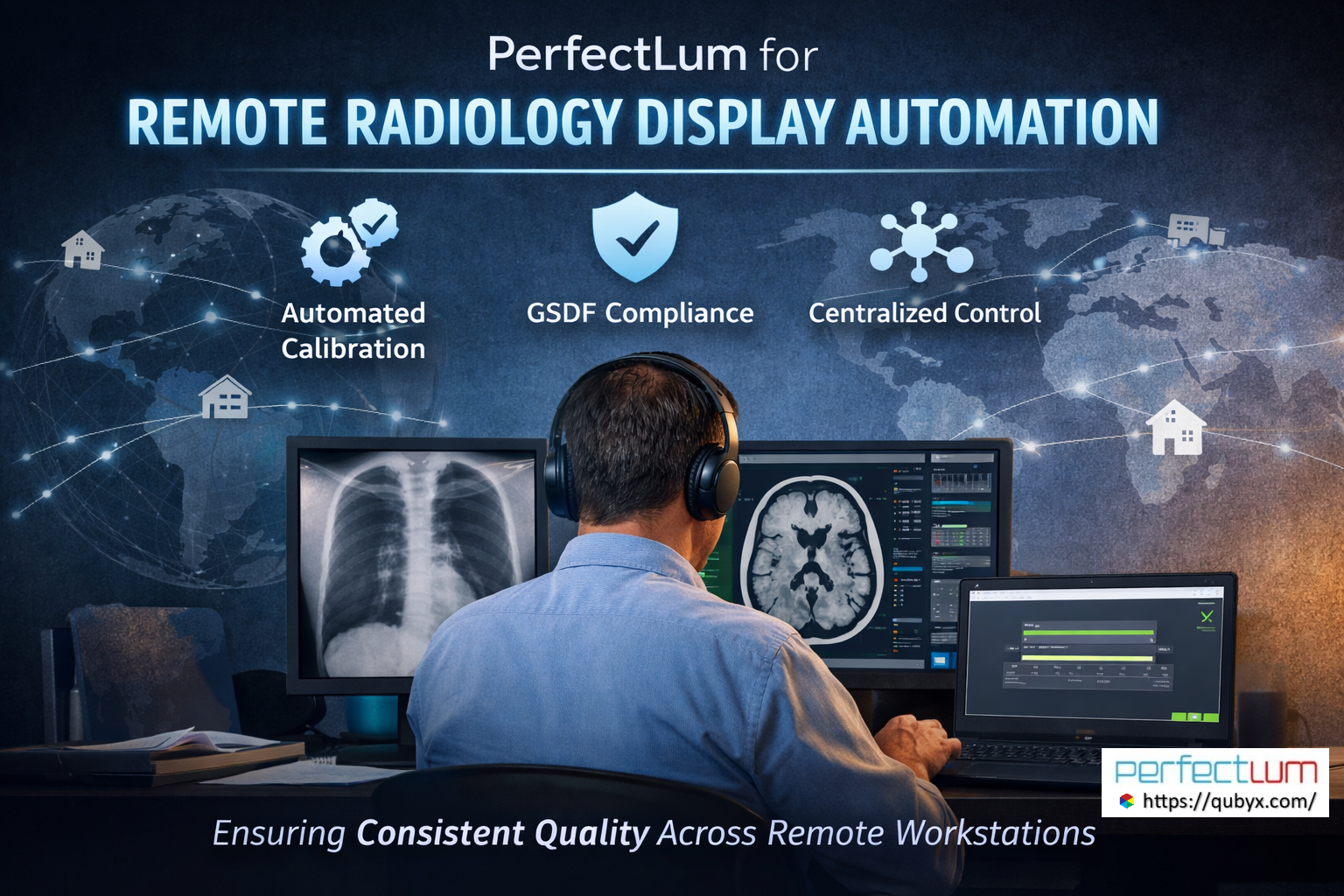
PerfectLum for Remote Radiology Display Automation
- December 31, 2025
- Shamsul
PerfectLum for Remote Radiology Display Automation
Introduction
Remote radiology has transitioned from a contingency solution into a permanent operating model for healthcare systems worldwide. Distributed reading environments now include home offices, satellite clinics, cross-border teleradiology providers, and hybrid radiologist workstations. While PACS, bandwidth, and cybersecurity receive significant attention, one foundational clinical risk is still underestimated: display inconsistency across remote radiology workstations.
In diagnostic imaging, every interpretation depends on grayscale fidelity, luminance stability, and perceptual accuracy. When workstations drift out of calibration, the risk is not merely technical—it is diagnostic. This is where remote radiology display automation becomes a clinical necessity rather than an IT convenience.
This article examines how PerfectLum by QUBYX enables scalable, automated calibration for remote radiology workstations, ensuring diagnostic-grade consistency across distributed environments.
The Hidden Display Risk in Remote Radiology
Remote radiology environments differ fundamentally from controlled hospital reading rooms:
-
Mixed hardware vendors and panel technologies
-
Variable ambient lighting conditions
-
Inconsistent quality assurance schedules
-
Limited on-site technical oversight
Without centralized control, even premium medical displays gradually deviate from DICOM GSDF standards. In a distributed setting, manual calibration is impractical, expensive, and unreliable.
This is precisely why remote radiology display automation is emerging as a strategic pillar of modern teleradiology operations.
Why Manual Calibration Fails at Scale
Traditional display QA relies on:
-
Periodic manual checks
-
Local calibration software
-
User-dependent workflows
In remote radiology, these methods break down due to:
-
Operational friction – Radiologists cannot pause clinical work for manual calibration
-
Human variability – User-initiated calibration is inconsistent
-
Lack of auditability – Compliance cannot be centrally verified
-
Scaling limitations – Hundreds of endpoints become unmanageable
Automated, policy-driven calibration is the only viable alternative—and this is the foundation of remote radiology display automation.
PerfectLum: Built for Distributed Diagnostic Environments
PerfectLum is a diagnostic-grade display calibration solution engineered specifically for regulated medical imaging environments. Unlike consumer or prosumer calibration tools, PerfectLum is designed to meet clinical, operational, and regulatory demands simultaneously.
At its core, PerfectLum enables remote radiology display automation through:
-
Continuous luminance monitoring
-
Automated DICOM GSDF compliance
-
Centralized policy enforcement
-
Zero-touch calibration workflows
This allows healthcare organizations to maintain diagnostic consistency without relying on local intervention.
Automated Calibration as a Clinical Control Layer
Calibration is not a one-time event. Displays drift due to:
-
Backlight aging
-
Temperature changes
-
Usage patterns
-
Environmental lighting
PerfectLum applies automated calibration as a persistent control layer, ensuring displays remain within clinical tolerances throughout their lifecycle.
This continuous approach is essential to effective remote radiology display automation, where clinical confidence must be preserved regardless of workstation location.
How PerfectLum Enables Remote Radiology Display Automation
1. Policy-Driven Calibration Rules
Administrators define calibration policies centrally, including:
-
Target luminance levels
-
GSDF tolerance thresholds
-
Calibration frequency
-
Alert escalation rules
Once deployed, these policies apply uniformly across all remote workstations.
2. Automated Execution
PerfectLum executes calibration tasks automatically, without radiologist involvement. This eliminates workflow disruption while ensuring compliance.
3. Centralized Monitoring and Reporting
All calibration activity is logged, time-stamped, and auditable—an essential requirement for regulatory compliance and clinical governance.
Together, these capabilities form the backbone of remote radiology display automation at enterprise scale.
Compliance and Risk Management Advantages
Remote radiology providers face increasing scrutiny from regulators, accrediting bodies, and hospital partners. Display compliance failures can expose organizations to:
-
Diagnostic liability
-
Accreditation risk
-
Contractual penalties
-
Reputational damage
PerfectLum mitigates these risks by embedding remote radiology display automation directly into the quality assurance framework.
Key compliance benefits include:
-
Continuous GSDF conformity
-
Objective audit trails
-
Reduced variability across readers
-
Documented quality assurance evidence
Operational Benefits for Teleradiology Providers
Beyond compliance, automated calibration delivers measurable operational advantages:
-
Reduced IT workload – No manual endpoint management
-
Higher radiologist productivity – Zero calibration interruptions
-
Faster onboarding – New workstations calibrated automatically
-
Predictable quality – Uniform display behavior across locations
These efficiencies compound as teleradiology networks scale, reinforcing the strategic value of remote radiology display automation.
Supporting Hybrid and Home-Based Radiology
Hybrid work is now standard in radiology. However, home reading environments are inherently variable and difficult to control.
PerfectLum addresses this challenge by:
-
Enforcing the same calibration standards at home as in hospitals
-
Adapting calibration to ambient conditions
-
Maintaining continuous compliance without user action
This ensures that diagnostic accuracy does not depend on geography—a core promise of remote radiology display automation.
Integration with Enterprise Display Ecosystems
PerfectLum integrates seamlessly into broader display quality ecosystems, enabling:
-
Fleet-wide visibility
-
Cross-site standardization
-
Scalable governance
For organizations managing thousands of endpoints, remote radiology display automation is no longer optional—it is foundational infrastructure.
Why Display Automation Is Now a Strategic Requirement
As imaging volumes rise and radiologist shortages persist, remote radiology will continue to expand. In this context:
-
Display inconsistency becomes a systemic clinical risk
-
Manual QA becomes operationally impossible
-
Regulators demand documented compliance
Automated calibration solutions like PerfectLum shift display quality from a reactive task to a proactive, governed process—defining the future of remote radiology display automation.
Conclusion
Remote radiology success depends on more than connectivity and PACS availability. Diagnostic trust begins at the display—and that trust must be maintained continuously, everywhere, without exception.
PerfectLum enables healthcare organizations to implement remote radiology display automation as a scalable, auditable, and clinically robust solution. By eliminating manual calibration dependencies and enforcing consistent display behavior across distributed environments, PerfectLum protects diagnostic accuracy, reduces risk, and supports the long-term sustainability of remote radiology services.
Start the conversation with our calibration experts today.
In a world where every Pixel accuracy matters, PerfectLum by QUBYX proves that innovation can deliver clinical precision without financial compromise. It’s not just calibration—it’s the democratization of diagnostic imaging.
To secure Medical Display Quality Assurance with precision while reducing the recurring costs of proprietary hardware, the answer is clear: transition to a Calibration Software platform with QUBYX OS Tools (Free) and PerfectLum today. Now, you easily pay less for Radiology.
Tags:
remote radiology display automation, PerfectLum calibration, automated display calibration radiology, DICOM GSDF remote workstations, teleradiology display quality, radiology workstation compliance, medical display automation, QUBYX PerfectLum
Related Posts
- January 9, 2026
- News
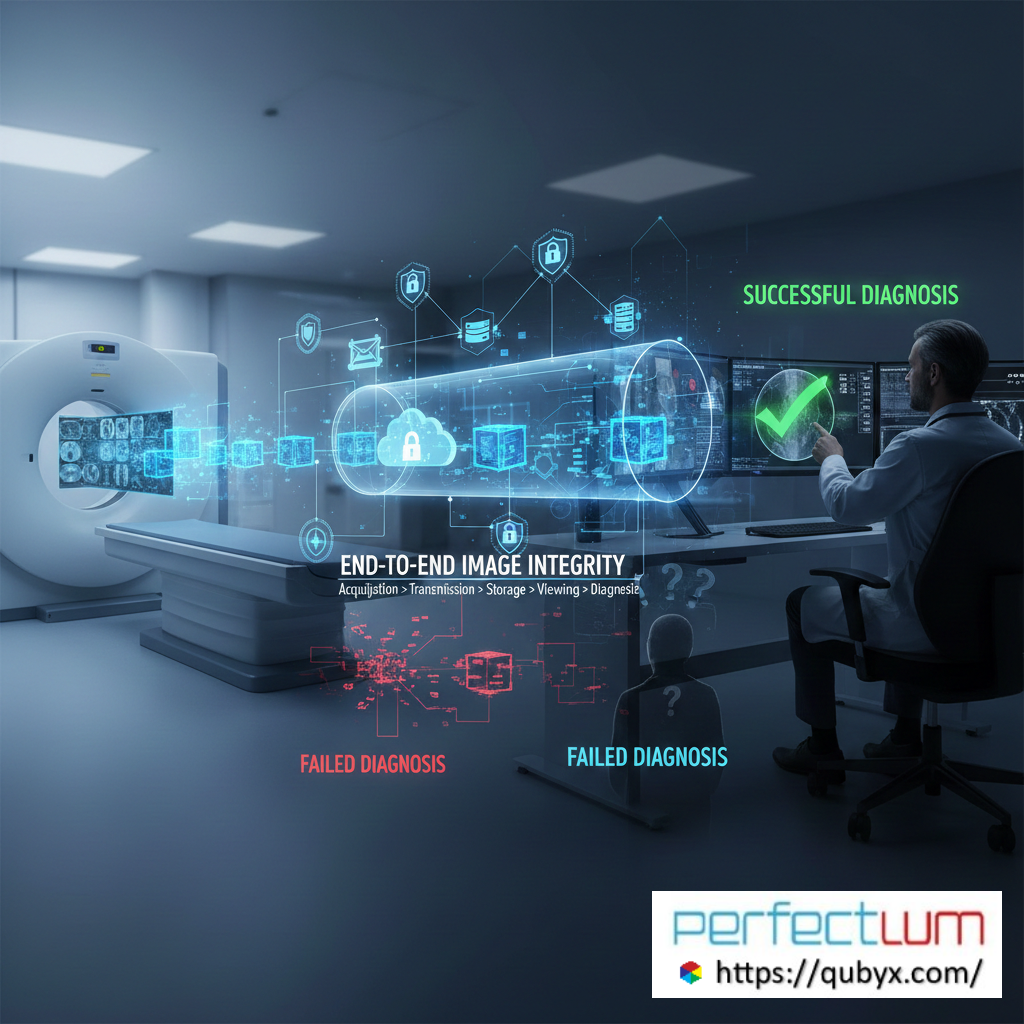
End-to-End Image Integrity | The Key to Teleradiology Success
- January 8, 2026
- News
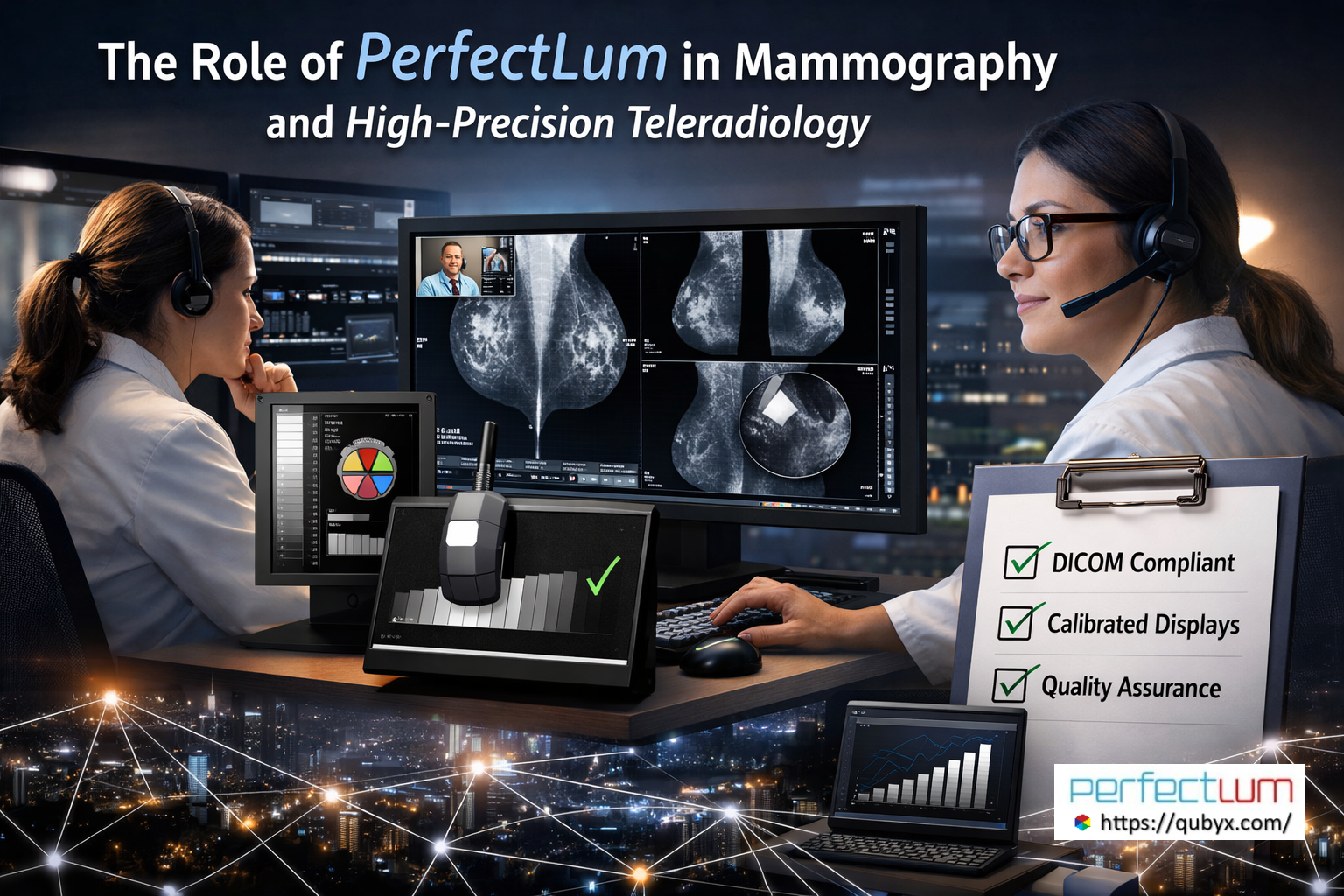
PerfectLum in Mammography & High-Precision Teleradiology Why Display Accuracy Is

- January 8, 2026
- News
Why PerfectLum Is Essential for Multi-Site Teleradiology Operations A