
News
- Home
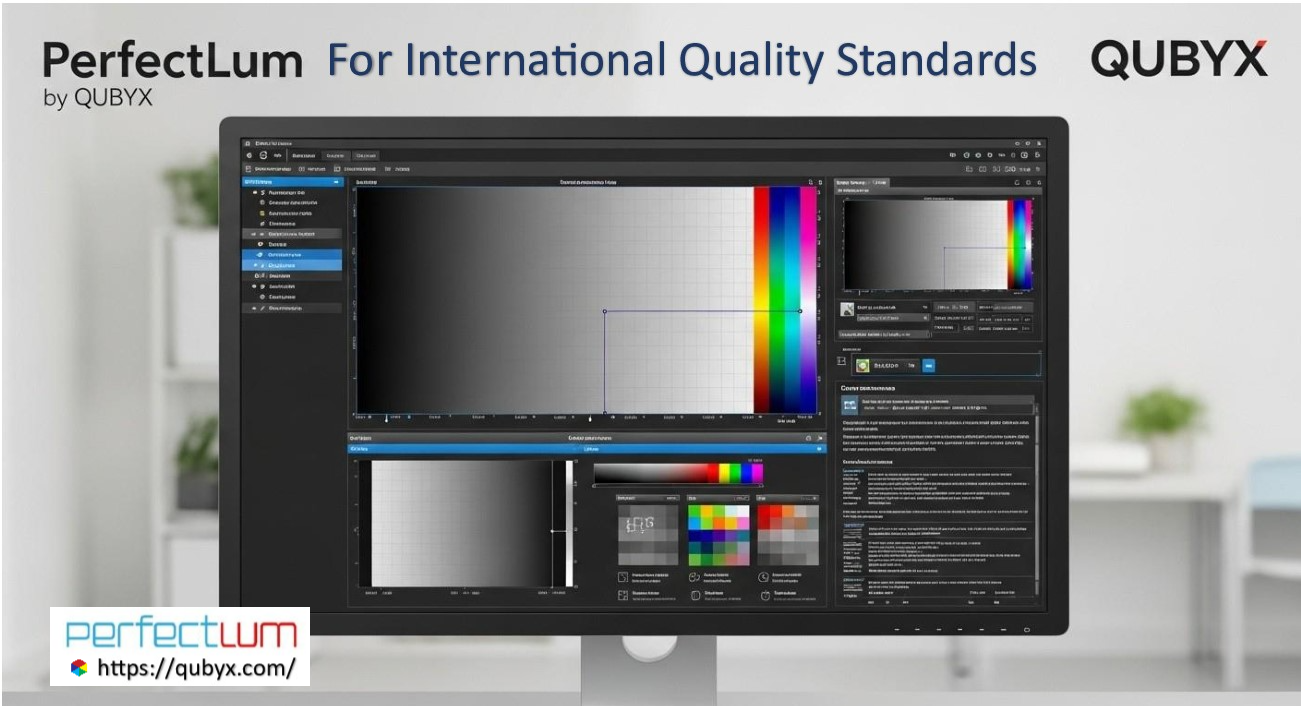
- PerfectLum by QUBYX for International Quality Standards
PerfectLum by QUBYX for International Quality Standards
- October 31, 2025
- QUBYX Team
PerfectLum by QUBYX for International Quality Standards
A Practical Guide for Hospitals, Imaging Centers, and Teleradiology Teams
In medical imaging, “good enough” isn’t good enough. Diagnostic accuracy depends on display performance that is measurable, repeatable, and provably compliant with international standards. That’s exactly where PerfectLum by QUBYX shines: it turns quality standards into day-to-day workflows—so radiologists can trust what they see, and administrators can prove it to auditors.
Below is a comprehensive guide to how PerfectLum by QUBYX helps organizations achieve, maintain, and document compliance with leading global standards, plus a practical roadmap for implementation across multi-facility and remote environments.
Why standards matter (and why software is the lever)
Regulators and professional bodies publish standards to reduce variability across modalities, sites, and devices. But standards only move the needle if you can operationalize them: schedule calibrations, run acceptance/constancy tests, capture results, generate audit-ready reports, and trigger remediation—all without reinventing the wheel for every workstation.
Software-first QA reduces cost and complexity compared to hardware-locked approaches, while improving visibility across fleets. PerfectLum by QUBYX centralizes calibration, testing, and reporting so your compliance posture is continuous, not episodic.
The core standards your program likely needs
Note: The exact standards you must follow depend on modality, jurisdiction, and accreditation body. PerfectLum by QUBYX is designed to support workflows aligned to the following commonly referenced frameworks:
-
DICOM Part 14 GSDF — Grayscale Standard Display Function (calibration curve for medical grayscale imaging)
-
AAPM TG18 — Procedures and test patterns for acceptance and constancy of medical displays
-
AAPM TG270 — Updates and practical guidance for display quality assurance (especially for modern LCDs)
-
DIN 6868-157 — German standard for diagnostic and review monitors, including room categories and constancy checks
-
IEC 62563-1 — International performance evaluation of medical imaging displays
-
IEC 62304 & ISO 13485 (contextual relevance) — Software lifecycle quality and medical device QMS (organizational compliance considerations)
-
Local/Accreditation overlays — ACR, IPEM, IAEA, JCI and national ministry/authority requirements referencing the above
PerfectLum’s strength is mapping daily tasks (calibrate → verify → document) to these frameworks and rolling them up into site-, department-, and enterprise-level compliance.
How PerfectLum by QUBYX operationalizes each requirement
1) DICOM GSDF calibration (foundation)
-
Automated GSDF calibration to align luminance response with DICOM Part 14.
-
Ambient light handling: prompts and procedures to measure/compensate for room illumination where applicable.
-
Per-display LUTs and verification plots: ensure reproducibility and provide visual/quantitative evidence.
Why this matters: The GSDF alignment is the baseline for consistent grayscale perception—vital for modalities such as CT, MR, CR/DR, US, and especially mammography.
2) Acceptance & constancy testing (TG18/TG270, DIN 6868-157, IEC 62563-1)
-
Built-in test patterns and guided workflows (e.g., TG18 line pairs, grayscale ramps, low-contrast detectability).
-
Thresholds by profile: modality- and room-class-specific pass/fail criteria (e.g., DIN categories).
-
Automated constancy schedules (daily/weekly/monthly/annual) with reminders and lock-step procedures.
-
Trend charts: catch drift early (e.g., luminance, contrast response, pixel uniformity over time).
Why this matters: Standards don’t just ask you to calibrate; they require ongoing proof the device remains within tolerance. PerfectLum by QUBYX makes that repeatable.
3) Fleet-level Remote QA & governance
-
Centralized Remote QA Server: monitor hundreds of displays across hospitals, clinics, and home workstations.
-
Policy-driven alerts: auto-notify when a device falls out of compliance or misses a scheduled check.
-
Role-based access for clinical engineering, IT, and medical physics teams.
-
Audit trail & version history: immutable logs that simplify accreditation visits and incident reviews.
Why this matters: Distributed reading (teleradiology) and multi-facility networks are the new normal. You need a single pane of glass for compliance.
4) Device & vendor neutrality
-
Works with a broad range of measurement devices (colorimeters/luminance meters) and commodity/pro monitors.
-
Vendor-agnostic workflows help standardize mixed fleets without expensive, proprietary lock-ins.
-
Supports Windows and macOS environments common to hospital IT and remote readers.
Why this matters: Real fleets are messy. Flexibility keeps QA practical and cost-effective.
5) Reporting & documentation mapped to standards
-
One-click reports: DICOM GSDF calibration results, TG18/TG270 checks, DIN constancy logs, IEC summaries.
-
Per-device and aggregate reports: show the workstation, room conditions, meter used, date/time, operator, and outcome.
-
Export options: share with auditors, upload to QMS, or attach to compliance tickets.
Why this matters: If it isn’t documented, it didn’t happen. PerfectLum by QUBYX produces defensible evidence.
Specialty considerations: mammography, PACS reading rooms, and remote sites
-
Mammography: tighter minimum luminance and contrast demands; PerfectLum supports higher-bar profiles and more frequent constancy checks.
-
PACS reading rooms: integrate ambient light checks and room-class profiles (e.g., DIN categories), ensuring environment and display are co-validated.
-
Home offices: remote radiologists get guided calibration and self-checks; admins retain central visibility and can enforce minimum requirements.
Building a standards-aligned QA program with PerfectLum (6-step blueprint)
-
Define your policy stack
Map which standards apply per modality and site (e.g., GSDF + TG18/TG270 across CT/MR/CR/DR; DIN 6868-157 for German sites; IEC 62563-1 globally). -
Profile your environments
Create PerfectLum by QUBYX profiles by room class (reading room, clinical review, OR), modality, and jurisdiction to encode thresholds and schedules. -
Onboard devices & meters
Inventory displays (make/model/serial), assign meters, and capture baseline acceptance tests with PerfectLum by QUBYX. -
Automate schedules
Set constancy test cadences and calibration intervals; align with TG18/TG270/DIN guidance and your risk policy. -
Close the loop with alerts & remediation
Route failures to IT/biomed/physics. Attach PerfectLum reports to tickets and require a passing retest before returning to service. -
Report and review
Monthly and quarterly dashboards: pass/fail trends, out-of-tolerance incidents, time-to-remediation, and devices approaching end-of-life.
Multi-facility/enterprise roll-out: governance tips
-
Standardize on profiles instead of ad hoc settings. Profiles embody your standards policy and make behavior consistent.
-
Use role-based access to separate who can edit profiles vs. who can run checks.
-
Track MTBF/aging via trend reports; plan replacements before performance dips below compliance.
-
For remote readers, require initial acceptance and auto-scheduled constancy before authorizing clinical use.
Cybersecurity & data handling
-
Keep QA artifacts (reports, measurement logs) in central repositories with appropriate access controls.
-
Ensure PerfectLum communication with the Remote QA server follows hospital security policies (network segmentation, authentication).
-
Integrate with your QMS (change control, periodic review) to align with ISO 13485/IEC 62304 governance expectations where applicable.
Cost and ROI: compliance without the premium tax
-
Software-first: achieve DICOM GSDF and constancy testing without premium, proprietary display ecosystems.
-
Labor savings: scheduled, guided tests reduce physicist/engineer time per device.
-
Audit readiness: fewer firefights during accreditation—reports are generated in minutes, not days.
-
Extend device life: early drift detection and environment tuning (e.g., ambient light) sustain performance longer.
Buyer’s checklist (use this to evaluate any QA solution)
-
✅ DICOM GSDF calibration with verification plots
-
✅ Built-in TG18/TG270, DIN 6868-157, IEC 62563-1 workflows
-
✅ Automated acceptance/constancy schedules and reminders
-
✅ Remote QA server with fleet-wide dashboards and alerts
-
✅ Vendor-neutral meter support; Windows/macOS coverage
-
✅ Audit-ready, exportable reports with immutable logs
-
✅ Role-based access, policy/profile management
-
✅ Trend analysis for drift, luminance, uniformity, and failures
-
✅ Support for specialty use cases (e.g., mammography)
If a tool can’t tick these boxes, you’ll feel the gap at audit time.
Frequently asked questions
Q1: We already have premium diagnostic monitors. Do we still need software QA?
Yes. Standards require verification and documentation over time, not just factory calibration. PerfectLum by QUBYX ensures your monitors stay within tolerance and that you can prove it.
Q2: Can we manage remote radiologists?
Yes. With the Remote QA server, you can schedule tests, receive results, and enforce profiles for home workstations just like on-site devices.
Q3: What meters are supported?
PerfectLum by QUBYX works with a broad range of industry-standard meters. Your existing devices may already be supported.
Q4: How hard is it to pass an audit with PerfectLum?
Organizations typically rely on PerfectLum’s one-click reports and audit trails mapped to the applicable standard(s). This shortens prep time dramatically.
Q5: Will it help outside radiology (e.g., surgery, cardiology, oncology)?
Yes. Any clinical area that relies on image fidelity benefits from GSDF calibration, constancy testing, and documentation.
Conclusion: Compliance as a capability, not a chore
International standards exist to protect patients and clinicians. PerfectLum by QUBYX transforms those standards into daily, automated routines that scale from a single reading room to a global teleradiology network. The result is consistent image quality, lower operational overhead, and audit confidence—every day, on every device.
Next steps
-
Identify the standards and accreditation bodies that apply to your sites.
-
Define modality/room profiles in PerfectLum.
-
Onboard devices, schedule acceptance and constancy tests, and enable Remote QA.
When your QA is software-driven and standards-aligned, quality becomes predictable—and compliance becomes the easy part.
In a world where every pixel matters, PerfectLum by QUBYX proves that innovation can deliver clinical precision without financial compromise. It’s not just calibration—it’s the democratization of diagnostic imaging.
To secure Medical Display Calibration with precision while reducing the recurring costs of proprietary hardware, the answer is clear: transition to a Calibration Software platform like QUBYX OS Tools (Free) and PerfectLum today. Now, you easily pay less for Radiology.
Tags:
PerfectLum, PerfectLum by QUBYX, International Quality Standards, DICOM GSDF calibration, medical display QA, AAPM TG18, AAPM TG270, DIN 6868-157, IEC 62563-1, radiology compliance, teleradiology QA, display calibration software, QUBYX, medical imaging standards, remote QA server, multi-facility imaging compliance
Related Posts
- April 12, 2026
- News
- April 8, 2026
- News

- April 6, 2026
- News