News
- Home
- Open Source Color Calibration from QUBYX OS Tools
Open Source Color Calibration from QUBYX OS Tools
- January 3, 2026
- Shamsul
Why QUBYX OS Tools Are the Future of Open Source Color Calibration
Color accuracy is no longer a niche requirement reserved for print studios. Today, consistent color is a business-critical dependency across photography, video production, design, e-commerce, industrial imaging, and even regulated environments where visual decisions must be repeatable. The challenge is not just calibrating a single monitor—it is controlling color performance at scale, across diverse hardware, operating systems, locations, and user behaviors.
That is exactly where most open source color calibration workflows struggle: they are powerful, but often difficult to standardize, automate, audit, and maintain across fleets.
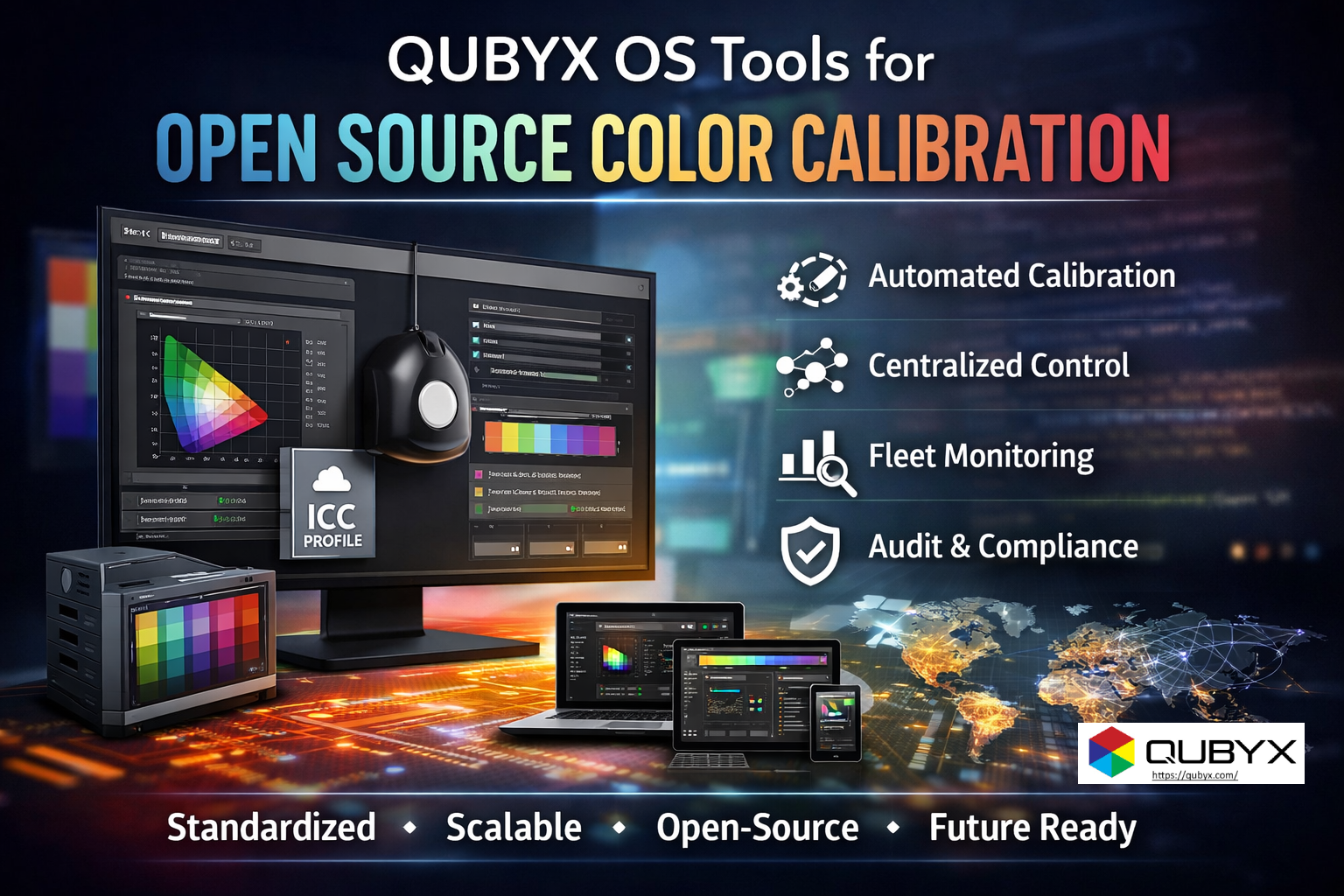
QUBYX OS Tools are designed to solve that “enterprise reality” gap—bringing structure, governance, automation, and operational control to color calibration in environments that want flexibility, interoperability, and future-proof workflows.
The real problem with color calibration in 2026 and beyond
Even strong teams face predictable issues:
-
Inconsistent results between devices (same profile intent, different outcomes).
-
Calibration drift over time due to backlight aging, ambient light changes, and usage patterns.
-
No operational visibility (who calibrated, when, with what target, and whether it passed).
-
Tool sprawl (different utilities per brand/model; ad-hoc scripts; mixed expertise across teams).
-
No enforceable standard across remote workers, studios, or distributed offices.
-
Limited auditability for clients, brand governance, or compliance requirements.
Open workflows can help, but they frequently lack centralized policy control, automated scheduling, reporting, and enterprise-grade lifecycle management.
What “open source color calibration” usually means—and what it often lacks
Most people use the phrase open source color calibration to describe some combination of:
-
Open ICC profile standards and open measurement concepts
-
Open-source calibration engines or utilities
-
Scriptable workflows and DIY automation
-
Community-driven support and extensibility
These are significant advantages. However, open-source-first approaches often run into gaps when organizations need:
-
Central governance (standard targets, limits, and rules across teams)
-
Repeatable calibration enforcement (not optional, not “when I remember”)
-
Evidence and traceability (reports, logs, pass/fail thresholds)
-
Scale operations (hundreds or thousands of endpoints)
-
Reduced dependency on individual experts (calibration as a managed process, not a craft)
This is where QUBYX OS Tools are positioned: not as “another calibration utility,” but as a control layer that professionalizes and operationalizes calibration.
QUBYX OS Tools: the control plane for modern calibration operations
Think of QUBYX OS Tools as enabling an “IT-grade” approach to color management:
1) Standardization: one policy, many devices
Color programs fail when standards are implicit. QUBYX OS Tools enable explicit, enforceable calibration targets such as:
-
White point (e.g., D65, D50, custom)
-
Luminance targets and minimum acceptable ranges
-
Gamma / tone response objectives
-
Validation tolerances and pass/fail thresholds
-
Role-based presets (photo editing vs. general design vs. review stations)
With policy-driven controls, teams stop calibrating “their way” and start calibrating “the company way.”
2) Automation: calibration becomes routine, not a reminder
The biggest hidden cost in color programs is the human layer: missed schedules, inconsistent procedures, and incomplete verification.
QUBYX OS Tools support automation patterns that are essential for the future of open source color calibration in real-world operations:
-
Scheduled calibration prompts and cadence control
-
Automated validation workflows
-
Reduced operator steps (less room for “creative interpretation”)
-
Centralized status visibility across endpoints
This turns calibration into a predictable operational activity—like patching, endpoint protection, or device compliance.
3) Fleet visibility: know your color health at a glance
If you manage more than a handful of monitors, you need to answer questions quickly:
-
Which devices are overdue for calibration?
-
Which devices failed verification and why?
-
Which users are out of compliance with the standard?
-
Where are drift trends appearing (by model, location, or usage profile)?
QUBYX OS Tools bring “fleet thinking” to color management: dashboards, reporting, and traceability that help teams move from reactive fixes to proactive control.
4) Open-standards friendly: future-proof interoperability
Even when organizations prefer open toolchains, they still need compatibility with the broader color ecosystem. QUBYX OS Tools align well with the realities of open standards color management:
-
ICC profile-based workflows
-
Cross-application consistency requirements
-
Multi-vendor display environments
-
Hybrid stacks where open-source components and commercial tools coexist
This matters because the future is not “all open-source” or “all proprietary.” The future is composable—and organizations win when they can integrate tools without locking themselves into fragile, one-off processes.
5) Governance and auditability: prove color consistency to clients and stakeholders
Brand owners, agencies, studios, and production pipelines increasingly require evidence. “We calibrated” is not a report.
QUBYX OS Tools help create the artifacts decision-makers want:
-
Calibration records (who, when, what settings/targets)
-
Compliance status snapshots
-
Exception handling (what failed, what was done)
-
Repeatable program documentation for QA and client confidence
This is especially valuable when you need to demonstrate process maturity—an area where DIY open source color calibration setups often struggle without substantial internal tooling.
Why QUBYX OS Tools fit the direction the market is actually moving
Remote work and distributed teams are permanent
Studios and creative teams now operate across home offices, satellite sites, and shared workspaces. Color consistency can’t depend on a handful of in-office experts.
QUBYX OS Tools help organizations scale color consistency beyond the “calibration specialist” model.
Device diversity is increasing, not decreasing
Teams run mixed fleets: different brands, panels, OS versions, and performance profiles. Single-vendor strategies are rarely realistic.
The future requires vendor-agnostic operational control—precisely the kind of layer QUBYX OS Tools provide.
AI and automated content pipelines raise the bar for consistency
As creative pipelines accelerate, review cycles shorten. If displays are inconsistent, approvals become subjective, and rework increases.
Color accuracy becomes a productivity lever, not just a quality preference.
Compliance and QA expectations are rising
Even outside medical imaging, audits, standards, and contractual deliverables are becoming more common. Organizations want traceability, not anecdotes.
Practical use cases where QUBYX OS Tools shine
-
Photography and post-production teams needing consistent grading across editors and review stations
-
Design agencies enforcing brand color reliability across multiple offices
-
E-commerce content production where product color fidelity affects returns and customer trust
-
Corporate brand governance where consistency matters across marketing, packaging, and digital media
-
Education labs and training environments that need standardized displays with minimal admin overhead
Implementation approach: how to modernize an open workflow with QUBYX OS Tools
A sensible, low-friction rollout typically looks like this:
-
Define your calibration standard (targets, tolerances, schedules)
-
Pilot with a representative group (different monitor models, different user types)
-
Operationalize enforcement (cadence, reminders, validation, escalation)
-
Scale with visibility (reporting, dashboards, compliance tracking)
-
Continuously optimize (drift trends, model-specific adjustments, policy tuning)
This approach preserves the flexibility and interoperability valued in open source color calibration philosophies, while adding the governance and repeatability enterprises require.
FAQ: common questions teams ask
Is QUBYX OS Tools “open-source”?
QUBYX OS Tools are best understood as an enterprise-grade management and control layer that supports open standards and interoperable workflows. In practice, many organizations combine open tools and commercial solutions; QUBYX OS Tools help make that hybrid reality reliable and scalable.
Do we still need color expertise?
You need expertise to define standards and exceptions. But you should not need experts to run routine calibration operations daily. QUBYX OS Tools reduce dependence on “hero knowledge.”
What is the biggest ROI driver?
Consistency and time. Fewer revisions, fewer disputes during review, less rework, and less downtime troubleshooting “why it looks different on my screen.”
Conclusion: the future is open-friendly, policy-driven, and scalable
The future of open source color calibration will be shaped by organizations that embrace openness in standards and interoperability—but demand enterprise-grade execution: automation, governance, auditability, and fleet-wide consistency.
QUBYX OS Tools are built for that future: they help teams move from calibration as a “best effort” activity to calibration as a managed, measurable, and enforceable operational system—without sacrificing the openness and flexibility modern workflows require.
Start the conversation with our calibration experts today.
In a world where every Pixel accuracy matters, PerfectLum by QUBYX proves that innovation can deliver clinical precision without financial compromise. It’s not just calibration—it’s the democratization of diagnostic imaging.
To secure Medical Display Quality Assurance with precision while reducing the recurring costs of proprietary hardware, the answer is clear: transition to a Calibration Software platform with QUBYX OS Tools (Free) and PerfectLum today. Now, you easily pay less for Radiology.
Take control of your color workflow and budget.
• Get the Code & Docs
Clone the repository and dive into full documentation.
• git clone https://github.com/QUBYX-LLC/your-repo-name.git
Tags:
open source color calibration, QUBYX OS Tools, ICC profiles, monitor calibration management, color consistency, calibration automation, display QA, color governance
Related Posts

- January 9, 2026
- News
End-to-End Image Integrity | The Key to Teleradiology Success
- January 8, 2026
- News
PerfectLum in Mammography & High-Precision Teleradiology Why Display Accuracy Is

- January 8, 2026
- News
Why PerfectLum Is Essential for Multi-Site Teleradiology Operations A