
How to Choose a Teleradiology Provider | Quality, Compliance & QUBYX PerfectLum
Teleradiology has transformed modern healthcare by enabling medical images to be interpreted remotely by qualified radiologists. Hospitals, diagnostic centers, and imaging networks increasingly rely on teleradiology to address radiologist shortages, provide 24/7 coverage, and accelerate reporting turnaround times.
However, choosing the right provider is not simply a procurement decision. It directly affects diagnostic accuracy, regulatory compliance, patient safety, and operational efficiency. Healthcare organizations must carefully evaluate several technical, clinical, and compliance-related factors before deciding which partner to trust with their imaging workflow.
This guide explains how to choose a teleradiology provider, outlining the most critical evaluation criteria, industry standards, and the often-overlooked role of display calibration and quality assurance infrastructure in remote radiology.
Understanding the Role of Teleradiology in Modern Healthcare
Teleradiology allows diagnostic images—such as CT scans, MRI scans, ultrasound images, and X-rays—to be transmitted electronically from one location to another for interpretation.
With the rapid expansion of digital imaging systems and PACS platforms, hospitals can now send studies to remote radiologists across cities, countries, or even continents.
The benefits include:
-
24/7 radiology reporting coverage
-
Reduced radiologist workload
-
Faster emergency imaging interpretation
-
Access to subspecialty expertise
-
Improved patient throughput
Yet these benefits only materialize when the teleradiology partner maintains strict quality assurance processes and compliant imaging infrastructure.
Organizations such as the American College of Radiology and American Association of Physicists in Medicine emphasize that remote reporting environments must meet the same diagnostic display and quality standards as on-site radiology departments.
Why Choosing the Right Teleradiology Provider Matters
Selecting a teleradiology provider is not merely outsourcing a service—it is extending your diagnostic decision-making process beyond your institution.
An inadequate provider can introduce serious risks:
-
Diagnostic errors due to poor display conditions
-
Data security vulnerabilities
-
Slow turnaround times
-
Lack of regulatory compliance
-
Incomplete audit documentation
Conversely, a well-qualified provider strengthens clinical performance by ensuring:
-
Reliable image transmission
-
Certified radiologist expertise
-
standardized reporting workflows
-
structured quality assurance procedures
For this reason, hospitals must evaluate providers across clinical expertise, infrastructure, security, and compliance readiness.
1. Evaluate Radiologist Credentials and Subspecialty Expertise
The most fundamental factor when you choose a teleradiology provider is the quality of the radiologists interpreting the studies.
A reputable provider should demonstrate:
-
Board-certified radiologists
-
Subspecialty expertise (neuro, cardiac, musculoskeletal, oncology imaging)
-
Active licensing in required jurisdictions
-
Continuous professional education
-
Peer review systems for diagnostic accuracy
Subspecialty interpretation is particularly important for complex studies such as neurological MRI or oncologic CT imaging.
Providers should also maintain structured reporting standards and second-opinion workflows for complex cases.
2. Assess Turnaround Time and Service Coverage
One of the primary reasons hospitals adopt teleradiology is to improve reporting speed.
Providers typically offer several turnaround time tiers:
| Reporting Type | Typical Turnaround Time |
|---|---|
| Emergency / STAT | 10–30 minutes |
| Urgent | 1–2 hours |
| Routine | 6–24 hours |
When evaluating providers, ask about:
-
Guaranteed turnaround times
-
After-hours coverage
-
Night-hawk reporting services
-
Weekend and holiday availability
-
Subspecialty availability
The provider must also have scalable staffing models to handle fluctuating study volumes.
3. Verify Data Security and Regulatory Compliance
Medical imaging data contains sensitive patient information and must comply with strict privacy regulations.
A reliable teleradiology provider should support:
-
End-to-end encryption of image transfers
-
secure DICOM communication protocols
-
compliance with international privacy standards
-
role-based access controls
-
detailed audit logs
Providers should also integrate seamlessly with existing systems such as PACS and RIS.
The imaging format itself is governed by the widely adopted DICOM standard developed by the National Electrical Manufacturers Association.
4. Evaluate Infrastructure and Technology Integration
A strong teleradiology provider must offer robust technological infrastructure.
Key technical requirements include:
-
High-availability reporting platforms
-
Cloud or hybrid image storage
-
PACS integration capability
-
reliable bandwidth optimization
-
redundant server infrastructure
Providers should also support modern workflow tools such as:
-
automated case prioritization
-
structured reporting templates
-
AI-assisted triage tools
This technological ecosystem ensures that remote interpretation operates with the same efficiency as on-site radiology departments.
5. Confirm Quality Assurance and Diagnostic Display Standards
One of the most overlooked—but critically important—factors when choosing a teleradiology provider is display quality assurance.
Radiologists make diagnostic decisions based on subtle grayscale differences in medical images. If the display monitor is not calibrated properly, critical findings may be missed.
International standards require diagnostic monitors to comply with the DICOM Part 14 Grayscale Standard Display Function (GSDF).
Without proper calibration, displays may suffer from:
-
luminance drift
-
inconsistent grayscale reproduction
-
reduced contrast visibility
-
diagnostic interpretation errors
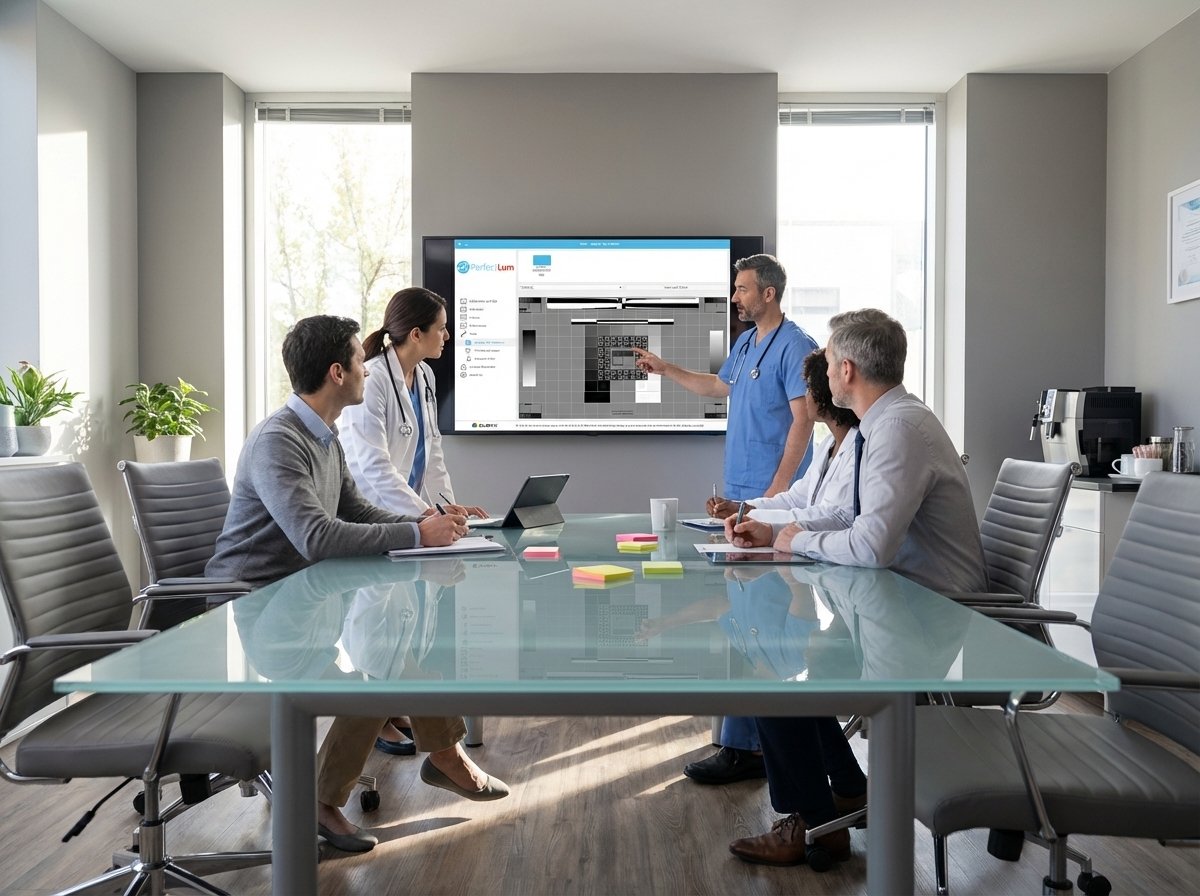
This is where structured QA solutions such as PerfectLum developed by QUBYX play a vital role in teleradiology environments.
5- The Role of QUBYX PerfectLum in Teleradiology Quality Assurance
Distributed teleradiology networks often include radiologists working from multiple locations—home workstations, reporting hubs, and regional reading centers.
Maintaining consistent diagnostic display performance across these environments is extremely challenging.
Solutions such as PerfectLum provide centralized quality assurance and display calibration infrastructure designed specifically for medical imaging environments.
PerfectLum enables healthcare organizations to implement:
-
DICOM GSDF-aligned display calibration
-
automated luminance tracking
-
uniformity testing for diagnostic monitors
-
scheduled QA tests
-
compliance-ready documentation
By integrating display calibration into the teleradiology workflow, healthcare institutions ensure that radiologists interpret images under consistent and validated viewing conditions.
This is particularly important for large teleradiology provider networks where dozens or hundreds of remote workstations must maintain consistent diagnostic accuracy.
6. Examine Reporting Quality and Peer Review Processes
Diagnostic accuracy depends not only on technology but also on structured quality management processes.
Reputable providers implement:
-
double-reading for complex cases
-
peer review audits
-
discrepancy tracking systems
-
standardized reporting templates
These processes ensure continuous improvement in diagnostic accuracy and maintain clinical accountability.
Hospitals should also verify whether the provider maintains performance metrics and reporting analytics.
7. Evaluate Communication and Clinical Collaboration
Teleradiology should not isolate radiologists from clinicians. Effective providers support collaborative workflows.
Important capabilities include:
-
direct communication with referring physicians
-
clinical consultation support
-
real-time case discussions
-
integrated reporting platforms
This collaboration ensures radiologists understand the clinical context behind each imaging study.
8. Review Scalability and Long-Term Partnership Potential
Healthcare institutions should choose providers capable of supporting long-term growth.
Questions to ask include:
-
Can the provider handle increased imaging volume?
-
Do they support multi-hospital networks?
-
Can they provide subspecialty reporting expansion?
-
Do they offer enterprise reporting infrastructure?
Scalability ensures the teleradiology service remains sustainable as the organization grows.
Teleradiology Provider Evaluation Checklist
When you choose a teleradiology provider, evaluate the following:
✔ Board-certified radiologists
✔ Subspecialty expertise availability
✔ Fast and guaranteed turnaround times
✔ Secure DICOM image transmission
✔ PACS integration capability
✔ Compliance with imaging standards
✔ Display calibration and QA infrastructure
✔ Peer review and quality monitoring
✔ Scalable service capacity
✔ Clear communication channels
Organizations that address all these criteria will build a reliable and compliant teleradiology ecosystem.
The Future of Teleradiology and Distributed Imaging Networks
The global demand for teleradiology continues to grow due to:
-
rising imaging volumes
-
global radiologist shortages
-
increasing telemedicine adoption
-
cross-border diagnostic services
At the same time, regulatory bodies are emphasizing stronger quality assurance frameworks for remote diagnostic environments.
Hospitals and imaging networks are therefore shifting from simple remote reporting models to integrated imaging quality management systems.
These systems combine:
-
image transmission infrastructure
-
workflow automation
-
AI-assisted triage
-
display calibration and compliance monitoring
Platforms like QUBYX PerfectLum support this transition by transforming display calibration from a one-time technical adjustment into a continuous quality assurance process.
Conclusion
Selecting the right partner is critical when you choose a teleradiology provider. The decision affects diagnostic reliability, regulatory compliance, operational efficiency, and ultimately patient outcomes.
Healthcare organizations must evaluate providers across several key dimensions, including clinical expertise, technological infrastructure, security, turnaround performance, and quality assurance processes.
One of the most overlooked factors is diagnostic display performance. Without proper calibration and monitoring, even the most experienced radiologist may struggle to interpret images accurately.
By integrating structured QA systems such as QUBYX PerfectLum, healthcare institutions can ensure that remote radiologists operate under consistent, validated, and compliant viewing conditions.
As teleradiology networks expand globally, the combination of expert radiologists, robust infrastructure, and continuous display quality assurance will define the next generation of reliable and audit-ready diagnostic imaging services.
FAQ
What should hospitals consider before choosing a teleradiology provider?
Hospitals should evaluate radiologist qualifications, turnaround times, technology infrastructure, data security, and quality assurance procedures.
Why is display calibration important in teleradiology?
Diagnostic accuracy depends on correct grayscale reproduction. Displays must comply with DICOM GSDF standards to ensure subtle image details are visible.
What role does QUBYX PerfectLum play in teleradiology?
PerfectLum provides centralized display calibration and quality assurance tools that ensure diagnostic monitors remain compliant and consistent across distributed reporting environments.
Can teleradiology maintain the same diagnostic quality as in-house radiology?
Yes—when the provider maintains qualified radiologists, secure infrastructure, and structured quality assurance systems including calibrated diagnostic displays.
Start the conversation with our calibration experts today.
In a world where every Pixel accuracy matters, PerfectLum by QUBYX proves that innovation can deliver clinical precision without financial compromise. It’s not just calibration—it’s the democratization of diagnostic imaging.
PerfectLum is Medical Display Calibration & QA Software by QUBYX LLC that delivers consistent, audit-ready display performance through standardized calibration, verification, and centralized quality assurance for radiology and teleradiology environments.
Tags:
teleradiology provider, choose a teleradiology provider, teleradiology services, how to select teleradiology provider, teleradiology workflow, radiology outsourcing, diagnostic imaging QA, DICOM display calibration, medical display quality assurance, QUBYX PerfectLum, remote radiology reporting, PACS teleradiology integration