
News
- Home
- From PACS to Pixels | Displays Powering Teleradiology
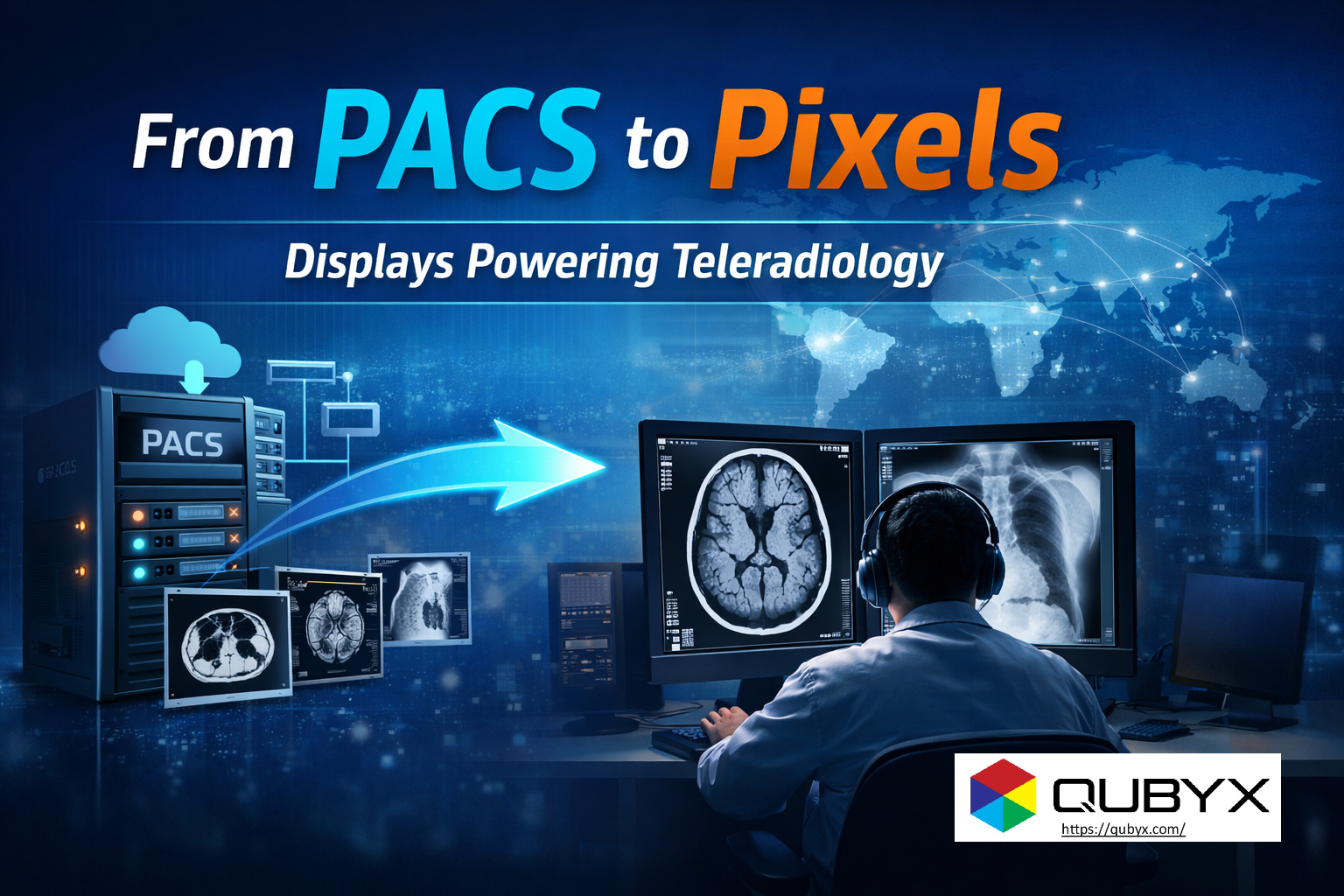
From PACS to Pixels | Displays Powering Teleradiology
- December 30, 2025
- Shamsul
From PACS to Pixels | The Hidden Role of Displays in Teleradiology
Why PACS to Pixels Defines Teleradiology Outcomes
Teleradiology has reshaped diagnostic healthcare by enabling radiologists to interpret studies remotely, expanding access and improving coverage. While scanners, networks, and PACS platforms receive most of the attention, the final diagnostic decision is made at the display. This is where PACS to Pixels becomes decisive.
The concept captures the full imaging pathway—from image acquisition and PACS storage to visual interpretation by the human eye. In teleradiology, where reading environments are decentralized, display accuracy is not a technical preference but a clinical necessity.
Understanding the PACS to Pixels Continuum
It describes the transition from digital image data to perceptual understanding. PACS systems ensure images are captured, archived, and transmitted correctly. However, PACS does not control how those images are rendered on a screen.
In teleradiology, the Pixels gap emerges when display luminance, contrast, or grayscale response deviates from expected standards. Even small deviations can alter how anatomy and pathology are perceived.
The Display Blind Spot in Teleradiology
Many organizations assume that if an image opens correctly in PACS, diagnostic integrity is preserved. It challenges this assumption. Displays age, backlights dim, and calibration drifts occur gradually and silently.
In remote reading environments, unmanaged displays introduce inconsistency. The same PACS image may appear differently to two radiologists, creating variability in interpretation. This hidden risk is central to the PACS to Pixels problem.
Clinical Risk Hidden in Workflows
The danger of failure lies in its invisibility. Reports are generated, turnaround times are met, and errors are rarely obvious. Yet subtle grayscale inaccuracies can obscure low-contrast findings or distort lesion boundaries.
In high-volume teleradiology operations, inaccuracies scale rapidly, amplifying diagnostic risk across thousands of studies and multiple providers.
PACS to Pixels and DICOM GSDF Compliance
A critical foundation of PACS to Pixels accuracy is DICOM GSDF (Grayscale Standard Display Function). GSDF ensures that equal steps in pixel values produce equal perceptual changes for the human eye.
Without GSDF compliance, the chain becomes unreliable. Displays that are too bright, too dim, or incorrectly calibrated alter grayscale perception, undermining diagnostic consistency in teleradiology.
Why Teleradiology Amplifies Challenges
Traditional hospital reading rooms are controlled environments with standardized equipment. Teleradiology replaces these with home offices, mobile workstations, and varied ambient lighting. This makes management more complex—and more critical.
Distributed models depend on scalable quality control. Without centralized oversight, PACS to Pixels variability becomes inevitable, increasing both clinical and regulatory exposure.
Operational Impact of Weak PACS to Pixels Control
Poor governance affects more than diagnosis. IT teams face increased support requests, manual calibration efforts, and reactive troubleshooting. Radiologists may lose confidence in image quality, slowing reporting and increasing fatigue.
Organizations that proactively manage the chain benefit from standardized performance, predictable workflows, and reduced operational friction.
Why PACS to Pixels Is a Trust Issue
It aligns directly with credibility and reliability in healthcare delivery.
-
Experience: Radiologists routinely encounter variability caused by unmanaged displays.
-
Expertise: Medical imaging standards define measurable display requirements.
-
Authoritativeness: Professional guidelines recognize display accuracy as a diagnostic factor.
-
Trustworthiness: Controlled PACS to Pixels workflows produce consistent, defensible results.
Strong practices signal organizational maturity and clinical responsibility.
Strengthening the PACS to Pixels Chain
A resilient strategy typically includes:
-
Regular display calibration to GSDF standards
-
Monitoring of luminance and contrast performance
-
Standardized workstation specifications
-
Documented quality assurance processes
By treating as part of the clinical system, teleradiology providers protect diagnostic integrity end-to-end.
Conclusion: PACS to Pixels Is the Silent Backbone of Teleradiology
Teleradiology’s effectiveness depends not only on connectivity and PACS reliability, but on pixel-level accuracy. It represents the final step where clinical data becomes diagnostic insight.
Organizations that recognize and control the PACS to Pixels pathway are better positioned to deliver consistent, compliant, and trustworthy teleradiology services in an increasingly distributed healthcare landscape.
Start the conversation with our calibration experts today.
In a world where every Pixel accuracy matters, PerfectLum by QUBYX proves that innovation can deliver clinical precision without financial compromise. It’s not just calibration—it’s the democratization of diagnostic imaging.
To secure Medical Display Quality Assurance with precision while reducing the recurring costs of proprietary hardware, the answer is clear: transition to a Calibration Software platform with QUBYX OS Tools (Free) and PerfectLum today. Now, you easily pay less for Radiology.
Tags:
PACS to Pixels, teleradiology displays, medical display accuracy, PACS workflow, DICOM GSDF, diagnostic imaging quality, remote radiology
Related Posts
- January 9, 2026
- News
End-to-End Image Integrity | The Key to Teleradiology Success
- January 8, 2026
- News
PerfectLum in Mammography & High-Precision Teleradiology Why Display Accuracy Is

- January 8, 2026
- News
Why PerfectLum Is Essential for Multi-Site Teleradiology Operations A