
News
- Home
- Display Standardization in Global Teleradiology
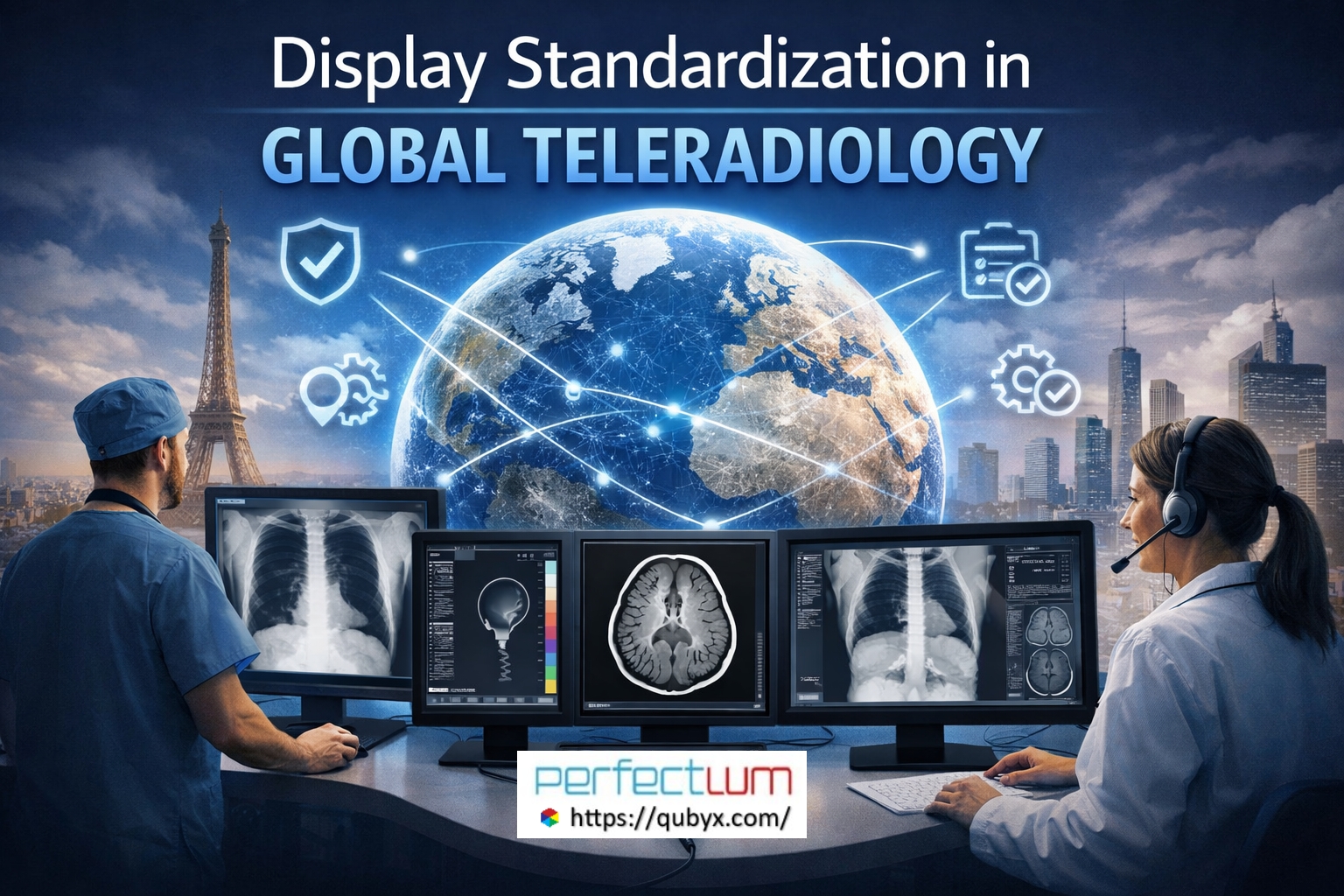
Display Standardization in Global Teleradiology
- January 25, 2026
- Shamsul
Display Standardization in Global Teleradiology
Global teleradiology has transformed how diagnostic imaging services are delivered, enabling radiologists to interpret studies across borders, time zones, and healthcare systems. While acquisition, transmission, and PACS infrastructures have matured significantly, one foundational element remains inconsistently managed: display standardization in global teleradiology.
At its core, teleradiology depends on the assumption that an image viewed in one location will appear the same in another. In practice, this assumption often fails. Variations in display hardware, calibration status, luminance stability, ambient lighting, and quality assurance processes can subtly—but materially—alter image presentation. These variations introduce diagnostic risk, operational inconsistency, and compliance exposure.
This article examines why display standardization is critical in global teleradiology, the challenges that prevent consistency at scale, and how structured display calibration and quality assurance frameworks—including the role of PerfectLum—support reliable, audit-ready diagnostic environments.
What Display Standardization Means in Teleradiology
Display standardization in global teleradiology refers to the systematic alignment of how medical images are rendered across all diagnostic workstations, regardless of geography or organizational boundaries. It ensures that grayscale response, luminance, contrast, and overall visual performance conform to accepted medical imaging standards.
Unlike general IT standardization, display standardization directly affects clinical interpretation. A pulmonary nodule, subtle fracture, or low-contrast lesion may be visible on one display but less apparent on another if calibration drifts or luminance degrades.
Core Elements of Display Standardization
Effective display standardization typically includes:
-
Consistent grayscale presentation aligned to DICOM GSDF
-
Controlled luminance and contrast performance
-
Ongoing calibration and verification
-
Environmental awareness (ambient light impact)
-
Documented quality assurance and traceability
In global teleradiology networks, these elements must be applied uniformly across diverse sites, vendors, and operating conditions.
Why Display Standardization Is Critical in Global Teleradiology
The importance of display standardization in global teleradiology extends beyond technical preference. It directly influences diagnostic confidence, workflow reliability, and organizational accountability.
Diagnostic Consistency Across Borders
Radiologists interpreting studies remotely rely entirely on display fidelity. Without standardization, two qualified professionals may reach different conclusions simply due to display variance rather than clinical judgment. This undermines the fundamental promise of teleradiology: consistent expertise delivered anywhere.
Risk Reduction and Clinical Confidence
Display inconsistency introduces silent risk. Unlike system outages, display drift often goes unnoticed until an adverse event, audit, or discrepancy review occurs. Standardization reduces this latent risk by making image presentation predictable and verifiable.
Regulatory and Audit Expectations
Many healthcare systems and accreditation bodies increasingly expect documented evidence of display performance management. In distributed teleradiology models, the absence of standardized display QA can become a material compliance gap.
Challenges to Display Standardization in Global Teleradiology
Despite its importance, achieving display standardization in global teleradiology is operationally complex.
Heterogeneous Hardware Environments
Global teleradiology networks often involve:
-
Different display manufacturers and models
-
Mixed generations of diagnostic and review displays
-
Variable hardware lifecycles and replacement schedules
This heterogeneity complicates uniform calibration and performance verification.
Geographic and Operational Scale
Managing display quality across multiple countries introduces logistical challenges, including:
-
Limited on-site technical access
-
Time zone differences
-
Inconsistent local IT practices
Manual or site-by-site approaches do not scale effectively.
Calibration Drift Over Time
Even compliant displays degrade. Backlight aging, panel wear, and environmental factors cause luminance and grayscale drift. One-time calibration does not ensure long-term standardization.
Display Standardization as a Quality Assurance Discipline
To be effective, display standardization in global teleradiology must be treated as an ongoing quality assurance (QA) discipline rather than a setup task.
From Calibration to Continuous Verification
Modern display QA emphasizes:
-
Baseline calibration to defined standards
-
Scheduled verification and drift detection
-
Exception handling and corrective actions
-
Longitudinal performance tracking
This lifecycle approach aligns display management with broader imaging QA frameworks.
Centralized Oversight in Distributed Networks
Global teleradiology operations benefit from centralized visibility into display performance. Central oversight enables consistent policies, uniform thresholds, and rapid identification of non-compliant workstations—without relying solely on local intervention.
The Role of PerfectLum in Display Standardization
Within this context, PerfectLum supports display standardization in global teleradiology by providing structured calibration, verification, and QA workflows tailored to medical imaging environments.
Developed by QUBYX LLC, PerfectLum is designed to address the operational realities of distributed diagnostic networks rather than isolated reading rooms.
Enabling Consistent Display Calibration
PerfectLum facilitates consistent alignment of displays to medical imaging standards, supporting uniform grayscale response and luminance behavior across geographically dispersed sites. This consistency reduces variability in image presentation, which is central to global teleradiology reliability.
Supporting Ongoing Display Quality Assurance
Beyond initial calibration, PerfectLum emphasizes verification and monitoring. By identifying performance drift and documenting corrective actions, it helps organizations maintain display standardization over time rather than relying on periodic manual checks.
Audit-Ready Documentation and Traceability
In global teleradiology, documentation matters. PerfectLum provides structured records of calibration status, verification results, and compliance history, supporting internal governance and external audit requirements without disrupting clinical workflows.
Importantly, its role is not to replace clinical judgment, but to ensure that judgment is exercised on displays that behave predictably and consistently.
Display Standardization and Clinical Governance
Display standardization in global teleradiology intersects directly with clinical governance frameworks.
Accountability in Distributed Reading Models
When interpretation spans borders, accountability must remain clear. Standardized display QA creates a defensible baseline, demonstrating that image presentation conditions were controlled and monitored at the time of interpretation.
Supporting Peer Review and Discrepancy Management
In peer review or discrepancy resolution, standardized displays reduce confounding variables. Differences in interpretation can be evaluated on clinical grounds rather than technical uncertainty.
Best Practices for Implementing Display Standardization Globally
Organizations seeking effective display standardization in global teleradiology typically adopt the following practices:
Define Clear Display Performance Policies
Establish organization-wide standards for calibration targets, verification frequency, and acceptable tolerances.
Centralize Visibility and Reporting
Use centralized systems to monitor display performance across all sites, enabling proactive management rather than reactive remediation.
Integrate Display QA Into Imaging QA Programs
Display standardization should align with modality QA, workflow QA, and reporting QA to form a coherent quality ecosystem.
Treat Standardization as Continuous
Recognize that display standardization is not a one-time achievement. Continuous verification and documentation are essential in long-term global operations.
The Future of Display Standardization in Global Teleradiology
As teleradiology continues to expand, display standardization will become more—not less—important. Increasing case volumes, AI-assisted workflows, and cross-border reporting amplify the need for consistent visual environments.
Future-ready teleradiology organizations will view display standardization as foundational infrastructure: invisible when working correctly, but essential to diagnostic trust, operational resilience, and regulatory confidence.
Conclusion | Display standardization in global teleradiology
Display standardization in global teleradiology is not a technical luxury; it is a clinical necessity. Without standardized displays, the promise of global radiology—consistent expertise delivered anywhere—cannot be fully realized.
By adopting structured calibration, continuous QA, and centralized oversight, organizations can reduce diagnostic variability, strengthen governance, and support sustainable global operations. Within this framework, tools like PerfectLum play a supporting role by enabling consistency, traceability, and long-term reliability across distributed diagnostic environments.
Start the conversation with our calibration experts today.
In a world where every Pixel accuracy matters, PerfectLum by QUBYX proves that innovation can deliver clinical precision without financial compromise. It’s not just calibration—it’s the democratization of diagnostic imaging.
PerfectLum is Medical Display Calibration & QA Software by QUBYX LLC delivers consistent, audit-ready display performance through standardized calibration, verification, and centralized quality assurance for radiology and teleradiology environments.
Tags:
display standardization in global teleradiology, teleradiology display calibration, diagnostic display consistency, medical display QA, DICOM GSDF compliance, radiology quality assurance, PerfectLum display calibration
About the Author:
Shamsul Islam is a strategy and growth professional focused on regulated B2B technology markets. He supports QUBYX LLC and its medical imaging solutions through product positioning, go-to-market strategy, and end-to-end digital content development, including website, social media, and educational video initiatives aligned with quality, compliance, and governance-driven environments.
Related Posts
- January 25, 2026
- News
Display Standardization in Global Teleradiology Global teleradiology has transformed
- January 24, 2026
- News
How PerfectLum Is Redefining Teleradiology Quality Assurance Why Quality
- January 24, 2026
- News
PerfectLum Display Calibration & Quality Assurance for Regulated Imaging