
News
- Home
- Display Quality Assurance with PerfectLum by QUBYX
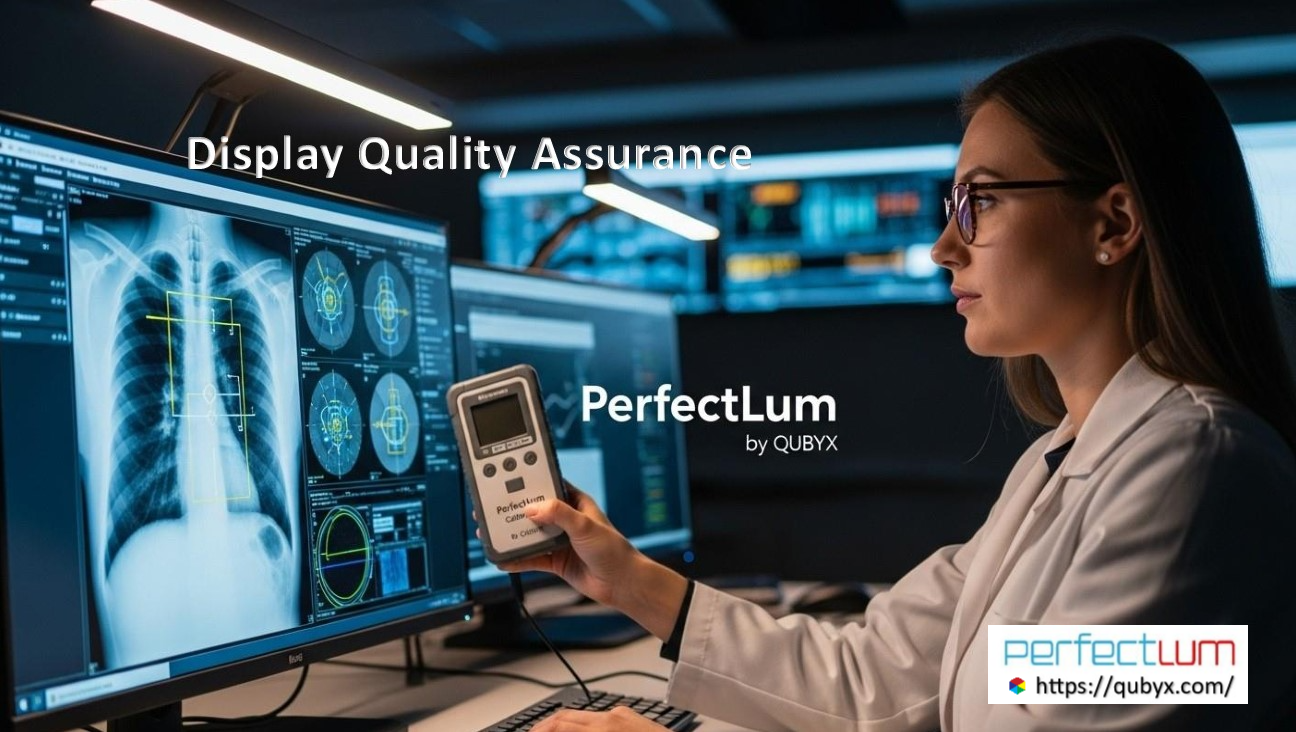
Display Quality Assurance with PerfectLum by QUBYX
- November 7, 2025
- QUBYX Team
Display Quality Assurance with PerfectLum by QUBYX
Why Display Quality Assurance Matters
In medical imaging, every pixel tells a story. A slightly dimmed grayscale or an inaccurate luminance curve can be the difference between early disease detection and a missed diagnosis. Whether in radiology, mammography, or pathology, the quality of visual information on a display directly impacts patient outcomes.
This is where Display Quality Assurance (DQA) becomes indispensable — and PerfectLum by QUBYX stands as one of the most advanced, standards-compliant solutions designed to ensure diagnostic confidence and compliance with international medical imaging standards.
1. The Core of Display Quality Assurance
Display Quality Assurance (QA) encompasses the calibration, verification, and continuous monitoring of medical monitors to maintain image consistency across devices and environments. It ensures that diagnostic displays meet the luminance response defined by the DICOM Part 14 GSDF (Grayscale Standard Display Function) and other industry benchmarks such as AAPM TG18, AAPM TG270, and DIN 6868-157.
Without systematic Display Quality Assurance, displays gradually drift from their calibrated states due to aging components, ambient lighting variations, or software inconsistencies. This drift leads to subtle but critical differences in contrast perception, particularly in low-contrast medical images.
PerfectLum eliminates this uncertainty by providing an end-to-end software-based Display Quality Assurance workflow — from initial calibration to automated routine checks and detailed compliance reporting.
2. The PerfectLum Advantage: Software That Outperforms Hardware-Locked Systems
While many medical monitors come with proprietary calibration tools, these often lock users into vendor-specific ecosystems and costly hardware upgrades. QUBYX took a radically different approach: a vendor-neutral software solution that delivers hardware-grade precision at a fraction of the cost.
Key Advantages of PerfectLum:
-
Universal Compatibility: Works with displays from EIZO, Barco, NEC, LG, Dell, HP, and others.
-
Precision Calibration: Achieves a DICOM GSDF curve with ΔE < 1, ensuring imperceptible visual deviation.
-
Remote QA Server: Enables IT administrators to manage, monitor, and enforce calibration policies across a fleet of displays from a central dashboard.
-
Multi-Standard Compliance: Supports DICOM Part 14, AAPM TG18/TG270, DIN 6868-157, and NYC PDM standards.
-
Cross-Platform Support: Runs seamlessly on Windows and macOS, making it ideal for hybrid IT infrastructures.
-
Smart Scheduling: Automates QA tests, ambient light checks, and re-calibrations during off-hours.
-
Comprehensive Reporting: Generates PDF-based QA reports for regulatory and audit documentation.
This flexibility empowers healthcare organizations to transform display management from a costly CAPEX burden into a predictable, software-driven OPEX model — without compromising diagnostic integrity.
3. PerfectLum’s Compliance with Global Standards
QUBYX designed PerfectLum to meet and exceed all major international display quality standards. Each standard defines specific parameters to ensure radiologists view images under consistent luminance, contrast, and uniformity conditions.
DICOM Part 14 GSDF
The foundation of medical display calibration, this standard defines the precise luminance response a diagnostic monitor should exhibit. PerfectLum performs a GSDF calibration by measuring actual screen luminance at multiple gray levels and adjusting the LUT (Look-Up Table) to ensure perceptually uniform brightness differences across the entire grayscale range.
AAPM TG18 & TG270
These American Association of Physicists in Medicine task group reports define comprehensive test patterns, procedures, and tolerances for medical display QA. PerfectLum includes built-in TG18 and TG270 pattern libraries and automates evaluation to ensure compliance with recommended performance metrics.
DIN 6868-157
This German standard focuses on acceptance and constancy testing for medical displays. PerfectLum automates these constancy tests, providing users with quantitative results and alerts for deviations beyond permissible limits.
NYC PDM & IEC Standards
PerfectLum’s flexible QA modules allow adaptation to local and institutional requirements such as the NYC PDM regulation, IEC 62563-1, and regional radiology board guidelines, making it suitable for global deployment.
4. Remote QA Server: Centralized Fleet Management
In today’s distributed healthcare environment — where teleradiology, home reporting, and multi-facility imaging are the norm — maintaining consistent image quality across multiple locations is a logistical challenge.
PerfectLum’s Remote QA Server provides a powerful solution. It enables centralized control and oversight over all calibrated workstations, regardless of their physical location.
Remote QA Server Capabilities:
-
Fleet-Wide Monitoring: View calibration status, last verification date, and compliance score for every workstation in real time.
-
Automated Notifications: Receive alerts for non-compliance, failed verifications, or overdue calibrations.
-
Centralized Reports: Collect QA data from multiple departments for consolidated audit reports.
-
Role-Based Access: Assign permissions to medical physicists, IT administrators, or QA officers for secure operations.
This feature transforms QA from a manual, time-consuming process into a proactive quality ecosystem, ensuring that radiologists in any facility — or even working remotely — see identical, accurate images.
5. Why Software-Based Display Quality Assurance Is the Future
Traditional calibration approaches rely on integrated hardware sensors and manufacturer-specific solutions. While functional, they come with significant drawbacks — limited interoperability, high replacement costs, and lack of transparency.
PerfectLum represents the evolution toward software-defined quality assurance, offering all the precision of hardware solutions with greater scalability and cost efficiency.
Key Benefits of Software-Based Display Quality Assurance:
-
Cost-Effectiveness: No need for proprietary hardware sensors or locked-in service contracts.
-
Scalability: Deploy across dozens or hundreds of workstations with minimal setup.
-
Transparency: Open verification logs and exportable reports enhance traceability.
-
Cross-Brand Support: Calibrate mixed fleets of displays from multiple vendors.
-
Sustainability: Extend display lifespan and reduce electronic waste by maintaining performance instead of replacing equipment prematurely.
The outcome: consistent diagnostic accuracy, lower costs, and greater control.
6. PerfectLum in Action: Real-World Applications
Radiology and Teleradiology
PerfectLum ensures uniform image quality across on-site and remote radiology workstations. This consistency allows radiologists to interpret CT, MRI, and X-ray images confidently, whether in a hospital reading room or a home office.
Mammography
High-contrast sensitivity is critical in mammography. PerfectLum supports luminance levels exceeding 500 cd/m² and verifies contrast response in compliance with mammography standards, ensuring the smallest lesions remain visible.
Pathology and Ophthalmology
Digital pathology and ophthalmic imaging demand precise color calibration. PerfectLum’s multi-standard approach supports both grayscale and color DICOM calibration, ensuring fidelity for color-sensitive applications.
Multisite Hospital Networks
Through its remote QA capabilities, PerfectLum allows large healthcare networks to maintain synchronized QA protocols across facilities — reducing audit complexity and ensuring regulatory compliance everywhere.
7. Reports, Documentation, and Audits Made Effortless
Regulatory compliance often means extensive documentation — proof of calibration, verification records, and periodic Display Quality Assurance results. PerfectLum simplifies this with automated, exportable reports that meet the documentation standards of healthcare accrediting bodies and internal QA teams.
Each report includes:
-
Calibration history
-
Test results (pass/fail status)
-
DICOM GSDF deviation metrics
-
Luminance uniformity data
-
Ambient light measurements
-
Timestamped operator and system details
This transparency helps facilities maintain readiness for audits by health authorities, accreditation agencies, and internal quality boards.
8. The QUBYX Philosophy: Precision Without Boundaries
QUBYX has long been recognized as a pioneer in display calibration and quality assurance software. With over two decades of experience in color science and imaging standards, the company’s solutions are used globally across radiology, defense, prepress, and geospatial imaging.
The guiding philosophy behind PerfectLum is freedom and precision — freedom from vendor lock-in and precision that rivals any proprietary system. Whether for a single workstation or a nationwide telehealth network, QUBYX delivers the same confidence: every image is accurate, every diagnosis reliable.
Conclusion: PerfectLum — The Future of Medical Display Quality Assurance
In the rapidly evolving landscape of digital healthcare, ensuring diagnostic accuracy through reliable display performance is not a luxury — it’s a necessity.
PerfectLum by QUBYX offers a future-ready, standards-compliant, and cost-efficient solution for Display Quality Assurance that empowers radiologists, IT administrators, and medical physicists alike. With its powerful calibration engine, automated QA routines, and centralized control, PerfectLum guarantees what every healthcare provider needs most: trust in what they see.
In a world where every pixel matters, PerfectLum by QUBYX proves that innovation can deliver clinical precision without financial compromise. It’s not just calibration—it’s the democratization of diagnostic imaging.
To secure Medical Display Quality Assurance with precision while reducing the recurring costs of proprietary hardware, the answer is clear: transition to a Calibration Software platform like QUBYX OS Tools (Free) and PerfectLum today. Now, you easily pay less for Radiology.
Tags:
Display Quality Assurance, PerfectLum, QUBYX, DICOM GSDF, AAPM TG270, medical display calibration, QA software, radiology imaging standards, display compliance, remote QA server
Related Posts
- April 12, 2026
- News
- April 8, 2026
- News

- April 6, 2026
- News