
News
- Home
- DICOM in Teleradiology | GSDF Compliance with QUBYX PerfectLum
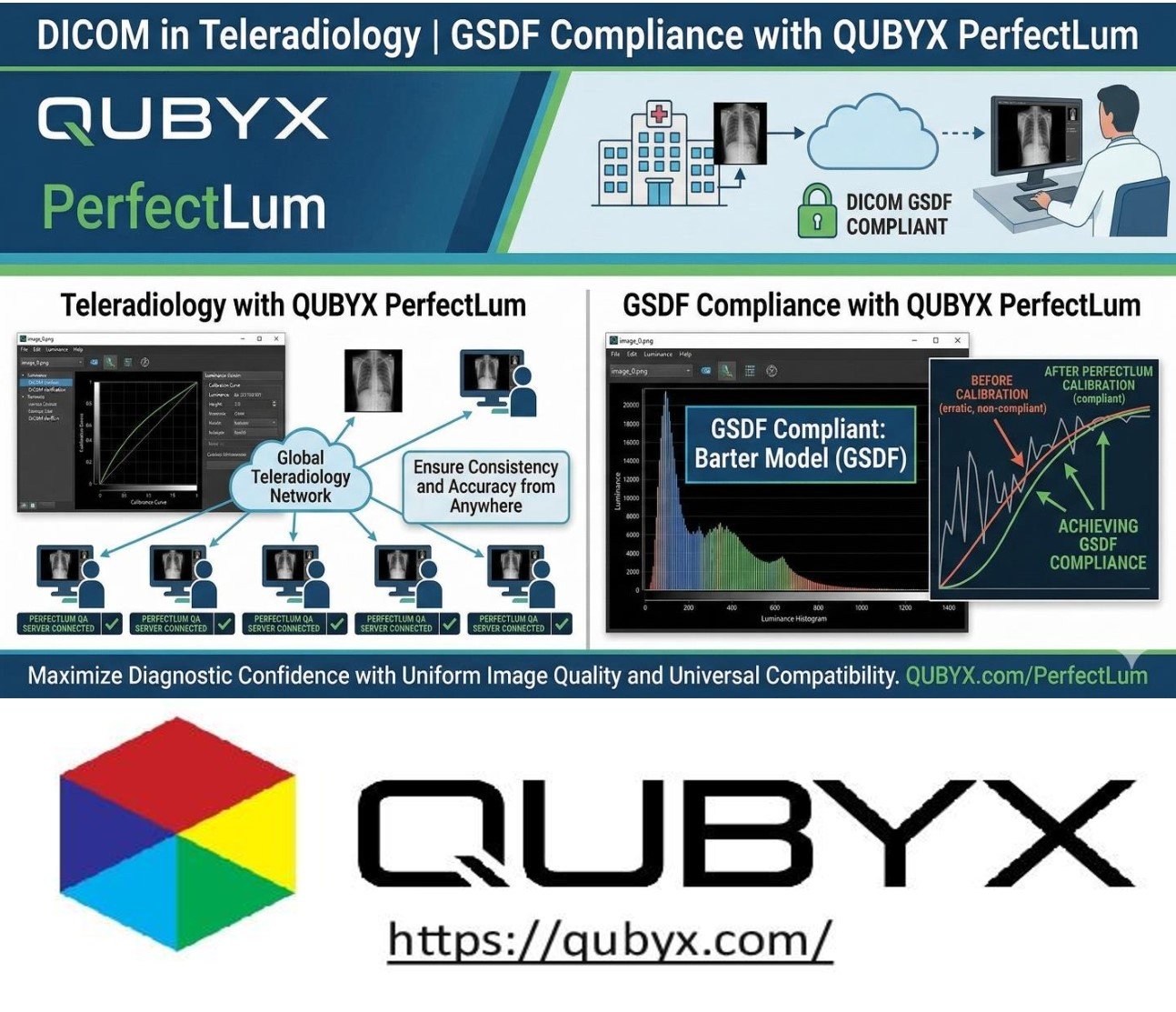
DICOM in Teleradiology | GSDF Compliance with QUBYX PerfectLum
- March 6, 2026
- QUBYX Team
DICOM in Teleradiology
Ensuring Diagnostic Accuracy with QUBYX PerfectLum
Teleradiology has transformed the way healthcare institutions deliver diagnostic imaging services. Hospitals, imaging centers, and radiology networks now transmit medical images across cities, countries, and even continents to be interpreted by remote radiologists. This capability allows healthcare providers to maintain continuous diagnostic coverage, access subspecialty expertise, and improve patient care.
However, remote interpretation introduces a critical challenge: maintaining consistent image quality across distributed viewing environments.
To ensure reliable image presentation and diagnostic accuracy, the medical imaging industry relies on the DICOM standard. Understanding the role of DICOM in Teleradiology is essential for healthcare organizations seeking to build compliant and high-quality remote imaging workflows.
In this article, we explore how DICOM standards support teleradiology systems, the importance of DICOM Part 14 GSDF, and how tools like **PerfectLum developed by QUBYX help maintain DICOM compliance across diagnostic displays.
What Is DICOM?
DICOM stands for Digital Imaging and Communications in Medicine, the global standard used to manage, store, transmit, and display medical imaging data.
The standard ensures interoperability between imaging equipment, software platforms, and hospital systems such as PACS and RIS.
DICOM standards are maintained by National Electrical Manufacturers Association, which works closely with healthcare and technology stakeholders to ensure compatibility across medical imaging environments.
Through DICOM, imaging devices from different manufacturers can exchange information seamlessly while preserving image quality and metadata.
Why DICOM in Teleradiology Is Essential
Teleradiology relies on the accurate transmission and display of medical images. Without standardized imaging formats and protocols, remote interpretation would be unreliable and inconsistent.
DICOM provides the foundation for:
-
standardized medical image formats
-
secure transmission of imaging studies
-
interoperability between PACS systems and radiology workstations
-
consistent display performance for diagnostic monitors
In remote radiology environments, DICOM in Teleradiology ensures that images appear consistently regardless of where they are viewed.
This consistency is critical for radiologists who rely on subtle visual details to detect abnormalities.
Understanding DICOM Part 14 GSDF
One of the most important aspects of DICOM for diagnostic imaging is DICOM Part 14, which defines the Grayscale Standard Display Function (GSDF).
The GSDF standard ensures that grayscale images are displayed consistently across different monitors.
Radiologists depend on grayscale contrast differences to detect small abnormalities in medical images. Without standardized display behavior, the same image could appear differently on different monitors.
DICOM Part 14 GSDF addresses this problem by defining how monitors should reproduce grayscale values so that luminance differences correspond to human visual perception.
In practical terms, GSDF ensures that:
-
subtle grayscale details remain visible
-
contrast differences are preserved
-
diagnostic images appear consistent across displays
This standard is essential in teleradiology environments where radiologists may interpret images on multiple remote workstations.
The Importance of DICOM in Teleradiology
Maintaining DICOM compliance is a fundamental requirement for healthcare organizations that rely on remote radiology workflows.
Compliance ensures that imaging systems meet industry standards for:
-
image transmission
-
display performance
-
interoperability between systems
-
diagnostic viewing consistency
Without proper DICOM compliance, several issues may arise:
-
inconsistent image appearance across monitors
-
loss of diagnostic detail due to improper display calibration
-
interoperability problems between imaging systems
-
regulatory compliance challenges
In distributed radiology environments, maintaining consistent compliance across multiple workstations can be particularly difficult.
The Role of Diagnostic Display Calibration
Even when images are transmitted correctly using DICOM standards, diagnostic accuracy depends heavily on the display device used by the radiologist.
Medical imaging monitors must reproduce grayscale values accurately to reveal subtle differences in tissue density.
However, displays naturally drift over time due to:
-
aging backlight components
-
environmental conditions
-
usage patterns
Without calibration, monitors may gradually deviate from the grayscale standard display function, causing images to appear brighter, darker, or less detailed.
This drift can compromise diagnostic interpretation, especially in remote radiology environments where workstation conditions vary.
The Role of QUBYX PerfectLum in DICOM Compliance
Maintaining consistent display performance across multiple diagnostic workstations requires specialized quality assurance tools.
Solutions like **PerfectLum developed by QUBYX help healthcare institutions implement structured display calibration and quality assurance processes.
PerfectLum supports DICOM standards by enabling:
-
DICOM Part 14 GSDF display calibration
-
automated luminance monitoring
-
diagnostic display uniformity testing
-
scheduled quality assurance checks
-
centralized compliance dashboards
-
audit-ready quality documentation
By ensuring that monitors remain calibrated according to GSDF requirements, PerfectLum helps healthcare institutions maintain consistent diagnostic viewing conditions across distributed teleradiology environments.
Why Display Calibration Matters in Teleradiology
In traditional hospital reading rooms, display calibration is often managed by medical physicists or imaging engineers.
However, teleradiology introduces new challenges because radiologists may interpret images from:
-
remote reading centers
-
home workstations
-
distributed reporting hubs
Maintaining consistent viewing conditions across these locations requires centralized monitoring systems.
PerfectLum helps address this challenge by enabling organizations to manage display calibration across an entire radiology network.
This ensures that DICOM in Teleradiology remains reliable regardless of where the radiologist is located.
Integrating DICOM in Teleradiology Standards in Modern Systems
Modern teleradiology systems rely on a combination of technologies that support the DICOM framework.
These technologies include:
-
PACS (Picture Archiving and Communication Systems)
-
secure DICOM communication protocols
-
cloud-based imaging storage
-
diagnostic reporting workstations
When integrated with display calibration tools like PerfectLum, these systems create a comprehensive imaging environment that maintains consistent quality across the entire diagnostic workflow.
The Future of DICOM in Teleradiology
As healthcare systems continue to adopt telemedicine and digital imaging technologies, the role of DICOM standards will become even more important.
Future developments in teleradiology may include:
-
cloud-based DICOM imaging networks
-
AI-assisted diagnostic workflows
-
centralized imaging quality management platforms
-
automated compliance monitoring
In these environments, maintaining consistent grayscale display performance will remain essential for accurate image interpretation.
Solutions like QUBYX PerfectLum will continue to support these evolving systems by ensuring that diagnostic displays remain calibrated and compliant.
Conclusion
DICOM in Teleradiology standards form the foundation of modern medical imaging systems. In teleradiology environments, where images are transmitted and interpreted remotely, these standards are essential for maintaining consistent image quality and diagnostic reliability.
Understanding DICOM in Teleradiology is critical for healthcare institutions seeking to build compliant and effective remote imaging workflows.
Key components of this framework include:
-
standardized image formats
-
secure transmission protocols
-
consistent display performance through DICOM Part 14 GSDF
-
structured quality assurance processes
Tools like QUBYX PerfectLum play an important role in maintaining DICOM in Teleradiology standards by ensuring that diagnostic displays remain calibrated and compliant across distributed radiology networks.
By combining DICOM-compliant imaging systems with advanced display calibration tools, healthcare organizations can build reliable, high-quality teleradiology infrastructures that support accurate diagnosis and improved patient care.
Start the conversation with our calibration experts today.
In a world where every Pixel accuracy matters, PerfectLum by QUBYX proves that innovation can deliver clinical precision without financial compromise. It’s not just calibration—it’s the democratization of diagnostic imaging.
PerfectLum is Medical Display Calibration & QA Software by QUBYX LLC that delivers consistent, audit-ready display performance through standardized calibration, verification, and centralized quality assurance for radiology and teleradiology environments.
Tags:
DICOM in Teleradiology, DICOM Part 14 GSDF, DICOM compliance, grayscale standard display function, medical display calibration, teleradiology standards, diagnostic display QA, QUBYX PerfectLum, DICOM imaging workflow, radiology display calibration
Related Posts
- April 12, 2026
- News
- April 8, 2026
- News

- April 6, 2026
- News