Introduction
In modern radiology and teleradiology environments, display technology has advanced rapidly. High-resolution diagnostic monitors are now widely available, offering impressive pixel counts and sharp visual detail. Yet despite these advances, diagnostic errors, interpretation variability, and quality gaps still occur. The root cause is rarely resolution alone. More often, it is the absence of diagnostic monitor calibration and the lack of consistent image presentation across displays.
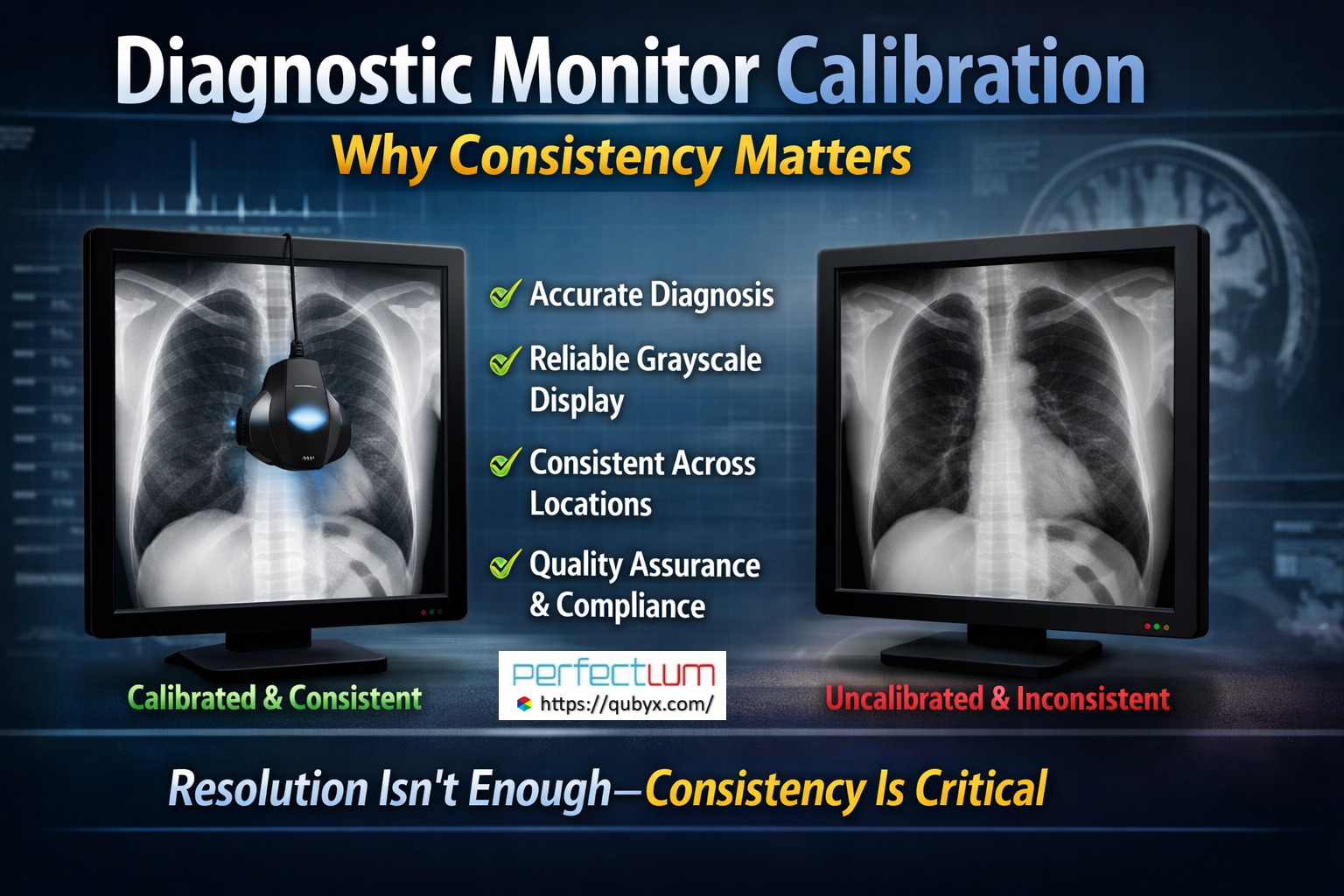
Diagnostic monitor calibration is not merely a technical adjustment—it is a foundational quality assurance practice. While resolution determines how much detail a display can show, calibration determines how reliably that detail is presented over time, across devices, and between readers. In clinical practice, consistency matters more than raw pixel density.
This article explores why diagnostic monitor calibration is critical, how it differs from resolution-focused thinking, and why consistency is the true driver of diagnostic confidence, accuracy, and governance.
What Is Diagnostic Monitor Calibration?
Diagnostic monitor calibration is the process of adjusting and verifying a medical display so that it presents images according to defined standards, most commonly the DICOM Grayscale Standard Display Function (GSDF). The goal is to ensure that luminance response, grayscale behavior, contrast, and overall brightness are predictable and repeatable.
At its core, diagnostic monitor calibration ensures that:
-
A grayscale value corresponds to the same perceived brightness
-
Subtle image details are neither lost nor exaggerated
-
Displays behave consistently across time and locations
-
Diagnostic intent is preserved from acquisition to interpretation
Unlike basic monitor setup, diagnostic monitor calibration is an ongoing process, not a one-time task.
Resolution vs. Consistency: Understanding the Difference
Resolution defines how many pixels a monitor can display. Consistency defines how those pixels behave.
A 6MP or 8MP diagnostic monitor without proper diagnostic monitor calibration can still present misleading images. Conversely, a lower-resolution display that is well calibrated can offer far more reliable diagnostic performance.
Key distinctions include:
| Aspect | Resolution | Diagnostic Monitor Calibration |
|---|---|---|
| Focus | Pixel count | Luminance & grayscale accuracy |
| Stability | Static | Degrades over time |
| Impact | Detail capacity | Diagnostic reliability |
| Risk without control | Limited | High |
This comparison highlights why diagnostic monitor calibration directly influences diagnostic outcomes, while resolution alone does not.
Why Consistency Is Critical in Diagnostic Imaging
1. Human Visual Perception
Radiologists rely on subtle grayscale differences to detect pathology. Human vision is highly sensitive to luminance changes but also highly adaptable. Without diagnostic monitor calibration, displays drift, causing the same image to appear differently from day to day.
Consistency ensures that visual perception remains stable, reducing cognitive load and interpretation variability.
2. Multi-Reader and Multi-Site Environments
Modern imaging workflows are distributed. Images are interpreted by multiple readers across hospitals, clinics, and home workstations. Without standardized diagnostic monitor calibration, the same study may appear differently on different screens.
This inconsistency can lead to:
-
Reader disagreement
-
Unnecessary follow-up studies
-
Reduced confidence in shared diagnoses
Diagnostic monitor calibration aligns displays so that interpretation is consistent regardless of location.
3. Temporal Stability and Monitor Aging
All displays age. Luminance decreases, contrast shifts, and grayscale response drifts. High resolution does not prevent this degradation.
Only continuous calibration and verification can detect and correct these changes before they affect diagnostic quality.
Diagnostic Monitor Calibration in Clinical Governance
Regulatory and Audit Expectations
Healthcare organizations increasingly require demonstrable control over diagnostic environments. Diagnostic monitor calibration supports:
-
Internal quality policies
-
Accreditation requirements
-
Audit readiness
-
Risk management frameworks
Calibration records provide evidence that image presentation is controlled, repeatable, and aligned with clinical standards.
Quality Assurance vs. One-Time Calibration
True diagnostic monitor calibration is part of a broader quality assurance (QA) strategy. This includes:
-
Baseline calibration
-
Scheduled recalibration
-
Ongoing verification
-
Centralized reporting
Without QA, calibration becomes reactive and inconsistent—defeating its purpose.
Why Resolution Alone Fails to Protect Diagnostic Quality
High-resolution monitors are often marketed as a solution to diagnostic accuracy. However, resolution cannot compensate for:
-
Incorrect luminance levels
-
Nonlinear grayscale response
-
Inconsistent contrast perception
-
Environmental lighting effects
Without it, even the highest-resolution display can distort clinical meaning.
Consistency ensures that what the radiologist sees today matches what they saw yesterday—and what their colleague sees tomorrow.
Diagnostic Monitor Calibration in Teleradiology
Teleradiology magnifies the importance of diagnostic monitor calibration. Remote reading environments introduce variables such as:
-
Different monitor models
-
Uncontrolled lighting
-
Inconsistent calibration practices
In these settings, calibration is the only reliable mechanism to enforce consistency. It transforms remote reading from a best-effort activity into a governed clinical process.
Environmental Factors and Calibration
Room lighting, reflections, and ambient conditions all influence perceived image quality. It accounts for these variables by:
-
Establishing appropriate luminance targets
-
Ensuring grayscale visibility under real-world conditions
-
Maintaining contrast performance
Without calibration, environmental changes silently undermine diagnostic reliability.
Operational Benefits of Diagnostic Monitor Calibration
Beyond clinical accuracy, diagnostic monitor calibration delivers operational value:
-
Reduced repeat reads
-
Fewer diagnostic disputes
-
Improved reader confidence
-
Lower compliance risk
-
Predictable display performance
These benefits scale significantly in enterprise and networked imaging environments.
Common Myths About Diagnostic Monitor Calibration
“High-resolution monitors don’t need calibration”
False. Resolution does not prevent luminance drift or grayscale distortion.
“Calibration is a one-time setup”
False. Diagnostic monitor calibration must be maintained continuously.
“Visual checks are sufficient”
False. Human perception adapts; objective measurement is essential.
Building a Sustainable Calibration Strategy
An effective diagnostic monitor calibration strategy includes:
-
Defined calibration standards (e.g., DICOM GSDF)
-
Scheduled recalibration intervals
-
Continuous verification and alerts
-
Centralized documentation and reporting
This approach ensures consistency without disrupting clinical workflows.
The Future of Diagnostic Monitor Calibration
As imaging volumes grow and AI-assisted diagnostics expand, consistency becomes even more critical. Algorithms trained on calibrated data assume consistent image presentation. Without it, AI outputs may become unreliable.
Future-ready imaging organizations treat calibration as infrastructure, not maintenance.
Conclusion
Resolution may impress, but consistency protects. In diagnostic imaging, reliability outweighs raw technical specifications. Diagnostic monitor calibration ensures that every image is presented as intended—accurately, consistently, and defensibly.
By prioritizing diagnostic monitor calibration over resolution alone, healthcare organizations safeguard diagnostic quality, support clinical confidence, and build resilient imaging workflows suited for modern, distributed care environments.
Start the conversation with our calibration experts today.
In a world where every Pixel accuracy matters, PerfectLum by QUBYX proves that innovation can deliver clinical precision without financial compromise. It’s not just calibration—it’s the democratization of diagnostic imaging.
PerfectLum is Medical Display Calibration & QA Software by QUBYX LLC delivers consistent, audit-ready display performance through standardized calibration, verification, and centralized quality assurance for radiology and teleradiology environments.
Tags:
diagnostic monitor calibration, medical display calibration, radiology monitor calibration, diagnostic display consistency, DICOM GSDF calibration, diagnostic imaging quality assurance
About the Author:
Shamsul Islam is a strategy and growth professional focused on regulated B2B technology markets. He supports QUBYX LLC and its medical imaging solutions through product positioning, go-to-market strategy, and end-to-end digital content development, including website, social media, and educational video initiatives aligned with quality, compliance, and governance-driven environments.