
News
- Home
- Diagnostic Imaging Center Cut Display Costs by PerfectLum
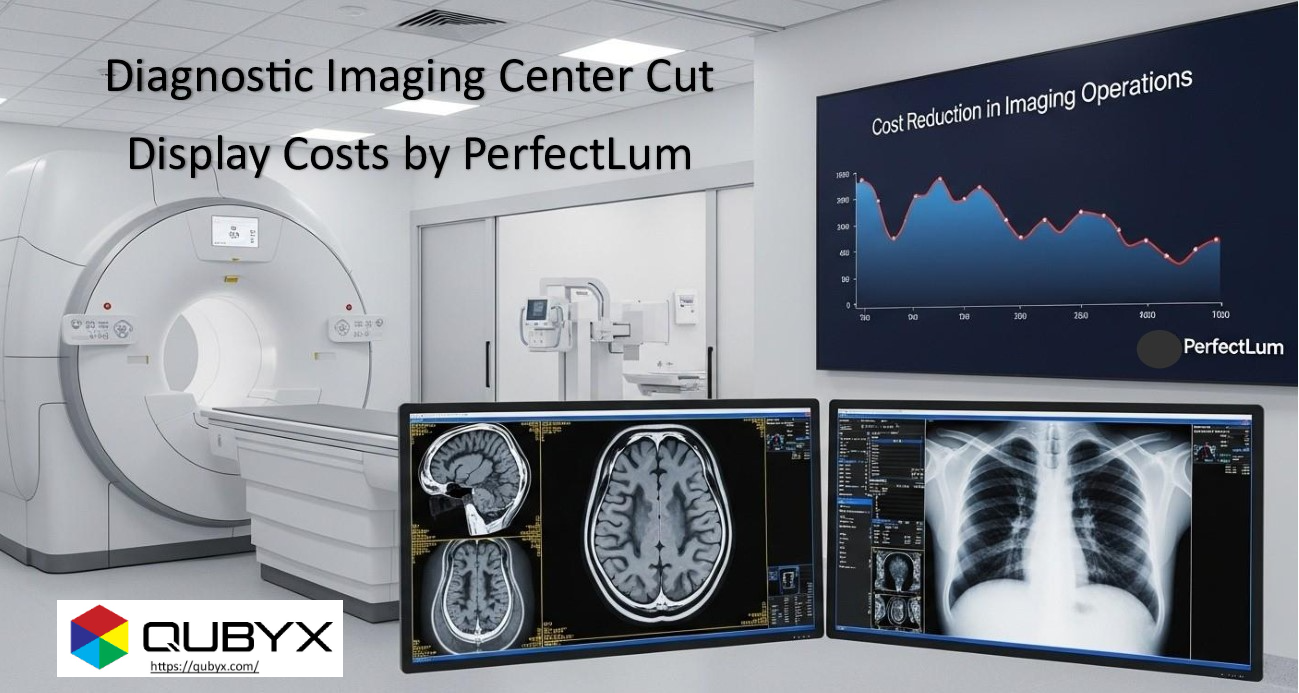
Diagnostic Imaging Center Cut Display Costs by PerfectLum
- October 31, 2025
- QUBYX Team
Optimizing OPEX | A Case Study on How PerfectLum Lowered Display Costs for a Diagnostic Imaging Center
Introduction
For any Diagnostic Imaging Center, image accuracy is everything. From MRI and CT scans to X-rays and mammography, radiologists rely on medical displays that present every shade and detail correctly. But maintaining this level of precision across dozens—or even hundreds—of workstations can quickly inflate operational expenditure (OPEX).
This case study explores how one mid-sized Diagnostic Imaging Center optimized its OPEX and achieved long-term sustainability by adopting PerfectLum, the software-based calibration and quality assurance (QA) solution from QUBYX. The transformation not only reduced calibration-related costs by nearly 40%, but also improved compliance with international standards such as DICOM Part 14, AAPM TG18, and DIN 6868-157.
The Challenge: Rising OPEX in Display Calibration
Like most modern imaging facilities, the client center operated over 60 diagnostic workstations, including both high-end diagnostic monitors and review displays. The main pain points were:
-
High recurring hardware costs: The center relied on hardware-locked calibration kits, often tied to specific monitor brands. Each required a proprietary colorimeter and license renewal.
-
Inconsistent image quality: Despite regular maintenance, deviations between displays created subtle but clinically significant differences in grayscale accuracy.
-
Manual QA processes: Physical calibration rounds required technicians to travel between departments—radiology, cardiology, and nuclear medicine—leading to wasted man-hours.
-
Regulatory risk: Compliance audits under AAPM TG18 and DIN 6868-157 demanded precise documentation of QA logs. Manual records were prone to human error.
As the director noted, “We were spending more on maintaining displays than on upgrading them. Calibration had turned into an OPEX trap.”
The Solution: PerfectLum by QUBYX
PerfectLum provided an all-in-one answer to these challenges. Unlike hardware-restricted systems, PerfectLum is a vendor-neutral software solution designed for both medical and professional displays. It brings advanced DICOM GSDF calibration, automated QA, and centralized management to every workstation—whether in the hospital or a remote home-reading setup.
Key features implemented at the Diagnostic Imaging Center included:
-
Centralized QA Server: IT managers could remotely monitor all workstations, schedule automatic QA checks, and flag non-compliant displays.
-
Automated DICOM Calibration: Displays were calibrated to DICOM Part 14 GSDF with delta-E accuracy below 1.
-
Multi-Vendor Compatibility: PerfectLum worked seamlessly with monitors from Barco, EIZO, NEC, and Dell—eliminating hardware vendor lock-in.
-
Comprehensive Audit Trails: Every calibration and QA result was automatically logged for compliance with AAPM TG270 and DIN 6868-157.
-
Cross-Platform Flexibility: The software ran equally well on Windows and macOS, simplifying deployment across hybrid environments.
Implementation Phase
The rollout was executed in three stages:
1. Assessment & Benchmarking
The QUBYX technical team conducted a baseline assessment of all diagnostic and review monitors. Using PerfectLum’s built-in QA tools, they documented the luminance uniformity, grayscale response, and delta-E deviations for each display.
2. Deployment & Calibration
PerfectLum was deployed on all 60 workstations. Displays were calibrated automatically using existing colorimeters, ensuring GSDF compliance within two hours—far faster than the manual method, which took days.
3. Training & Remote QA Setup
Radiology staff and IT administrators were trained to schedule periodic QA checks through the PerfectLum Remote QA Server. The software’s intuitive dashboard allowed instant visualization of compliance status across all devices.
The Results: Quantifiable OPEX Optimization
Within three months, the Diagnostic Imaging Center observed substantial improvements in both cost efficiency and image quality.
1. 40% Reduction in Calibration OPEX
-
The elimination of proprietary licenses and external service contracts resulted in annual savings exceeding $25,000.
-
PerfectLum’s perpetual software licensing model converted recurring CAPEX replacements into manageable Smart-OPEX—a sustainable financial shift.
2. 75% Faster QA Cycles
-
Remote automation reduced QA time per workstation from 30 minutes to under 8 minutes.
-
IT staff could schedule QA tasks overnight, minimizing downtime during clinical hours.
3. Improved Image Consistency
-
The DICOM GSDF compliance level improved from 88% to 99.5%.
-
Radiologists reported more uniform grayscale perception, especially critical for subtle findings in mammography and neurology cases.
4. Seamless Regulatory Compliance
-
Automated audit logs ensured complete documentation for DIN 6868-157 and AAPM TG270 audits.
-
The QA Server provided detailed reports suitable for hospital accreditation bodies and external regulators.
Cost Breakdown: Before and After PerfectLum
| Expense Category | Before (Annual) | After PerfectLum (Annual) | Savings |
|---|---|---|---|
| Hardware Calibration Tools | $14,000 | $3,000 | 79% |
| Vendor-Specific Licenses | $8,500 | $0 | 100% |
| Technician Labor (QA Rounds) | $12,000 | $5,000 | 58% |
| Downtime During QA | $6,000 | $1,500 | 75% |
| Total | $40,500 | $9,500 | $31,000 (≈ 76%) |
The diagnostic imaging facility redirected these savings toward expanding its PACS storage and upgrading two legacy monitors to 12-MP units—demonstrating how OPEX optimization can directly enhance diagnostic capability.
Staff Perspective: User Experience and Workflow Impact
Radiologists and technicians alike praised the simplicity of PerfectLum’s interface. The on-screen calibration assistant guided users through DICOM compliance checks with clear progress indicators. Notifications for “Calibration Due” or “QA Failed” allowed proactive issue resolution.
A senior radiologist commented:
“PerfectLum gave us peace of mind. We no longer worry about drift or compliance gaps. Every display feels the same—whether in the main reading room or at a home workstation.”
The IT manager added:
“What impressed us most was central control. I can see which displays need recalibration without leaving my desk. It’s like having a fleet management system for monitors.”
Broader Implications: Sustainability and Scalability
The success of this Diagnostic Imaging Center illustrates how software-based calibration can redefine medical display maintenance across the healthcare industry.
-
Environmental Benefits: By reducing dependence on hardware devices and replacement kits, the center cut down on electronic waste and shipping emissions.
-
Scalability: PerfectLum can be deployed to hundreds of displays using the same server infrastructure—ideal for multi-facility hospital networks.
-
Hybrid Work Support: As teleradiology expands, PerfectLum ensures remote radiologists maintain the same QA standards as on-site teams.
The QUBYX Advantage
Behind PerfectLum stands QUBYX, a company known for its imaging science expertise and commitment to open, standards-based solutions. From DICOM GSDF algorithms to ICC profile management in QUBYX OS Tools, the company continues to push the boundaries of software-driven quality assurance.
PerfectLum is more than a calibration tool—it’s a strategic OPEX optimizer for any healthcare facility that values accuracy, compliance, and long-term cost control.
Conclusion
The transition from hardware-locked calibration to PerfectLum software transformed the way this Diagnostic Imaging Center managed display quality. It reduced OPEX, increased QA efficiency, and reinforced diagnostic confidence.
As healthcare organizations worldwide seek smarter, leaner operational models, this case proves a powerful truth: when precision meets software intelligence, cost efficiency follows.
In a world where every pixel matters, PerfectLum proves that innovation can deliver clinical precision without financial compromise. It’s not just calibration—it’s the democratization of diagnostic imaging.
To secure Medical Display Calibration with precision while reducing the recurring costs of proprietary hardware, the answer is clear: transition to a Calibration Software platform like QUBYX OS Tools (Free) and PerfectLum today. Now, you easily pay less for Radiology.
Tags:
Diagnostic Imaging Center, PerfectLum software, medical display calibration, QA compliance, OPEX optimization, DICOM GSDF, software-based calibration, QUBYX solutions, hospital QA software, medical imaging cost reduction, remote QA server, TG18 compliance, DIN 6868-157.
Related Posts
- April 12, 2026
- News
- April 8, 2026
- News
- April 6, 2026
- News