
News
- Home
- Calibration vs Quality Assurance | Why Calibration Alone Fails
Calibration vs Quality Assurance | Why Calibration Alone Fails
- February 1, 2026
- QUBYX Team
Calibration vs Quality Assurance | Why Calibration Alone Fails
Why Calibration Alone Is Not Quality Assurance
The debate around calibration vs quality assurance is one of the most misunderstood topics in medical imaging, radiology, and other regulated visual environments. Many organizations still assume that once a display is calibrated, quality is assured. In reality, calibration alone addresses only a small portion of what true quality assurance requires.
Understanding the difference between calibration vs quality assurance is essential for organizations that depend on consistent, defensible image interpretation. This article explains why calibration is necessary—but insufficient—and why quality assurance must be treated as an ongoing, system-level process rather than a one-time technical task.
Understanding Calibration in Imaging Environments
Calibration refers to the technical process of adjusting a display so that it conforms to a defined target—such as luminance, grayscale response, or color characteristics. In radiology, calibration ensures that monitors initially meet standards required for diagnostic viewing.
However, in the broader discussion of calibration vs quality assurance, calibration represents only a starting point. It answers one question:
| Is the display set correctly right now?
Calibration does not answer whether the display will remain compliant, whether it behaves consistently across locations, or whether deviations are detected and documented over time.
What Quality Assurance Actually Means
Quality assurance (QA) is a continuous framework designed to ensure consistent performance, traceability, and accountability. When examining calibration vs quality assurance, QA extends far beyond technical adjustment and includes:
-
Ongoing verification of display performance
-
Drift detection and trend analysis
-
Automated monitoring across sites and users
-
Centralized reporting and audit trails
-
Governance and compliance readiness
Quality assurance answers a very different question:
| Can this organization prove sustained image consistency over time?
This distinction is why calibration vs quality assurance is not a matter of preference, but of operational maturity.
Why Calibration Alone Creates Hidden Risk
Organizations that rely solely on calibration often believe they are managing quality, when in fact they are managing configuration, not assurance. This misunderstanding is at the heart of the calibration vs quality assurance problem.
Key risks of calibration-only approaches include:
1. Undetected Display Drift
Displays naturally drift due to aging panels, environmental conditions, and usage patterns. Without QA monitoring, drift remains invisible until diagnostic confidence is compromised.
2. No Proof of Ongoing Compliance
Calibration produces a point-in-time result. Quality assurance produces evidence. In audit-driven environments, the absence of longitudinal data is a serious vulnerability.
3. Inconsistent Performance Across Sites
Distributed radiology and teleradiology networks require uniform image presentation. Calibration alone cannot enforce or verify consistency at scale—highlighting the real-world impact of calibration vs quality assurance.
Calibration vs Quality Assurance in Regulated Environments
In regulated imaging workflows, the difference between calibration vs quality assurance directly affects compliance, risk exposure, and clinical defensibility.
Regulators and accreditation bodies increasingly expect organizations to demonstrate:
-
Repeatable QA processes
-
Historical performance records
-
Proactive issue detection
-
Controlled remediation workflows
Calibration does not satisfy these expectations on its own. Quality assurance does.
This is why modern imaging governance frameworks treat calibration as a component of QA—not a substitute for it.
The Operational Gap Between Calibration and QA
Another key issue in the calibration vs quality assurance discussion is operational scalability. Manual calibration processes do not scale well across:
-
Large hospital systems
-
Multi-site imaging networks
-
Remote reading environments
-
High-volume diagnostic operations
Quality assurance systems are designed to scale by automating verification, centralizing oversight, and reducing human dependency. Without QA, calibration becomes fragmented, inconsistent, and difficult to manage.
Why Quality Assurance Is a Governance Function
One of the most important insights in the calibration vs quality assurance debate is that QA is not just technical—it is organizational.
Quality assurance supports:
-
Clinical governance
-
Risk management
-
IT and imaging leadership
-
Regulatory readiness
Calibration is performed on displays. Quality assurance is performed across an organization.
This shift—from device-level adjustment to system-level governance—is what separates mature imaging organizations from reactive ones.
The Role of Purpose-Built QA Software
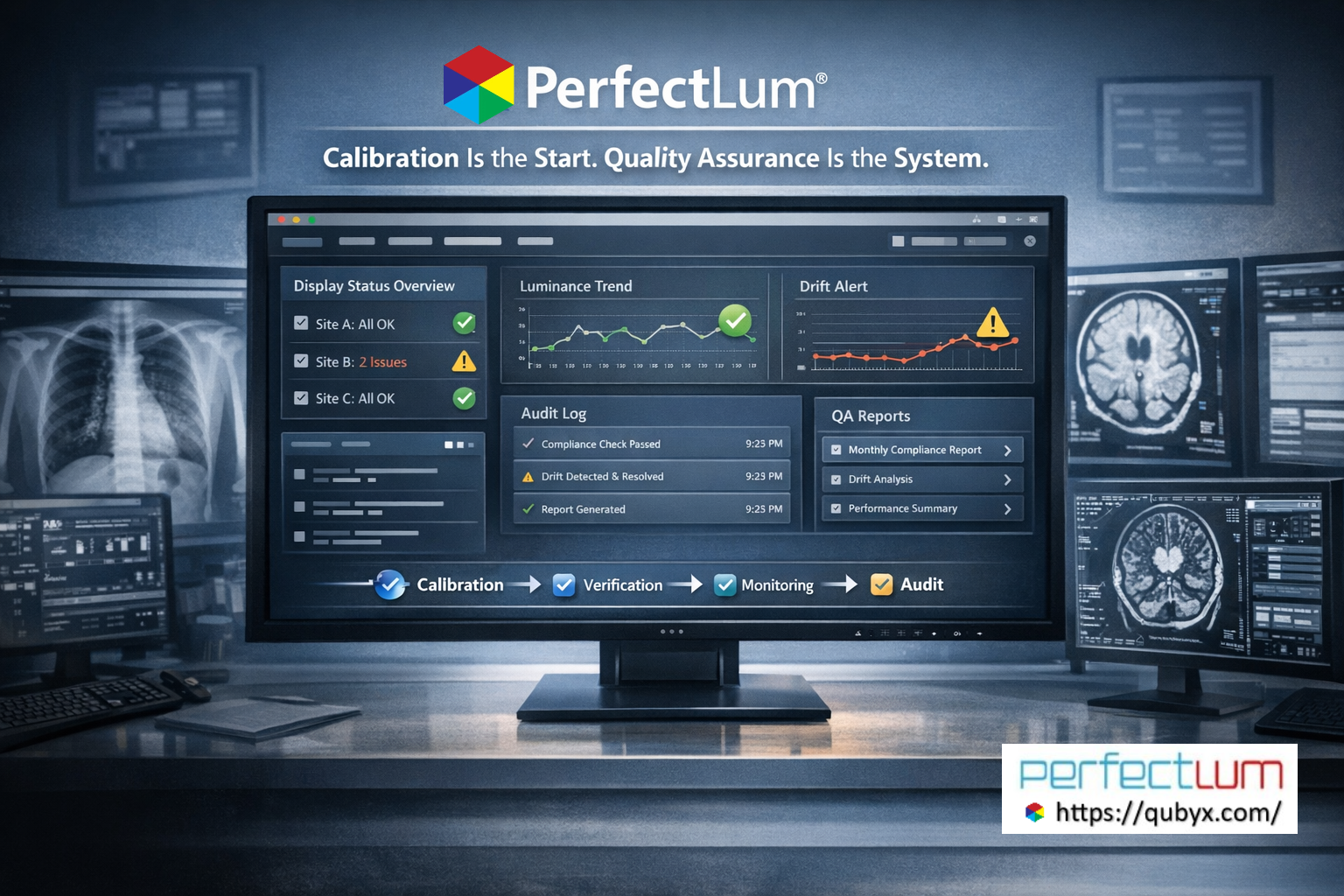
Modern imaging environments increasingly rely on purpose-built platforms to bridge the gap between calibration vs quality assurance. These systems integrate calibration, verification, monitoring, and reporting into a unified QA framework.
For example, QUBYX developed PerfectLum specifically to address this gap—treating calibration as one controlled step within a broader quality assurance lifecycle.
Such platforms are designed not just to adjust displays, but to prove consistency, detect drift, and support audit-ready imaging operations.
Calibration vs Quality Assurance: A Practical Comparison
| Aspect | Calibration | Quality Assurance |
|---|---|---|
| Scope | Single display | Entire imaging environment |
| Timing | Point-in-time | Continuous |
| Drift Detection | No | Yes |
| Audit Evidence | Limited | Comprehensive |
| Scalability | Poor | High |
| Governance Support | No | Yes |
This comparison makes the calibration vs quality assurance distinction unmistakable: calibration is necessary, but QA is essential.
Why This Distinction Matters More Than Ever
As radiology becomes more distributed and imaging volumes increase, the consequences of misunderstanding calibration vs quality assurance grow more severe. Diagnostic confidence depends on consistent image presentation—not just on initial setup.
Organizations that continue to equate calibration with QA expose themselves to:
-
Diagnostic variability
-
Regulatory risk
-
Operational blind spots
-
Loss of clinical trust
By contrast, organizations that invest in true quality assurance frameworks gain visibility, control, and defensibility.
Importance of PerfectLum Developed by QUBYX
In the context of calibration vs quality assurance, the importance of PerfectLum, developed by QUBYX, lies in how it operationalizes quality assurance as a continuous, defensible process rather than a one-time calibration event. PerfectLum is designed specifically for regulated medical imaging environments where organizations must prove—not assume—diagnostic display consistency. By combining calibration, automated verification, drift detection, centralized reporting, and long-term performance tracking, PerfectLum closes the critical gap exposed in the calibration vs quality assurance debate. It transforms calibration into a controlled input within a broader QA framework, enabling imaging organizations to demonstrate sustained compliance, manage risk proactively, and maintain diagnostic confidence across distributed and high-volume reading environments.
Final Perspective: Calibration Is a Tool—QA Is a Strategy
The most important takeaway from the calibration vs quality assurance discussion is this:
Calibration is a technical task.
Quality assurance is a strategic discipline.
Calibration adjusts displays. Quality assurance protects outcomes.
For any organization serious about diagnostic consistency, audit readiness, and long-term imaging quality, calibration alone is not enough—and never has been.
The distinction between calibration vs quality assurance is no longer theoretical—it is operationally decisive. Calibration remains a necessary technical step, but on its own it cannot deliver consistency, accountability, or regulatory confidence. True quality assurance requires continuous verification, historical traceability, and governance-level oversight.
This is precisely where solutions like PerfectLum developed by QUBYX become critical. By embedding calibration within a comprehensive quality assurance system, PerfectLum enables organizations to move beyond point-in-time adjustments toward measurable, auditable, and defensible imaging quality. In modern radiology and teleradiology environments, calibration is a tool—but quality assurance, supported by platforms like PerfectLum, is the strategy that protects diagnostic integrity over time.
Start the conversation with our calibration experts today.
In a world where every Pixel accuracy matters, PerfectLum by QUBYX proves that innovation can deliver clinical precision without financial compromise. It’s not just calibration—it’s the democratization of diagnostic imaging.
PerfectLum is Medical Display Calibration & QA Software by QUBYX LLC delivers consistent, audit-ready display performance through standardized calibration, verification, and centralized quality assurance for radiology and teleradiology environments.
Tags:
calibration vs quality assurance, display quality assurance, medical display calibration, imaging QA, radiology quality assurance, audit-ready imaging, diagnostic consistency, PerfectLum, QUBYX, QUBYX LLC, PerfectLum Developed by QUBYX LLC,
About the Author:
Shamsul Islam is a strategy and growth professional focused on regulated B2B technology markets. He supports QUBYX LLC and its medical imaging solutions through product positioning, go-to-market strategy, and end-to-end digital content development, including website, social media, and educational video initiatives aligned with quality, compliance, and governance-driven environments.
Related Posts


- April 12, 2026
- News

- April 8, 2026
- News

- April 6, 2026
- News