
News
- Home
- Barten Curve Calibration in Medical Imaging | Perceptual Display Accuracy
Barten Curve Calibration in Medical Imaging | Perceptual Display Accuracy
- February 7, 2026
- QUBYX Team
Barten Curve Calibration | The Foundation of Perceptual Accuracy in Medical Imaging
Introduction: Why Barten Curve Calibration Matters
In medical imaging, diagnostic confidence depends not only on image acquisition but also on how images are displayed to the human eye. Displays that fail to match human visual perception can distort contrast, obscure pathology, or exaggerate noise. This is where Barten Curve calibration plays a critical role.
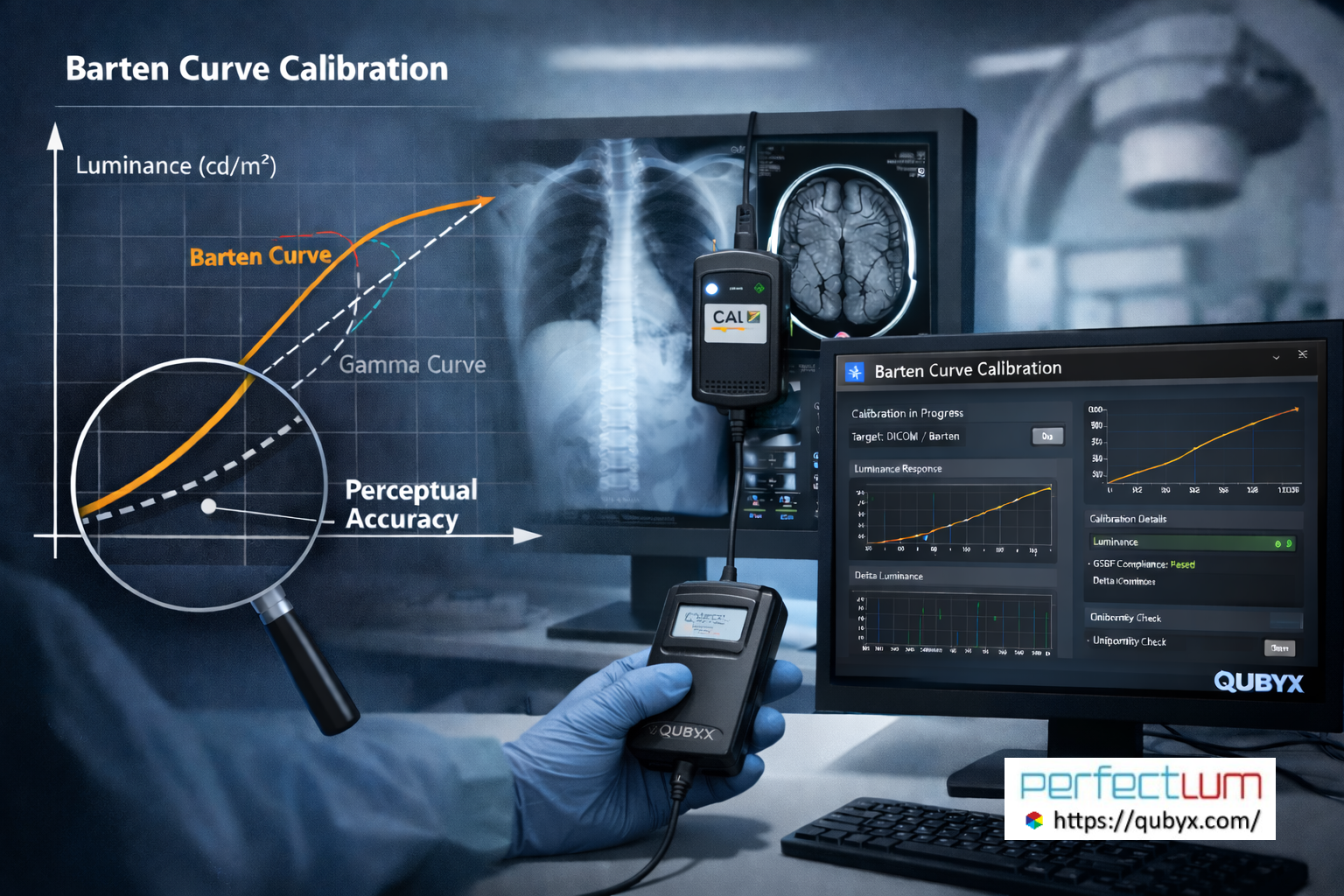
Barten Curve calibration is a perceptual display calibration methodology derived from human contrast sensitivity modeling. It ensures that luminance steps between gray levels are visually uniform, allowing radiologists and clinicians to perceive subtle differences in medical images with consistency and reliability.
As imaging workflows expand across hospitals, teleradiology networks, and remote reading environments, Barten Curve calibration has become a cornerstone of advanced display quality assurance.
Understanding the Barten Curve
The Barten Curve originates from the work of Peter Barten, who developed a contrast sensitivity function (CSF) describing how the human visual system perceives luminance differences under varying conditions.
Unlike purely mathematical gamma curves, the Barten model accounts for:
-
Human contrast sensitivity
-
Ambient luminance influence
-
Visual noise and threshold perception
-
Spatial frequency response
Barten Curve calibration applies this perceptual model to display luminance response, aligning digital gray values with what the human eye can actually detect.
Barten Curve Calibration vs Traditional Gamma Calibration
Traditional gamma calibration focuses on electrical signal response rather than visual perception. While suitable for consumer displays, it falls short in clinical environments.
Key differences include:
| Aspect | Gamma Calibration | Barten Curve Calibration |
|---|---|---|
| Basis | Electrical response | Human visual perception |
| Medical relevance | Limited | High |
| Contrast uniformity | Inconsistent | Perceptually linear |
| Diagnostic reliability | Variable | Optimized |
Barten Curve calibration ensures that each grayscale step is equally perceptible, reducing the risk of missed diagnostic details.
Relationship Between Barten Curve and DICOM GSDF
In medical imaging, DICOM GSDF (Grayscale Standard Display Function) is the regulatory benchmark. Importantly, DICOM GSDF itself is mathematically derived from the Barten contrast sensitivity model.
This means:
-
Barten Curve calibration is the perceptual foundation
-
DICOM GSDF is the clinical standardization layer
When implemented correctly, Barten Curve calibration ensures displays conform to GSDF with true perceptual accuracy rather than superficial compliance.
Clinical Importance of Barten Curve Calibration
Accurate implementation of Barten Curve calibration directly impacts:
-
Detection of low-contrast lesions
-
Consistent grayscale rendering across workstations
-
Reduced visual fatigue for radiologists
-
Audit-ready display performance
In high-risk modalities such as mammography, CT, and MRI, even minor luminance inconsistencies can influence diagnostic outcomes. Barten Curve calibration minimizes these risks by aligning display behavior with human vision.
Challenges in Implementing Barten Curve Calibration
Despite its importance, implementing Barten correctly is not trivial. Common challenges include:
-
Inaccurate luminance measurement
-
Poor ambient light compensation
-
Lack of continuous verification
-
Calibration drift over time
Without a robust QA system, displays may initially meet perceptual targets but silently degrade, undermining long-term reliability.
The Role of PerfectLum Developed by QUBYX
PerfectLum plays a critical role in translating Barten Curve calibration theory into practical, defensible clinical workflows.
PerfectLum is engineered to:
-
Implement perceptual calibration aligned with Barten-based models
-
Validate and maintain DICOM GSDF compliance
-
Measure and correct luminance response using certified sensors
-
Track calibration history for audits and regulatory reviews
By embedding Barten Curve calibration into an automated quality assurance framework, PerfectLum ensures that perceptual accuracy is not a one-time event but a continuously maintained standard.
Barten Curve Calibration in Remote and Distributed Environments
Modern imaging increasingly relies on distributed reading environments. In these settings, Barten Curve calibration becomes even more critical.
PerfectLum supports:
-
Centralized calibration policies
-
Remote verification of luminance response
-
Consistent perceptual performance across locations
This ensures that a radiologist reading remotely sees the same perceptual contrast as one working on-site.
Barten Curve Calibration as Part of Display Quality Assurance
It is important to distinguish calibration from quality assurance.
-
Calibration sets the initial perceptual response
-
Quality assurance ensures it remains correct over time
Barten Curve calibration is most effective when integrated into a broader QA strategy that includes:
-
Scheduled consistency checks
-
Drift detection
-
Automated alerts
-
Compliance reporting
PerfectLum is designed to support this full lifecycle approach.
Regulatory and Audit Considerations
Regulatory bodies and accreditation programs increasingly expect:
-
Evidence of perceptual calibration
-
Traceable luminance measurements
-
Documented compliance with GSDF
Because DICOM GSDF is rooted in Barten’s perceptual model, it is directly relevant to audit readiness. PerfectLum provides structured reports that demonstrate ongoing compliance, not just initial setup.
Future of Barten Curve Calibration
As display technologies evolve (OLED, HDR, high-luminance panels), the importance of perceptual models will increase. It remains adaptable because it is based on human vision, not hardware limitations.
Future developments will likely include:
-
Adaptive calibration based on viewing conditions
-
AI-assisted perceptual optimization
-
Deeper integration into enterprise QA platforms
Conclusion
Barten Curve calibration is not an abstract theoretical concept—it is the perceptual foundation of reliable medical image display. By aligning luminance response with human visual sensitivity, it ensures consistent, diagnostically meaningful image presentation.
When implemented within a structured QA framework, it supports clinical accuracy, regulatory compliance, and long-term display performance. PerfectLum developed by QUBYX enables organizations to operationalize Barten-based calibration with precision, traceability, and confidence—making perceptual accuracy a sustained standard rather than a best-effort goal.
Start the conversation with our calibration experts today.
In a world where every Pixel accuracy matters, PerfectLum by QUBYX proves that innovation can deliver clinical precision without financial compromise. It’s not just calibration—it’s the democratization of diagnostic imaging.
PerfectLum is Medical Display Calibration & QA Software by QUBYX LLC that delivers consistent, audit-ready display performance through standardized calibration, verification, and centralized quality assurance for radiology and teleradiology environments.
Tags:
Barten Curve calibration, perceptual linearization, medical display calibration, DICOM GSDF vs Barten curve, luminance response calibration, display quality assurance, PerfectLum QUBYX
About the Author:
Shamsul Islam is a strategy and growth professional focused on regulated B2B technology markets. He supports QUBYX LLC and its medical imaging solutions through product positioning, go-to-market strategy, and end-to-end digital content development, including website, social media, and educational video initiatives aligned with quality, compliance, and governance-driven environments.
Related Posts


- April 12, 2026
- News

- April 8, 2026
- News

- April 6, 2026
- News