
News
- Home
- AAPM TG-270 Acceptance Test with PerfectLum Guide
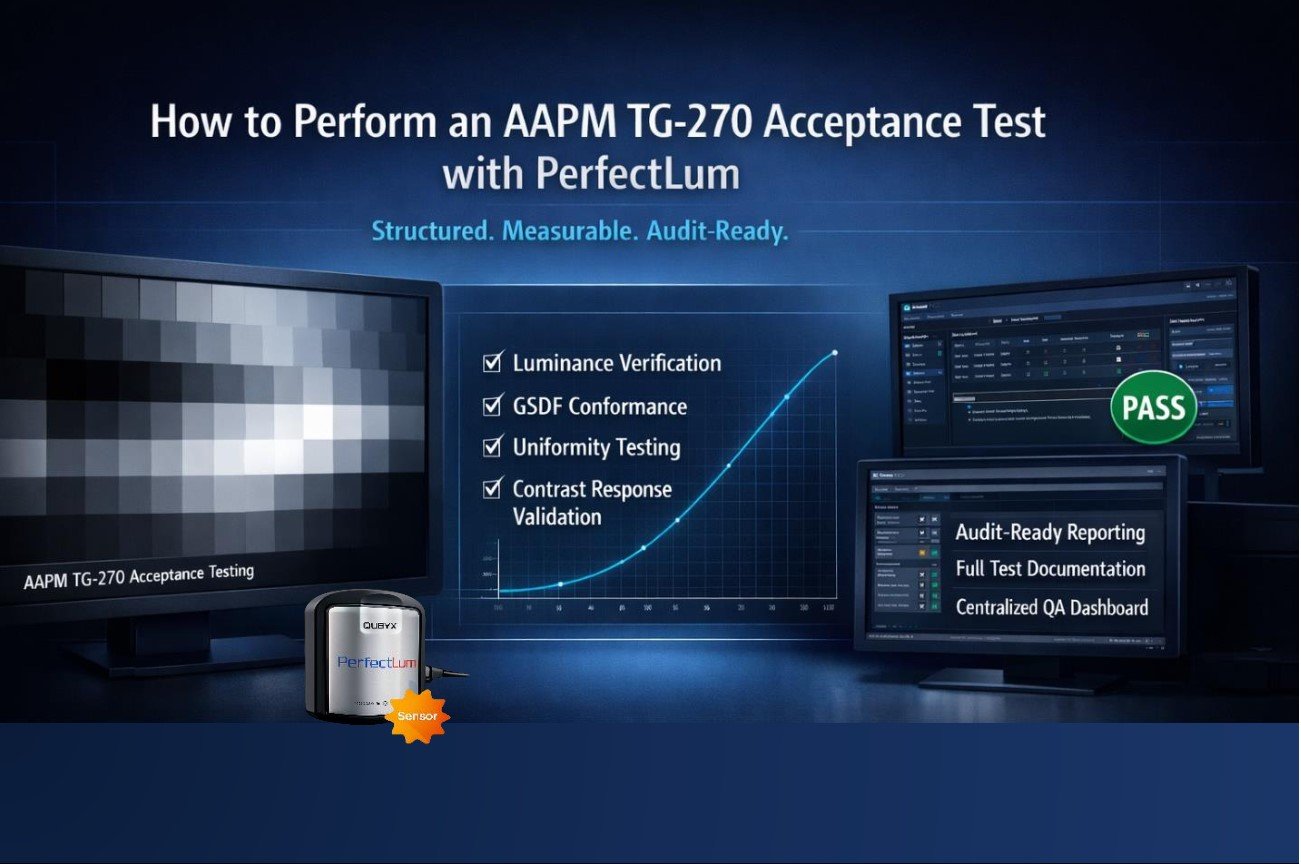
AAPM TG-270 Acceptance Test with PerfectLum Guide
- February 26, 2026
- QUBYX Team
How to Perform an AAPM TG-270 Acceptance Test with PerfectLum
Introduction
An AAPM TG-270 acceptance test is the formal verification process that ensures a medical imaging display meets performance requirements before clinical use. Acceptance testing validates luminance response, contrast behavior, uniformity, and DICOM GSDF conformance according to professional quality standards defined by the American Association of Physicists in Medicine.
Using PerfectLum developed by QUBYX, healthcare institutions can perform a structured, measurable, and audit-ready AAPM TG-270 acceptance test that aligns with DICOM Part 14 GSDF and regulatory compliance requirements.
This guide explains how to perform an AAPM TG-270 acceptance test step by step using PerfectLum.
What Is an AAPM TG-270 Acceptance Test?
The AAPM TG-270 report provides updated recommendations for:
-
Acceptance testing of medical displays
-
Ongoing performance verification
-
Luminance and contrast response evaluation
-
Documentation and quality control workflows
An AAPM TG-270 acceptance test is typically performed:
-
After new monitor installation
-
Following display replacement
-
After major hardware servicing
-
During system commissioning
The objective is to confirm that the display meets defined performance criteria before diagnostic use.
Why Use PerfectLum for AAPM TG-270 Acceptance Testing?
PerfectLum is purpose-built for medical display quality assurance. It enables:
-
Automated DICOM GSDF calibration
-
Luminance response measurement
-
Uniformity testing
-
Ambient light compensation
-
Comprehensive audit-ready reporting
-
Centralized QA dashboard (for multi-site networks)
For hospitals, teleradiology providers, PACS administrators, and OEM partners, PerfectLum transforms the AAPM TG-270 acceptance test from a manual process into a structured compliance workflow.
Step-by-Step: How to Perform an AAPM TG-270 Acceptance Test with PerfectLum
Step 1: Prepare the Environment
Before starting the AAPM TG-270 acceptance test:
-
Stabilize the display (warm-up time: typically 30–60 minutes)
-
Control ambient lighting conditions
-
Clean the display surface
-
Connect a calibrated luminance sensor
Ensure the display is in its factory diagnostic mode or neutral preset.
Step 2: Identify the Display in PerfectLum
Launch PerfectLum and:
-
Register the monitor in the QA database
-
Assign device location and modality type
-
Select applicable testing protocol (Diagnostic / Clinical Review)
This creates traceable documentation from the beginning of the AAPM TG-270 acceptance test.
Step 3: Perform DICOM GSDF Calibration
An AAPM TG-270 acceptance test requires verification of grayscale performance.
Using PerfectLum:
-
Run automatic DICOM GSDF calibration
-
Measure luminance at multiple grayscale levels
-
Adjust LUT to align with DICOM Part 14 GSDF
-
Confirm conformance curve alignment
This ensures perceptual linearization of grayscale response for diagnostic interpretation.
Step 4: Verify Luminance Performance
The AAPM TG-270 acceptance test requires confirmation of:
-
Maximum luminance (Lmax)
-
Minimum luminance (Lmin)
-
Luminance ratio
-
Contrast response
PerfectLum automatically records measurement points and calculates compliance thresholds.
Results are displayed as:
-
Conformance graph
-
Deviation metrics
-
Pass/Fail indicators
Step 5: Conduct Uniformity Testing
Uniformity testing evaluates luminance consistency across the display surface.
Using PerfectLum:
-
Measure multiple screen regions
-
Compare deviations against tolerance limits
-
Document spatial variation
Uniformity failures can significantly impact diagnostic accuracy, making this step critical in the AAPM TG-270 acceptance test.
Step 6: Evaluate Ambient Light Conditions
Ambient light affects perceived contrast. PerfectLum allows:
-
Ambient light measurement
-
Verification against recommended limits
-
Documentation within the QA report
This supports environmental compliance under AAPM TG-270.
Step 7: Generate Audit-Ready Documentation
Documentation is a central requirement of any AAPM TG-270 acceptance test.
PerfectLum automatically generates:
-
Complete measurement logs
-
GSDF conformance graphs
-
Uniformity maps
-
Environmental data
-
Pass/Fail summary
Reports can be exported in PDF format and stored in centralized QA systems for inspection readiness.
Acceptance Criteria Under AAPM TG-270
While institutions define tolerance thresholds, common parameters include:
-
Luminance response within specified deviation
-
Acceptable uniformity variation
-
Verified contrast ratio
-
Proper DICOM GSDF conformance
PerfectLum allows institutions to customize thresholds based on internal policy or regulatory requirements.
Best Practices for TG-270 Acceptance Testing
To ensure defensible compliance:
-
Use calibrated sensors only
-
Maintain consistent environmental conditions
-
Archive all baseline acceptance data
-
Integrate acceptance tests into long-term QA schedules
-
Perform periodic re-verification
Acceptance testing establishes the baseline performance record for future drift comparison.
Benefits of Using PerfectLum for TG-270 Compliance
✔ Automated and standardized workflow
✔ Reduced human error
✔ Centralized QA management
✔ Multi-site reporting capability
✔ OEM-ready lifecycle documentation
✔ Audit and inspection readiness
PerfectLum supports hospitals, imaging centers, and enterprise radiology networks requiring defensible and measurable display quality assurance.
Conclusion
Performing an AAPM TG-270 acceptance test is not merely a regulatory formality — it establishes the technical baseline for diagnostic accuracy and patient safety.
Using PerfectLum by QUBYX, institutions can:
-
Calibrate displays to DICOM GSDF
-
Validate luminance and contrast
-
Perform structured uniformity testing
-
Generate audit-ready documentation
-
Maintain long-term compliance
In medical imaging, precision must be engineered — not assumed.
Start the conversation with our calibration experts today.
In a world where every Pixel accuracy matters, PerfectLum by QUBYX proves that innovation can deliver clinical precision without financial compromise. It’s not just calibration—it’s the democratization of diagnostic imaging.
PerfectLum is Medical Display Calibration & QA Software by QUBYX LLC that delivers consistent, audit-ready display performance through standardized calibration, verification, and centralized quality assurance for radiology and teleradiology environments.
Tags:
AAPM TG-270 acceptance test, PerfectLum, DICOM GSDF calibration, medical display QA, luminance verification, GSDF conformance, radiology display compliance, acceptance testing medical monitors,
Related Posts
- April 12, 2026
- News
- April 8, 2026
- News

- April 6, 2026
- News