
News
- Home
- DICOM Display Calibration in Remote Reporting | QUBYX
DICOM Display Calibration in Remote Reporting | QUBYX
- March 9, 2026
- QUBYX Team
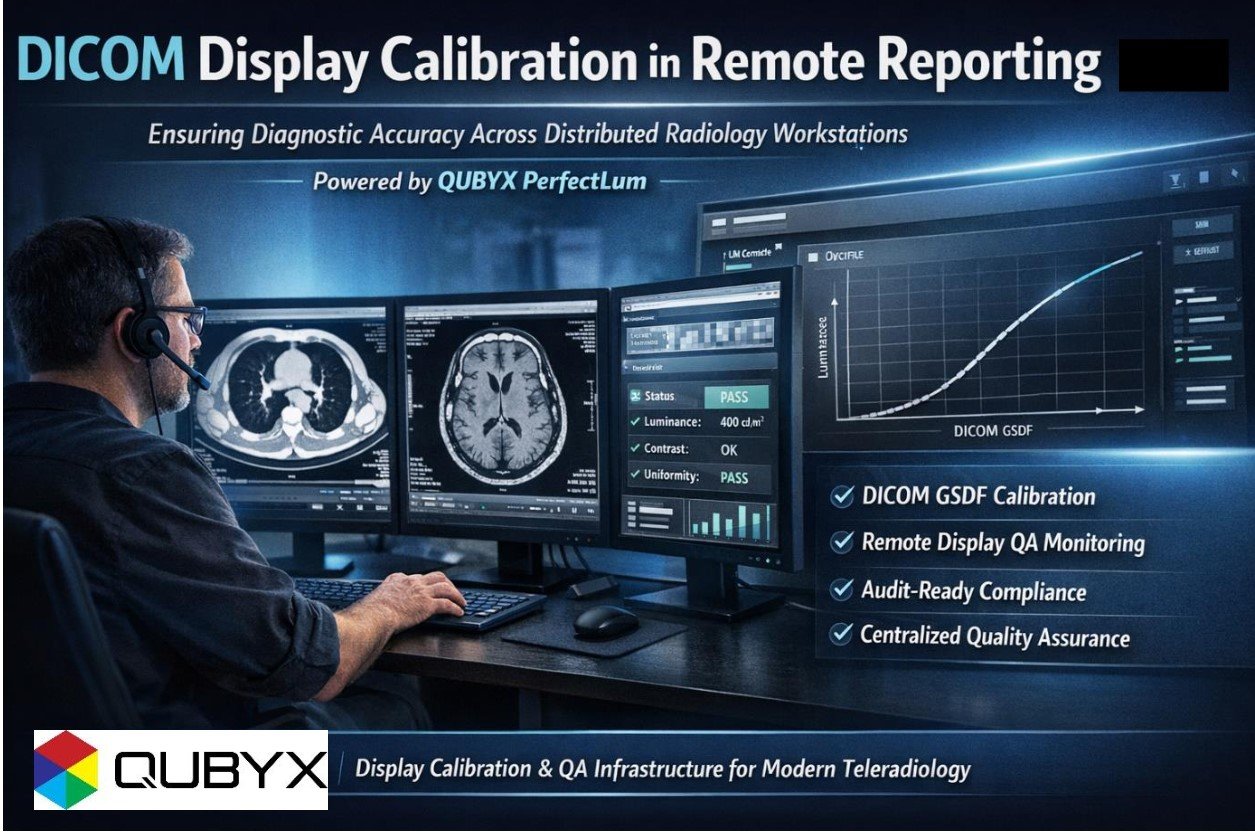
DICOM Display Calibration in Remote Reporting
Why QUBYX PerfectLum Is Essential
The rapid growth of teleradiology and remote reporting has transformed how medical imaging services are delivered worldwide. Radiologists now interpret diagnostic images from home offices, satellite reading rooms, and international reporting centers. While this model improves access to expertise and reduces turnaround time, it introduces a critical challenge: ensuring consistent diagnostic display performance across remote environments.
This is where DICOM Display Calibration in Remote Reporting with QUBYX PerfectLum becomes essential. Proper calibration guarantees that grayscale images appear consistently across monitors, ensuring radiologists see the same diagnostic details regardless of location.
Without standardized calibration and quality assurance, remote reporting risks inconsistent image presentation, potentially affecting diagnostic accuracy.
What Is DICOM Display Calibration?
DICOM display calibration aligns a diagnostic monitor’s grayscale performance with the DICOM Part 14 Grayscale Standard Display Function (GSDF). This standard ensures that subtle differences in luminance are visible to the human eye, which is critical for detecting abnormalities in medical images.
When healthcare institutions implement DICOM Display Calibration in Remote Reporting with QUBYX PerfectLum, they ensure that:
-
Diagnostic monitors follow standardized luminance curves
-
Grayscale contrast remains perceptually linear
-
Image interpretation remains consistent across locations
For radiologists reading remotely, this consistency is fundamental to maintaining clinical confidence and diagnostic reliability.
The Challenge of Remote Radiology Workstations
Remote reporting environments introduce several technical challenges:
1. Uncontrolled Hardware Environments
Radiologists may use different monitor models, luminance capabilities, and graphics configurations.
2. Environmental Variations
Home reading rooms often lack controlled lighting conditions found in hospital reading suites.
3. Lack of Centralized QA Oversight
Hospitals may struggle to verify whether remote workstations remain compliant with imaging standards.
4. Display Drift Over Time
Monitors naturally drift in luminance and grayscale performance, requiring ongoing monitoring.
Implementing DICOM Display Calibration in Remote Reporting with QUBYX PerfectLum directly addresses these challenges through automated calibration, verification, and monitoring.
Why DICOM Calibration Is Critical for Remote Reporting
Radiology depends heavily on grayscale perception. Subtle differences in brightness can reveal or obscure pathology.
If remote monitors are not calibrated properly:
-
Lung nodules may be less visible on CT images
-
Microcalcifications may be harder to detect in mammography
-
Soft tissue contrast in MRI may appear inconsistent
Using DICOM Display Calibration in Remote Reporting with QUBYX PerfectLum ensures that remote radiologists view images with the same perceptual accuracy as in hospital environments.
This reduces diagnostic variability and protects patient safety.
The Role of QUBYX PerfectLum in Remote Display Calibration
QUBYX PerfectLum is a professional display calibration and quality assurance system designed specifically for medical imaging environments.
When deployed for DICOM Display Calibration in Remote Reporting with QUBYX PerfectLum, healthcare organizations gain centralized control over distributed radiology workstations.
Key Capabilities
Automated DICOM Calibration
PerfectLum automatically calibrates diagnostic displays to the DICOM GSDF curve, ensuring accurate grayscale reproduction.
Sensor-Based Measurement
Using dedicated luminance sensors, the system measures actual display performance rather than relying on software estimates.
Remote QA Monitoring
PerfectLum allows administrators to monitor multiple remote workstations through a centralized QA infrastructure.
Compliance Documentation
The system automatically generates audit-ready reports required for regulatory inspections.
These capabilities make DICOM Display Calibration in Remote Reporting with QUBYX PerfectLum a practical solution for modern distributed radiology networks.
Compliance Standards for Remote Diagnostic Displays
Healthcare organizations implementing remote radiology must comply with several international quality assurance frameworks.
These include:
-
AAPM TG-18
-
AAPM TG-270
-
DIN 6868-157
-
ACR Practice Parameters
By implementing DICOM Display Calibration in Remote Reporting with QUBYX PerfectLum, institutions can maintain consistent compliance with these standards across both hospital and remote environments.
This helps organizations remain audit-ready and regulator compliant.
Centralized QA for Distributed Radiology Networks
One of the biggest advantages of DICOM Display Calibration in Remote Reporting with QUBYX PerfectLum is centralized quality assurance.
Instead of managing displays individually, institutions can:
-
Monitor calibration status across remote locations
-
Detect luminance drift automatically
-
Schedule calibration tasks
-
Maintain historical performance records
This transforms calibration from a manual technical task into a structured quality management system.
Benefits for Teleradiology Providers
For teleradiology companies and hospital imaging networks, implementing DICOM Display Calibration in Remote Reporting with QUBYX PerfectLum delivers measurable benefits.
Improved Diagnostic Consistency
Radiologists view images with standardized grayscale performance.
Reduced Clinical Risk
Proper calibration ensures subtle findings remain visible.
Operational Scalability
Centralized QA allows organizations to support large distributed reporting teams.
Regulatory Confidence
Automated documentation simplifies compliance audits.
These advantages make DICOM Display Calibration in Remote Reporting with QUBYX PerfectLum a strategic investment for growing teleradiology networks.
Best Practices for Remote Radiology Display Calibration
Healthcare organizations should follow several best practices when implementing remote calibration programs.
Standardize Display Hardware
Use diagnostic-grade monitors whenever possible.
Implement Sensor-Based Calibration
Accurate measurement requires physical luminance sensors.
Monitor Performance Continuously
Displays must be checked periodically to detect drift.
Maintain Audit Documentation
All calibration tests should be recorded and archived.
Using DICOM Display Calibration in Remote Reporting with QUBYX PerfectLum simplifies all of these processes through automated workflows and centralized management.
The Future of Remote Diagnostic Imaging
As telemedicine expands, remote radiology reporting will continue to grow. Hospitals are increasingly relying on distributed reading networks to address radiologist shortages and provide 24/7 coverage.
However, this shift demands stronger infrastructure for display quality assurance.
By implementing DICOM Display Calibration in Remote Reporting with QUBYX PerfectLum, healthcare organizations ensure that remote radiology remains safe, standardized, and compliant with global imaging standards.
The future of radiology will not be limited to hospital reading rooms, but diagnostic accuracy must remain consistent everywhere.
Conclusion
Remote reporting has revolutionized radiology workflows, but it also introduces new quality assurance challenges.
Consistent display performance is critical for accurate diagnosis. Without proper calibration, remote radiology environments risk inconsistent image interpretation.
Implementing DICOM Display Calibration in Remote Reporting with QUBYX PerfectLum ensures that diagnostic displays remain standardized, monitored, and compliant across distributed reading environments.
For hospitals, teleradiology providers, and imaging networks, this approach provides the foundation for safe, scalable, and reliable remote radiology services.
Start the conversation with our calibration experts today.
In a world where every Pixel accuracy matters, PerfectLum by QUBYX proves that innovation can deliver clinical precision without financial compromise. It’s not just calibration—it’s the democratization of diagnostic imaging.
PerfectLum is Medical Display Calibration & QA Software by QUBYX LLC that delivers consistent, audit-ready display performance through standardized calibration, verification, and centralized quality assurance for radiology and teleradiology environments.
Tags:
DICOM display calibration, DICOM display calibration in remote reporting, QUBYX PerfectLum display calibration, teleradiology display calibration, remote radiology workstation calibration, DICOM GSDF calibration software, medical imaging display QA, radiology monitor calibration, remote diagnostic display compliance, AAPM TG270 display testing, centralized radiology QA system, PerfectLum remote QA monitoring, medical imaging quality assurance software
Related Posts
- May 24, 2026
- News
- May 16, 2026
- News
- May 14, 2026
- News