
News
- Home
- Cost of Teleradiology Services | QA & Compliance Guide
Cost of Teleradiology Services | QA & Compliance Guide
- March 8, 2026
- QUBYX Team
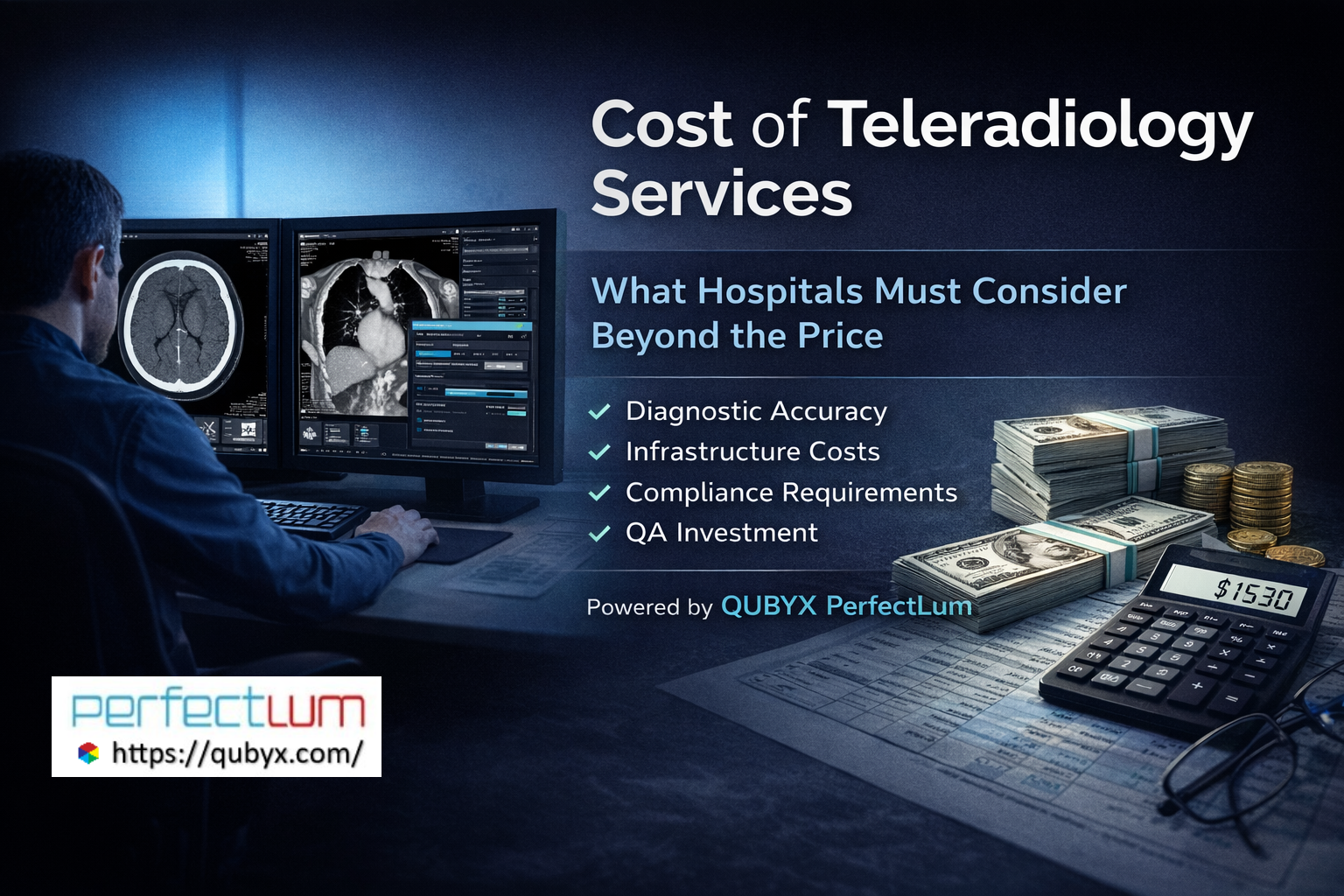
Cost of Teleradiology Services
What Hospitals Must Consider Beyond the Price
A Complete Guide for Hospitals and Imaging Networks
Healthcare systems around the world are increasingly adopting teleradiology to address radiologist shortages, expand diagnostic coverage, and improve turnaround times for medical imaging reports.
While the technology offers significant operational advantages, many healthcare organizations evaluating remote radiology solutions ask the same question:
What is the true cost of teleradiology services?
Understanding the cost structure of teleradiology involves more than just per-report fees. Hospitals must also consider infrastructure, compliance requirements, diagnostic display quality, and long-term operational efficiency.
One critical but often overlooked component in the cost equation is quality assurance for diagnostic displays, an area where solutions like QUBYX PerfectLum play a vital role.
Why Hospitals Use Teleradiology
Hospitals and imaging centers increasingly rely on teleradiology to solve several common challenges, including the cost of teleradiology services.
These include:
• shortages of qualified radiologists
• limited subspecialty expertise
• need for 24/7 radiology coverage
• high staffing costs for in-house radiology teams
• increasing imaging volumes
Teleradiology allows healthcare providers to send CT, MRI, X-ray, and ultrasound studies to remote radiologists for interpretation, enabling hospitals to scale their radiology services efficiently.
Typical Pricing Models for Teleradiology
The cost of teleradiology services varies depending on the provider, geographic location, and level of expertise required.
Most teleradiology services follow one of the following pricing models.
Per-Study Pricing
This is the most common model used by teleradiology providers.
Average price ranges may include:
| Imaging Study | Typical Price Range |
|---|---|
| X-ray interpretation | $5 – $20 |
| CT scan interpretation | $30 – $80 |
| MRI interpretation | $40 – $120 |
| Ultrasound reports | $25 – $70 |
Cost of teleradiology services may increase for subspecialty readings, such as neuroradiology or cardiac imaging.
Monthly Contract Models
Some hospitals prefer subscription-style contracts with teleradiology providers.
These agreements typically include:
• a fixed number of studies per month
• guaranteed turnaround times
• subspecialty access
• night and weekend coverage
Monthly contracts provide predictable budgeting for hospitals with consistent imaging volumes.
Emergency and Night Coverage Fees
Many teleradiology providers charge additional fees for urgent interpretations or after-hours coverage.
These services may include:
• stat reports
• emergency department coverage
• overnight radiology support
These services ensure hospitals maintain continuous imaging coverage even when local radiologists are unavailable.
Hidden Costs in Teleradiology Implementation
While per-study pricing is easy to calculate, the true cost of teleradiology services also includes several infrastructure and compliance components.
Hospitals must invest in:
• PACS systems
• secure data transmission networks
• diagnostic workstations
• regulatory compliance programs
• medical display calibration
Among these factors, diagnostic display quality assurance is one of the most critical yet frequently underestimated requirements.
Why Display Quality Impacts the Cost of Teleradiology
In a traditional hospital radiology department, radiologists read images using calibrated diagnostic monitors located within the facility.
In teleradiology environments, however, radiologists may interpret images from remote locations, which introduces variability in display conditions.
If diagnostic monitors are not properly calibrated, hospitals risk:
• inaccurate grayscale representation
• reduced lesion visibility
• inconsistent diagnostic interpretation
• regulatory compliance failures
Inaccurate interpretation can lead to misdiagnosis, repeat imaging, or delayed treatment, which significantly increases healthcare costs.
Therefore, maintaining consistent diagnostic display performance is essential in distributed radiology networks.
Medical Imaging Standards That Affect Teleradiology
Healthcare organizations must ensure that diagnostic displays meet internationally recognized imaging standards.
These standards include:
• DICOM Part 14 GSDF for grayscale calibration
• AAPM TG-270 for medical display QA
• DIN 6868-157 diagnostic monitor requirements
• ACR accreditation standards
Compliance with these standards requires structured display calibration and ongoing quality assurance monitoring at a reduced cost of teleradiology services.
The Role of QUBYX PerfectLum in Teleradiology Infrastructure
To maintain consistent diagnostic environments across distributed radiology networks, many healthcare organizations rely on QUBYX PerfectLum.
PerfectLum is a professional calibration and quality assurance system designed specifically for diagnostic imaging displays.
By integrating PerfectLum into their imaging infrastructure, hospitals can ensure that remote radiologists view medical images under standardized display conditions.
DICOM GSDF Calibration
PerfectLum calibrates medical displays according to the DICOM GSDF standard, ensuring accurate grayscale representation across radiology workstations.
This consistency is essential for detecting subtle abnormalities in medical images.
Continuous Display Monitoring
Diagnostic monitors gradually lose brightness and contrast accuracy over time.
PerfectLum automatically tracks luminance drift, alerting administrators when recalibration is required.
This proactive monitoring helps maintain consistent image quality.
Centralized Quality Assurance
For healthcare networks using distributed radiology workstations, PerfectLum enables centralized QA management.
Hospitals can monitor display performance across multiple locations, including remote teleradiology workstations.
Administrators can easily track:
• calibration status
• display performance metrics
• scheduled QA tests
• compliance documentation
Audit-Ready Compliance Documentation
Healthcare facilities must maintain detailed records for regulatory inspections and accreditation programs.
PerfectLum automatically generates reports that demonstrate compliance with medical imaging standards.
These reports support regulatory audits and ensure that hospitals maintain consistent imaging quality.
Cost Savings Through Proper QA Infrastructure
While implementing display calibration and QA systems represents an initial investment, the long-term financial benefits are substantial.
Hospitals using structured QA platforms such as QUBYX PerfectLum benefit from:
• reduced diagnostic errors
• fewer repeat imaging studies
• improved regulatory compliance
• increased radiologist confidence
• consistent imaging standards across remote workstations
Ultimately, proper quality assurance helps healthcare organizations maximize the value of their teleradiology investments.
Organizations that build robust infrastructure today will be better positioned to scale their radiology operations at reduced cost of teleradiology services in the future.
Conclusion
The cost of teleradiology services extends beyond simple per-study interpretation fees.
Hospitals must also account for infrastructure, compliance requirements, and diagnostic display quality when evaluating remote radiology solutions.
Ensuring consistent display performance is critical for maintaining diagnostic accuracy across distributed radiology networks.
Solutions like QUBYX PerfectLum provide the calibration, monitoring, and quality assurance tools necessary to maintain standardized imaging environments.
By combining remote radiology expertise with structured QA infrastructure, healthcare organizations can deliver accurate, reliable, and cost-effective diagnostic imaging services regardless of location with a reduced cost of teleradiology services.
Start the conversation with our calibration experts today.
In a world where every Pixel accuracy matters, PerfectLum by QUBYX proves that innovation can deliver clinical precision without financial compromise. It’s not just calibration—it’s the democratization of diagnostic imaging.
PerfectLum is Medical Display Calibration & QA Software by QUBYX LLC that delivers consistent, audit-ready display performance through standardized calibration, verification, and centralized quality assurance for radiology and teleradiology environments.
Tags:
cost of teleradiology services, teleradiology pricing, QUBYX, PerfectLum, outsourced radiology cost, radiology outsourcing pricing, medical display calibration, DICOM GSDF calibration, radiology QA software, QUBYX PerfectLum, medical imaging compliance, remote radiology services
Related Posts
- May 24, 2026
- News
- May 16, 2026
- News
- May 14, 2026
- News