
News
- Home
- Teleradiology for Rural Hospitals | Reliable Diagnostics
Teleradiology for Rural Hospitals | Reliable Diagnostics
- March 8, 2026
- QUBYX Team
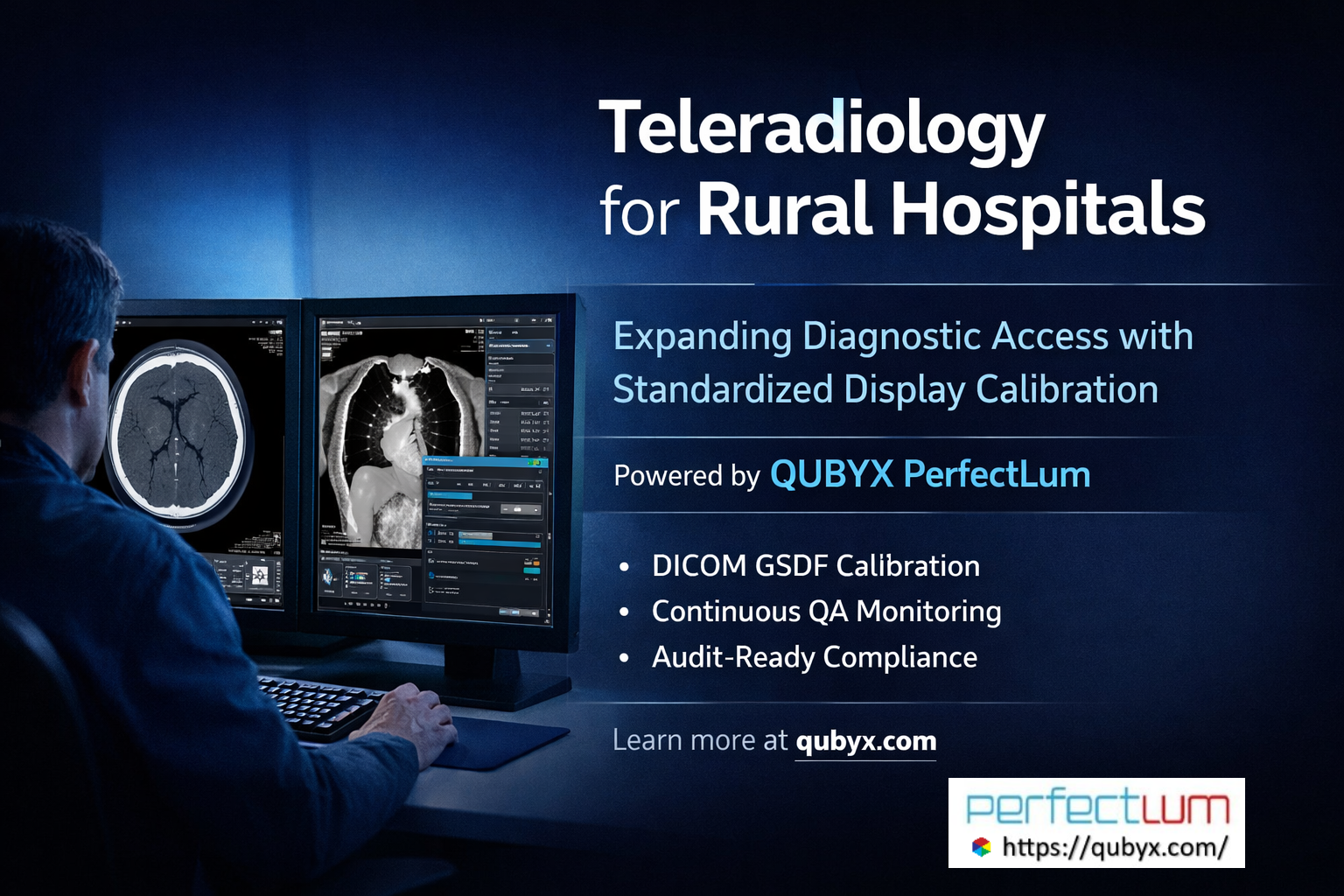
Teleradiology for Rural Hospitals
Expanding Access to Diagnostic Expertise
Rural hospitals often face a serious shortage of specialized radiologists. Limited staffing, smaller patient volumes, and geographic isolation make it difficult for many rural healthcare facilities to maintain full in-house radiology departments.
Teleradiology for rural hospitals is rapidly transforming how these facilities deliver diagnostic imaging services. By enabling remote radiologists to interpret medical images from anywhere in the world, teleradiology bridges the gap between rural healthcare providers and specialized diagnostic expertise.
However, while remote reporting solves access issues, it also introduces new challenges — especially ensuring image display quality, diagnostic accuracy, and regulatory compliance. This is where structured quality assurance platforms like QUBYX PerfectLum play a critical role.
Why Rural Hospitals Struggle with Radiology Coverage
Many rural healthcare facilities operate with limited resources. Recruiting and retaining experienced radiologists can be difficult due to:
-
Geographic isolation
-
Lower patient volumes
-
Budget constraints
-
Limited subspecialty coverage
-
Night and weekend staffing challenges
As a result, many hospitals rely on delayed readings, outsourced interpretation, or transferring patients to larger medical centers.
These delays can impact patient outcomes, particularly in urgent cases such as:
-
Stroke detection
-
Trauma imaging
-
Cancer diagnosis
-
Emergency CT scans
Teleradiology for rural hospitals provides a scalable solution that allows rural hospitals to deliver timely diagnostic services without needing on-site specialists.
How Teleradiology Works in Rural Healthcare
In a teleradiology workflow, imaging studies such as CT scans, MRIs, and X-rays are captured at the rural hospital and securely transmitted to remote radiologists for interpretation.
The Teleradiology for rural hospitals workflow typically includes:
-
Image acquisition using CT, MRI, ultrasound, or X-ray systems
-
Secure transmission through PACS or cloud-based systems
-
Remote interpretation by board-certified radiologists
-
Diagnostic report delivery back to the hospital
This process enables hospitals to provide 24/7 radiology coverage, even in remote areas.
Key Benefits of Teleradiology for Rural Hospitals
1. Access to Specialized Radiologists
Rural hospitals can connect with subspecialists such as:
-
neuroradiologists
-
musculoskeletal radiologists
-
pediatric radiologists
This ensures complex imaging cases receive expert review.
2. Faster Diagnostic Turnaround Times
Teleradiology for rural hospitals network allows hospitals to receive imaging reports within minutes rather than hours or days.
Faster reporting improves:
-
emergency care decisions
-
patient throughput
-
treatment planning
3. Cost Efficiency
Hiring full-time radiologists may be financially challenging for smaller hospitals. Teleradiology allows facilities to scale radiology services based on demand without large staffing overhead.
4. Continuous 24/7 Coverage
Nighttime and weekend coverage are particularly challenging for rural hospitals. Teleradiology for rural hospitals networks provides round-the-clock access to radiologists located in different time zones.
The Hidden Risk: Display Quality in Remote Radiology
While teleradiology improves access to specialists, it introduces an often-overlooked issue:
Radiologists may interpret medical images on displays located hundreds or thousands of miles away from the hospital where images were captured.
Diagnostic accuracy depends heavily on the quality of medical displays used for image interpretation.
If monitors are improperly calibrated, radiologists may experience:
-
incorrect grayscale rendering
-
reduced contrast visibility
-
luminance drift
-
inconsistent image presentation
These problems can lead to missed findings or reduced diagnostic confidence.
Why Display Calibration Matters in Teleradiology
Medical imaging standards require that diagnostic displays meet strict performance criteria.
Important standards include:
-
DICOM Part 14 GSDF – grayscale display function
-
AAPM TG-270 – medical display quality assurance
-
DIN 6868-157 – diagnostic monitor compliance
-
ACR accreditation requirements
Maintaining compliance across distributed teleradiology networks requires continuous monitoring and documentation.
This is where QUBYX PerfectLum becomes essential.
The Role of QUBYX PerfectLum in Teleradiology for Rural Hospital Networks
QUBYX PerfectLum is a professional display calibration and quality assurance system designed for medical imaging environments.
For rural hospitals relying on teleradiology, PerfectLum ensures that remote radiologists view medical images under controlled, standardized display conditions.
Key capabilities include:
DICOM GSDF Calibration
PerfectLum calibrates diagnostic monitors to the DICOM Part 14 grayscale standard, ensuring consistent contrast perception across all radiology workstations.
Continuous Luminance Monitoring
Displays naturally drift over time. PerfectLum continuously monitors luminance performance and alerts administrators when recalibration is required.
Centralized Quality Assurance
Using PerfectLum Remote Server, hospitals can manage and monitor diagnostic displays across entire teleradiology networks for rural hospitals.
This allows IT teams to:
-
monitor workstation compliance
-
track calibration history
-
schedule automated tests
-
maintain regulatory documentation
Audit-Ready Reporting
Healthcare regulators require detailed QA documentation.
PerfectLum automatically generates reports for:
-
compliance inspections
-
accreditation audits
-
internal QA programs
Why QA Infrastructure Matters for Rural Teleradiology
Without structured quality assurance, Teleradiology for rural hospitals networks risks inconsistent diagnostic environments.
Implementing a centralized QA system like QUBYX PerfectLum provides:
-
standardized display performance
-
consistent diagnostic conditions
-
regulatory compliance documentation
-
improved diagnostic reliability
For rural hospitals, this means they can confidently expand radiology services while maintaining the same quality standards as major medical centers.
Real-World Impact on Rural Healthcare
When properly implemented, teleradiology supported by structured QA systems can dramatically improve healthcare access in rural regions.
Hospitals can:
-
deliver faster diagnoses
-
reduce patient transfers
-
improve emergency response
-
support local physicians with specialist insights
By combining remote radiology expertise with robust display calibration infrastructure, rural healthcare systems can provide high-quality diagnostic imaging regardless of location.
The Future of Rural Radiology
Healthcare systems worldwide are increasingly adopting distributed imaging networks, making teleradiology an essential part of modern medicine.
Future developments in Teleradiology for rural hospitals will likely include:
-
AI-assisted image analysis
-
cloud-based imaging platforms
-
enterprise-wide QA monitoring
-
integrated telehealth diagnostics
As these technologies expand, tools like QUBYX PerfectLum will remain critical in ensuring that diagnostic displays maintain precision, consistency, and compliance.
Conclusion
Teleradiology for rural hospitals is revolutionizing access to diagnostic imaging by connecting remote healthcare facilities with specialized radiologists.
However, diagnostic accuracy depends not only on expert interpretation but also on the quality of the displays used to view medical images.
By implementing professional calibration and QA systems such as QUBYX PerfectLum, rural hospitals can ensure that remote radiology services operate under standardized, audit-ready imaging conditions.
The result is a healthcare model where geography no longer limits access to high-quality diagnostic care.
Start the conversation with our calibration experts today.
In a world where every Pixel accuracy matters, PerfectLum by QUBYX proves that innovation can deliver clinical precision without financial compromise. It’s not just calibration—it’s the democratization of diagnostic imaging.
PerfectLum is Medical Display Calibration & QA Software by QUBYX LLC that delivers consistent, audit-ready display performance through standardized calibration, verification, and centralized quality assurance for radiology and teleradiology environments.
Tags:
teleradiology for rural hospitals, rural radiology services, remote radiology interpretation, QUBYX, PerfectLum, telehealth imaging services, medical display calibration, DICOM GSDF calibration, radiology QA systems, QUBYX PerfectLum, medical imaging compliance, remote radiology networks
Related Posts
- May 24, 2026
- News
- May 16, 2026
- News
- May 14, 2026
- News