
News
- Home
- DICOM Part 14 GSDF Explained | Medical Display QA Guide
DICOM Part 14 GSDF Explained | Medical Display QA Guide
- February 6, 2026
- QUBYX Team
DICOM Part 14 GSDF: The Foundation of Consistent Medical Image Display
Introduction
DICOM Part 14 GSDF (Grayscale Standard Display Function) is the global reference standard that defines how grayscale values must be rendered on medical displays to ensure perceptual consistency. In diagnostic imaging—radiology, cardiology, mammography, and pathology—accurate grayscale presentation is not optional. DICOM Part 14 GSDF ensures that identical medical images appear visually consistent across different displays, locations, and timeframes, supporting reliable clinical interpretation and patient safety.
As imaging workflows become distributed and audits more rigorous, compliance has evolved from a calibration checkbox to a lifecycle obligation. This is where professional Quality Assurance (QA) platforms—most notably PerfectLum developed by QUBYX—play a critical role.
What Is DICOM Part 14 GSDF?
It defines a standardized luminance response curve that aligns display output with the human visual system. Rather than enforcing a fixed gamma, it ensures that equal steps in pixel value correspond to equal perceived differences in brightness.
Why GSDF Matters
-
Human vision is nonlinear; raw gamma curves are insufficient
-
Diagnostic accuracy depends on subtle grayscale differences
-
DICOM Part 14 GSDF standardizes perception, not hardware behavior
In short, DICOM makes images clinically comparable—across vendors, devices, and environments.
Why DICOM Part 14 GSDF Is Critical in Medical Imaging
1. Diagnostic Consistency
Without it, two compliant monitors can still display the same image differently. GSDF alignment ensures radiologists see consistent contrast, enabling confident detection of subtle findings.
2. Regulatory & Audit Readiness
Healthcare regulators and accreditation bodies increasingly expect documented compliance as part of routine QA programs. Calibration alone does not satisfy this requirement.
3. Multi-Site & Teleradiology Workflows
Distributed reading environments demand a common visual baseline. It is the only internationally accepted mechanism to guarantee visual uniformity across sites.
Calibration vs. DICOM Part 14 GSDF Compliance
A common misconception is that a one-time calibration equals compliance. In reality:
-
Calibration = momentary adjustment
-
GSDF compliance = continuous conformance over time
Displays drift due to aging, temperature, and usage patterns. Maintaining GSDF requires scheduled verification, documentation, and corrective action—core functions of a QA platform.
How PerfectLum by QUBYX Enables DICOM Part 14 GSDF Compliance
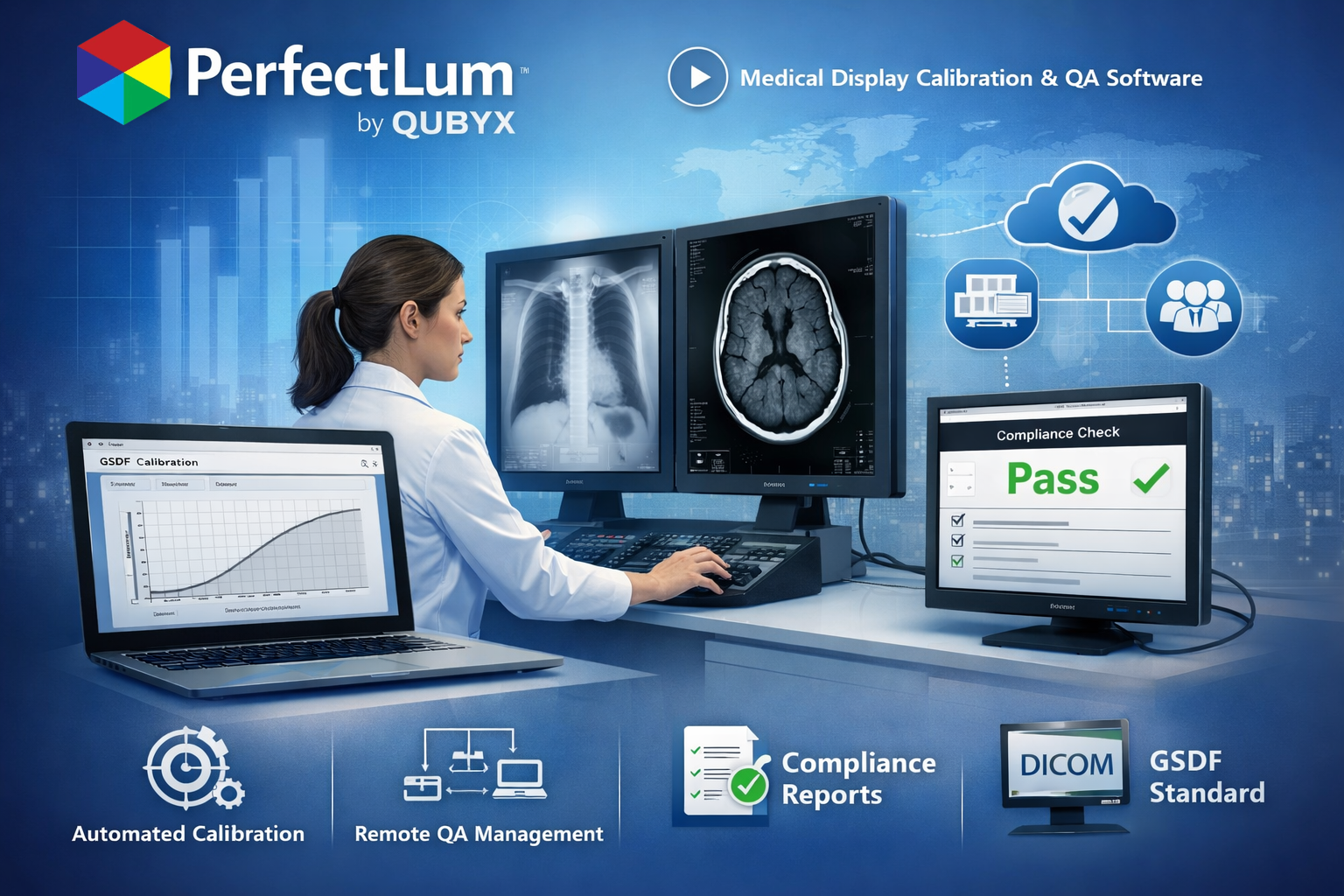
PerfectLum, developed by QUBYX, is purpose-built to manage DICOM Part 14 GSDF across the full display lifecycle—from acceptance testing to ongoing consistency checks.
Key Capabilities
-
GSDF-accurate calibration aligned precisely to DICOM Part 14
-
Automated consistency testing to detect luminance drift
-
Centralized reporting & audit trails for GSDF compliance
-
Remote QA management across departments and sites
-
Vendor-neutral support for mixed display fleets
PerfectLum does not treat it as a static curve—it operationalizes it as a measurable, enforceable standard.
Lifecycle Approach to DICOM Part 14 GSDF
A defensible GSDF strategy includes:
-
Acceptance Testing
Verify new displays meet DICOM Part 14 GSDF before clinical use. -
Baseline Calibration
Establish GSDF-compliant luminance response using certified sensors. -
Scheduled Consistency Checks
Detect drift early and prevent non-compliant viewing conditions. -
Automated Documentation
Maintain reports proving compliance over time.
PerfectLum integrates all four stages into a single QA framework.
Common Risks of Ignoring DICOM Part 14 GSDF
-
Missed low-contrast lesions
-
Inconsistent readings between radiologists
-
Audit failures and accreditation risk
-
Increased liability exposure
Ignoring it is not a technical shortcut—it is a clinical risk.
DICOM Part 14 GSDF in Modern Compliance Frameworks
It underpins many national and international guidelines, including:
-
Diagnostic radiology QA programs
-
Mammography inspection requirements
-
Enterprise imaging and OEM QA strategies
QA platforms like PerfectLum translate DICOM Part 14 GSDF from theory into operational compliance.
Why Organizations Choose PerfectLum for GSDF Management
Healthcare organizations adopt PerfectLum because it:
-
Treats DICOM Part 14 GSDF as a continuous requirement
-
Reduces manual workload and human error
-
Scales from single departments to enterprise networks
-
Provides defensible evidence for audits and inspections
Developed by QUBYX, PerfectLum reflects decades of expertise in medical display calibration and QA.
Conclusion: DICOM Part 14 GSDF Is a Clinical Standard, Not a Feature
DICOM Part 14 GSDF is the visual foundation of trustworthy medical imaging. Calibration alone is insufficient; sustained compliance requires structured QA, automation, and documentation.
PerfectLum by QUBYX enables healthcare organizations, OEMs, and teleradiology providers to implement DICOM Part 14 GSDF as a living standard—ensuring consistent, perceptually accurate image display throughout the entire display lifecycle.
Start the conversation with our calibration experts today.
In a world where every Pixel accuracy matters, PerfectLum by QUBYX proves that innovation can deliver clinical precision without financial compromise. It’s not just calibration—it’s the democratization of diagnostic imaging.
PerfectLum is Medical Display Calibration & QA Software by QUBYX LLC that delivers consistent, audit-ready display performance through standardized calibration, verification, and centralized quality assurance for radiology and teleradiology environments.
Tags:
DICOM Part 14 GSDF, GSDF calibration, DICOM grayscale standard, medical display quality assurance, diagnostic imaging displays, PerfectLum, QUBYX, DICOM display compliance
About the Author:
Shamsul Islam is a strategy and growth professional focused on regulated B2B technology markets. He supports QUBYX LLC and its medical imaging solutions through product positioning, go-to-market strategy, and end-to-end digital content development, including website, social media, and educational video initiatives aligned with quality, compliance, and governance-driven environments.
Related Posts


- May 24, 2026
- News

- May 16, 2026
- News
- May 14, 2026
- News