
News
- Home
- OEM Display Quality Assurance in Medical Imaging
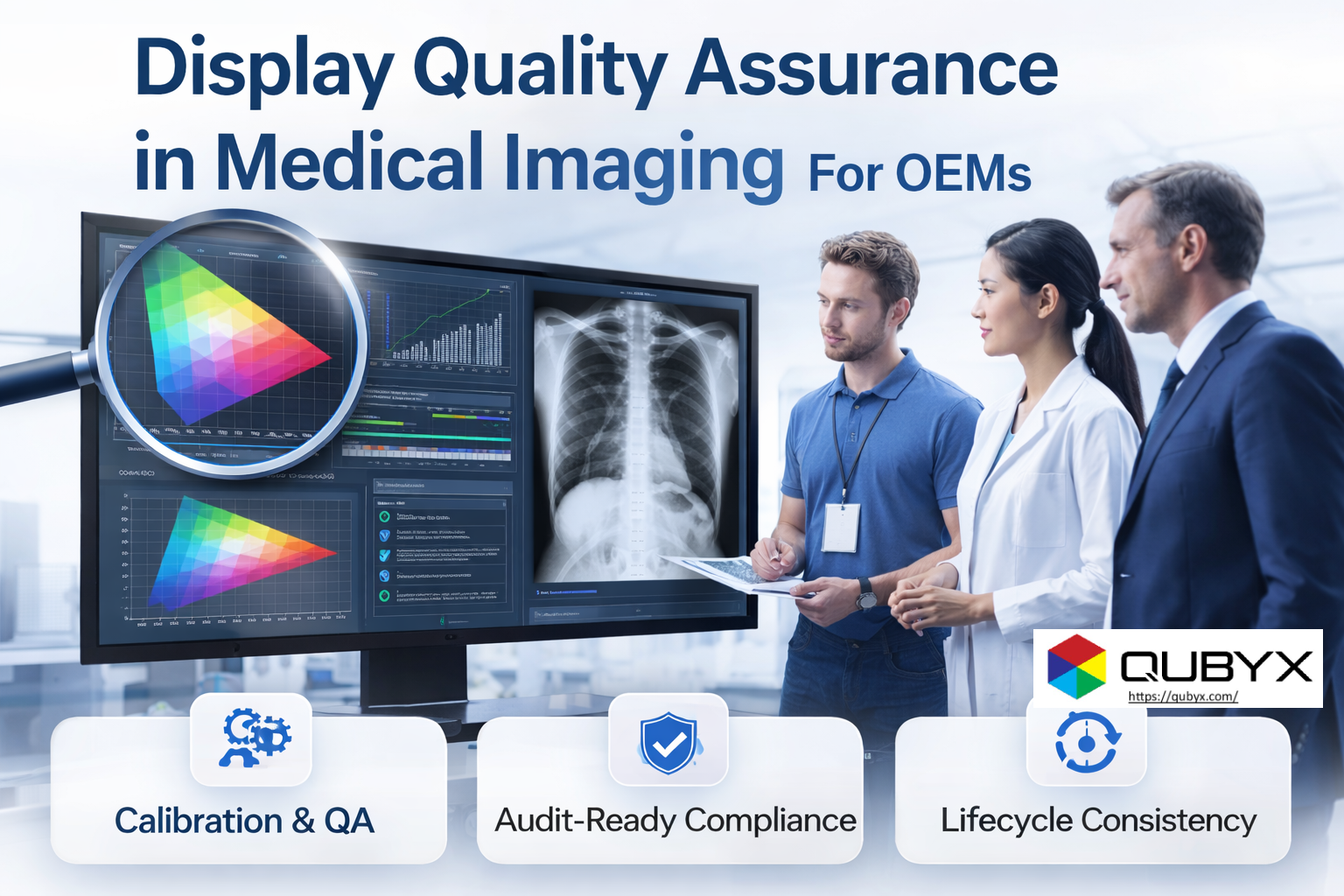
OEM Display Quality Assurance in Medical Imaging
- February 2, 2026
- QUBYX Team
OEM Display Quality Assurance in Medical Imaging
A Lifecycle, Compliance-Aware Perspective for OEM Partners
Why OEM Display Quality Assurance Matters
Medical imaging depends on trust. That trust is not created solely by scanners, modalities, or networks—it ultimately rests on how images are displayed at the point of interpretation. As medical imaging workflows expand across hospitals, teleradiology providers, and distributed reading environments, display quality assurance has become a core OEM responsibility, not an optional technical feature.
For original equipment manufacturers (OEMs) operating in medical imaging, display quality is no longer limited to factory calibration or panel specifications. Healthcare customers increasingly expect repeatable, traceable, and defensible display performance throughout the lifecycle of a device. This expectation has reshaped how OEMs approach calibration software, Display Quality Assurance (QA), compliance, and long-term product support.
This pillar post explains:
-
What OEM display quality assurance means in modern medical imaging
-
Why calibration alone is insufficient for OEM responsibility
-
How regulatory and audit expectations affect OEM strategy
-
What deployment models OEMs must support
-
The role of QUBYX as an OEM Display Quality Assurance enabler
Understanding OEM Responsibility in Medical Imaging
OEMs in medical imaging occupy a unique position. They design, manufacture, integrate, and support components that directly influence diagnostic confidence. While clinicians interpret images, OEMs are responsible for ensuring those images are presented consistently, accurately, and reliably.
In practice, this responsibility spans:
-
Factory calibration and verification
-
Field deployment and installation
-
Ongoing performance stability
-
Documentation for audits and inspections
Historically, many OEMs treated calibration as a one-time technical step. However, this approach no longer aligns with clinical reality. Displays age. Environments change. Firmware and operating systems evolve. Without continuous Display Quality Assurance, calibration drifts—and with it, diagnostic consistency.
Why Calibration Alone Is Not Enough for OEMs
Calibration is essential, but it is not synonymous with Display Quality Assurance.
Calibration answers the question:
Is this display adjusted to a defined target right now?
Display Quality assurance answers a different, more critical question:
Can we prove that this display continues to meet requirements over time?
From an OEM perspective, the difference is significant. Calibration without QA:
-
Provides no historical evidence
-
Does not detect long-term drift reliably
-
Cannot support audit or inspection requirements
-
Shifts risk to the healthcare customer
Modern medical imaging environments require continuous verification, not periodic adjustment. OEMs are increasingly expected to deliver systems that can demonstrate performance consistency—not just claim it.
Regulatory and Audit Expectations for OEM Display QA
Healthcare buyers operate in regulated and inspection-driven environments. While regulations differ by region, expectations are converging around a common theme: prove quality, don’t assume it.
OEMs must support:
-
DICOM GSDF alignment for grayscale presentation
-
Documented Display Quality Assurance workflows
-
Traceable measurement records
-
Evidence suitable for internal reviews and external inspections
Importantly, regulators rarely mandate a specific software product. Instead, they evaluate whether organizations can demonstrate control, consistency, and accountability. OEMs that provide robust Display Quality Assurance infrastructure reduce compliance risk for their customers—and for themselves.
Display QA as a Lifecycle Responsibility
OEM responsibility does not end at shipment. Displays may remain in clinical use for many years, often beyond original procurement cycles. During that time, multiple variables influence performance:
-
Panel aging and luminance decay
-
Environmental lighting changes
-
OS and driver updates
-
Workflow reconfiguration
Without lifecycle QA, OEMs face:
-
Increased support incidents
-
Inconsistent customer experiences
-
Reputational risk in regulated markets
A lifecycle approach to Display Quality Assurance allows OEMs to:
-
Detect issues before they become clinical problems
-
Provide evidence-based support
-
Maintain consistency across product generations
OEM Deployment Models for Display Quality Assurance
OEMs must support diverse deployment scenarios. A single calibration workflow rarely fits all use cases. Common OEM deployment models include:
Factory Calibration
Used to establish baseline conformity before shipment. Valuable, but insufficient on its own.
Field Calibration
Performed during installation or servicing. Useful, but inconsistent without centralized oversight.
Centralized Display Quality Assurance
Enables monitoring, verification, and reporting across sites and fleets. Increasingly expected in enterprise and teleradiology environments.
Effective OEM QA strategies support all three models, allowing flexibility without sacrificing consistency.
The Challenge of Mixed Fleets and Long Product Lifecycles
Healthcare environments rarely standardize on a single display model or generation. OEMs must support:
-
Mixed hardware fleets
-
Multiple display generations
-
Gradual technology transitions
Without a unified QA framework, each variation increases complexity. OEMs risk fragmented support, inconsistent measurements, and higher operational cost. A centralized, vendor-neutral QA approach mitigates these risks by providing a consistent measurement and reporting layer across hardware diversity.
QUBYX’s Role in OEM Display Quality Assurance
QUBYX LLC operates as an OEM enabler, not a hardware vendor, system integrator, or clinical authority. Its role is to provide display calibration and quality assurance software infrastructure that OEMs can integrate into their own medical imaging ecosystems.
QUBYX supports OEMs by delivering:
-
Vendor-neutral calibration and Display Quality Assurance software
-
Separation between calibration and ongoing QA
-
Centralized measurement, verification, and reporting
-
Support for regulated and audit-driven environments
Crucially, QUBYX does not manufacture displays, sensors, or diagnostic systems, and does not compete with OEM partners. This independence allows OEMs to retain control over product strategy while leveraging specialized QA expertise.
Supporting OEM Compliance Without Overclaiming
QUBYX software is designed to support compliance activities—not to replace regulatory responsibility. This distinction is critical for OEMs operating in medical environments.
QUBYX enables:
-
DICOM GSDF-aligned calibration workflows
-
Ongoing verification of display performance
-
Documentation suitable for audits and inspections
QUBYX does not certify devices, issue regulatory approvals, or make clinical claims. This ensures OEMs can integrate QA capabilities without introducing compliance risk through overstatement or misrepresentation.
Reducing OEM Risk Through Evidence-Based QA
One of the most tangible benefits of structured QA is risk reduction. OEMs face risk in several forms:
-
Clinical credibility risk
-
Regulatory exposure
-
Support and warranty escalation
-
Brand trust erosion
By enabling continuous, documented QA, OEMs can:
-
Provide objective evidence during disputes
-
Identify systemic issues early
-
Reduce dependency on anecdotal troubleshooting
QA data transforms support from reactive problem-solving into evidence-based quality management.
OEM Support Efficiency and Operational Impact
Unmanaged display quality often manifests as support issues:
-
“Images look different than before”
-
“Displays don’t match across rooms”
-
“Compliance documentation is missing”
Without QA data, these issues are difficult to diagnose remotely. OEMs may be forced into site visits or hardware replacement without clear cause.
Centralized QA software enables:
-
Remote verification
-
Consistent diagnostic baselines
-
Faster issue resolution
This reduces operational burden while improving customer confidence.
Enabling OEM Trust With Healthcare Buyers
Healthcare organizations increasingly evaluate OEMs on more than technical specifications. Trust is built on:
-
Consistency
-
Transparency
-
Accountability
OEMs that can demonstrate control over display quality throughout the lifecycle position themselves as long-term partners, not just equipment suppliers. QA infrastructure becomes part of the OEM brand promise—even if it operates quietly in the background.
Vendor Neutrality and Long-Term OEM Strategy
OEMs must retain flexibility. Lock-in to proprietary QA systems limits future product planning and complicates ecosystem partnerships.
QUBYX’s vendor-neutral approach allows OEMs to:
-
Support evolving hardware portfolios
-
Integrate with existing workflows
-
Avoid dependency on closed measurement ecosystems
This flexibility is essential for OEMs planning multi-year roadmaps in fast-changing medical imaging markets.
The Shift Toward Quality Governance
Across medical imaging, the industry is moving from isolated technical checks toward quality governance—the ability to oversee, verify, and prove quality at scale.
For OEMs, this shift means:
-
Calibration becomes a component, not the endpoint
-
QA becomes continuous, structured, and reviewable
-
Software plays a central role in trust infrastructure
QUBYX supports this evolution by enabling OEMs to embed Display Quality Assurance governance capabilities without redefining their core business.
Conclusion: OEM Display Quality Assurance as Strategic Infrastructure
Display quality assurance is no longer a background technical function. For medical imaging OEMs, it is a strategic infrastructure layer that supports compliance, trust, and long-term customer relationships.
OEMs that rely solely on factory calibration or manual processes expose themselves—and their customers—to avoidable risk. Those that adopt structured, software-driven QA frameworks are better positioned to:
-
Meet regulatory expectations
-
Reduce operational cost
-
Strengthen brand credibility
QUBYX plays a defined, non-competitive role in this ecosystem by providing OEM-ready display calibration and Display Quality Assurance software designed for regulated, distributed, and long-lifecycle medical imaging environments.
Start the conversation with our calibration experts today.
In a world where every Pixel accuracy matters, PerfectLum by QUBYX proves that innovation can deliver clinical precision without financial compromise. It’s not just calibration—it’s the democratization of diagnostic imaging.
About the Author:
Shamsul Islam is a strategy and growth professional focused on regulated B2B technology markets. He supports QUBYX LLC and its medical imaging solutions through product positioning, go-to-market strategy, and end-to-end digital content development, including website, social media, and educational video initiatives aligned with quality, compliance, and governance-driven environments.
Tags:
OEM display quality assurance, Display Quality Assurance, medical imaging OEM, display calibration OEM, medical display QA, audit-ready imaging QA, DICOM GSDF OEM, OEM imaging compliance, healthcare display QA
Related Posts

- May 24, 2026
- News

- May 16, 2026
- News
- May 14, 2026
- News