
News
- Home
- QUBYX PerfectLum | Global Leader in Medical Display QA
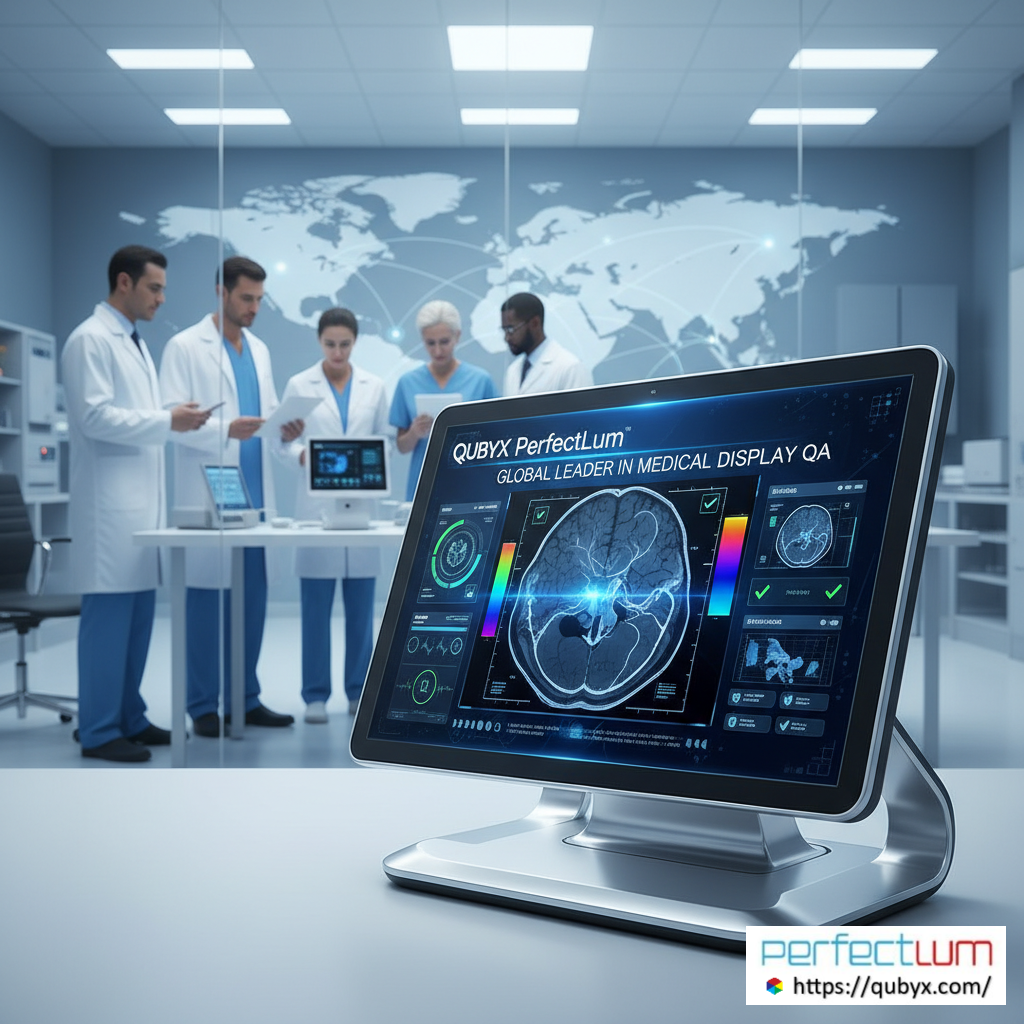
QUBYX PerfectLum | Global Leader in Medical Display QA
- November 14, 2025
- QUBYX Team
QUBYX PerfectLum: Setting Global Standards for Medical Display Quality Assurance
In modern healthcare, a diagnosis is only as good as the image behind it. From CT and MRI to mammography and interventional radiology, clinicians depend on diagnostic displays that show every detail with absolute consistency. That’s where QUBYX PerfectLum stands out: it’s not just another calibration tool, but a complete medical display quality assurance (QA) platform designed to meet and exceed global standards.
In this comprehensive SEO-focused guide, we’ll explore how QUBYX PerfectLum is setting global standards for medical display QA, why that matters for hospitals and imaging centers, and how it helps you stay compliant, efficient, and audit-ready.
Why Medical Display Quality Assurance Matters
Diagnostic imaging is one of the most technology-dependent areas of medicine. Even the best modality (CT/MRI) is useless if the display is inaccurate. Common risks of poor display QA include:
-
Missed microcalcifications in mammography
-
Misinterpretation of subtle lesions or fractures
-
Inconsistent brightness and contrast between reading rooms
-
Failed accreditation or regulatory audits
Healthcare regulators and professional bodies now expect structured QA for displays used in primary diagnosis. That includes:
-
Regular calibration to a defined standard (e.g., DICOM GSDF)
-
Routine acceptance, constancy, and visual tests
-
Detailed documentation of results, history, and maintenance
Without the right software, this quickly becomes complex, manual, and error-prone. QUBYX PerfectLum solves this with an integrated, automated QA workflow.
What Is QUBYX PerfectLum?
PerfectLum is a professional-grade medical display calibration and quality assurance software developed by QUBYX. It is designed for:
-
Radiology and teleradiology workstations
-
Mammography and breast imaging displays
-
Surgical and endoscopy monitors
-
Clinical review and modality consoles
At its core, QUBYX PerfectLum:
-
Calibrates displays to DICOM Part 14 GSDF (Grayscale Standard Display Function)
-
Supports leading QA standards and guidelines (e.g., AAPM, DIN, etc.)
-
Automates test patterns, measurements, reporting, and scheduling
-
Centralizes management via QUBYX PerfectLum QA Server (for multi-site environments)
The result: consistent, standard-compliant image quality across your entire fleet of displays.
PerfectLum and Global Standards: Compliance Made Practical
One of the key reasons hospitals and imaging centers choose QUBYX PerfectLum is its alignment with international QA standards. Instead of struggling with fragmented tools and spreadsheets, you get built-in workflows that reflect current regulations and best practices.
1. DICOM Part 14 GSDF Calibration
The foundation of diagnostic display QA is DICOM Part 14 GSDF. This standard ensures that perceived brightness steps are uniform across the entire luminance range. In practice, that means:
-
Radiologists see predictable, reproducible grayscale on every workstation
-
Subtle details in low-contrast areas are not lost
-
Diagnostic accuracy is supported by a scientifically defined grayscale curve
QUBYX PerfectLum:
-
Measures luminance response using a supported sensor
-
Calculates corrections to match the DICOM GSDF curve
-
Creates and maintains a precise LUT (Look-Up Table) for the display
-
Monitors drift over time and prompts recalibration when needed
This turns complex physics into a simple, repeatable software process.
2. Supporting AAPM, DIN and Other QA Guidelines
Beyond DICOM GSDF, many regions and institutions rely on more detailed QA guidance such as:
-
AAPM Task Groups (e.g., TG18, TG270) – widely used in North America
-
DIN 6868-157 – important for QA in German and European hospitals
-
Local or national QA protocols for radiology and mammography
QUBYX PerfectLum is designed to:
-
Provide the test patterns and workflows necessary for these protocols
-
Log and document visual and quantitative tests
-
Generate standardized reports for audits and inspections
Instead of manually stitching together procedures, physicists and PACS administrators can rely on a single platform that speaks the language of global display QA standards.
Key Features That Set QUBYX PerfectLum Apart
To understand why PerfectLum is considered a global benchmark, look at its feature set from a practical hospital perspective.
1. End-to-End Calibration & QA Workflow
PerfectLum covers the full lifecycle of a medical display:
-
Acceptance testing – for new displays entering service
-
Initial calibration – to DICOM Part 14 or other specified standard
-
Constancy tests – recurring checks to confirm performance over time
-
Visual and quantitative tests – comprehensive QA, not just one-time calibration
This is essential for hospitals that want traceability from installation to retirement.
2. Multi-Vendor, Multi-Display Support
Most hospitals don’t have a single-vendor display environment. They may use:
-
High-end diagnostic displays from different manufacturers
-
Surgical or modality monitors from niche vendors
-
Standard commercial monitors in review areas
PerfectLum’s multi-vendor support allows you to:
-
Standardize QA across all displays, not just those from one manufacturer
-
Avoid vendor lock-in to proprietary calibration tools
-
Extend the life and usability of existing hardware
This flexibility is a major cost saver and a strategic advantage.
3. Automated Scheduling and Reminders
In busy clinical environments, it’s easy to forget QA checks until an audit looms. PerfectLum solves this with:
-
Configurable schedules for calibration and constancy tests
-
Automatic reminders for overdue tasks
-
Central dashboards that show QA status across devices
This ensures that QA is proactive, not reactive, and that compliance doesn’t depend on one person’s memory.
4. Centralized Management with QA Server
For larger institutions, QUBYX PerfectLum QA Server (central management) is a critical component. It allows IT and physics teams to:
-
Manage multiple sites and departments from a single interface
-
Push policies and schedules to all connected clients
-
View real-time status of each display (pass/fail, overdue, calibrated, etc.)
-
Generate institution-wide compliance reports for leadership and regulators
This is particularly powerful for:
-
Hospital networks with multiple campuses
-
Teleradiology providers serving clinics across regions
-
National or regional imaging chains
PerfectLum turns fragmented QA into a coherent, centrally controlled program.
5. Detailed, Audit-Ready Reporting
Regulators and accreditation bodies don’t just want to hear that you do QA—they want proof. QUBYX PerfectLum offers:
-
Automated, standardized reports for each display
-
Historical logs of calibration dates, test results, and changes
-
Export options (e.g., PDF, CSV) for sharing with auditors and management
This reduces the stress of inspections and demonstrates that your facility takes QA seriously.
Benefits for Different Stakeholders
For Radiologists and Clinicians
-
Confidence that every image is displayed as intended
-
Reduced risk of missed findings due to poor display performance
-
Consistent appearance of studies across different workstations
When radiologists trust the image, they can focus on diagnosis—not on fiddling with brightness and contrast.
For Medical Physicists and QA Teams
-
Less manual work; more automated, standardized processes
-
Easy documentation for audits and accreditation
-
A single platform to enforce policy and track compliance
QUBYX PerfectLum becomes the technical backbone of the display QA program.
For IT & PACS Administrators
-
Centralized management of software, settings, and schedules
-
Less downtime with predictable maintenance cycles
-
Better inventory overview of diagnostic and clinical displays
PerfectLum integrates smoothly into existing IT workflows.
For Hospital Management and CFOs
-
Lower QA overhead compared to manual or vendor-locked solutions
-
Extended useful lifetime of displays through proper maintenance
-
Reduced regulatory and legal risk from non-compliant display performance
-
Clear ROI in terms of both cost savings and risk mitigation
In other words, PerfectLum is not just an IT purchase—it’s a strategic quality and risk management investment.
PerfectLum in a Teleradiology and Remote Reading World
The rise of teleradiology and remote reporting makes standardization across locations more critical than ever. PerfectLum supports this by enabling:
-
Consistent calibration on remote workstations
-
Central QA monitoring via the QUBYX PerfectLum QA Server
-
Documented compliance even when radiologists work off-site
This helps teleradiology providers prove that remote reading setups are as safe and compliant as on-premise reading rooms.
Conclusion: Setting the Global Benchmark for Display QA
In an era where imaging drives clinical decisions, display quality is mission-critical. QUBYX Software PerfectLum helps hospitals, imaging centers, and teleradiology providers:
-
Standardize calibration with DICOM Part 14 GSDF
-
Align with international QA standards such as AAPM and DIN
-
Automate and centralize their entire display QA process
-
Prove compliance with clear, audit-ready documentation
By combining technical precision with practical workflow tools, QUBYX PerfectLum truly sets global standards for medical display quality assurance—turning QA compliance from a burden into a powerful quality and risk-management advantage.
In a world where every Pixel accuracy matters, PerfectLum by QUBYX proves that innovation can deliver clinical precision without financial compromise. It’s not just calibration—it’s the democratization of diagnostic imaging.
To secure Medical Display Quality Assurance with precision while reducing the recurring costs of proprietary hardware, the answer is clear: transition to a Calibration Software platform like QUBYX OS Tools (Free) and PerfectLum today. Now, you easily pay less for Radiology.
Tags:
QUBYX PerfectLum, medical display quality assurance, DICOM GSDF calibration software, radiology monitor QA, diagnostic imaging display compliance, teleradiology display calibration, AAPM TG18 TG270 DIN QA
Related Posts
- May 24, 2026
- News
- May 16, 2026
- News
- May 14, 2026
- News