
News
- Home
- PerfectLum and RCR PACS Compliance for Diagnostic Displays
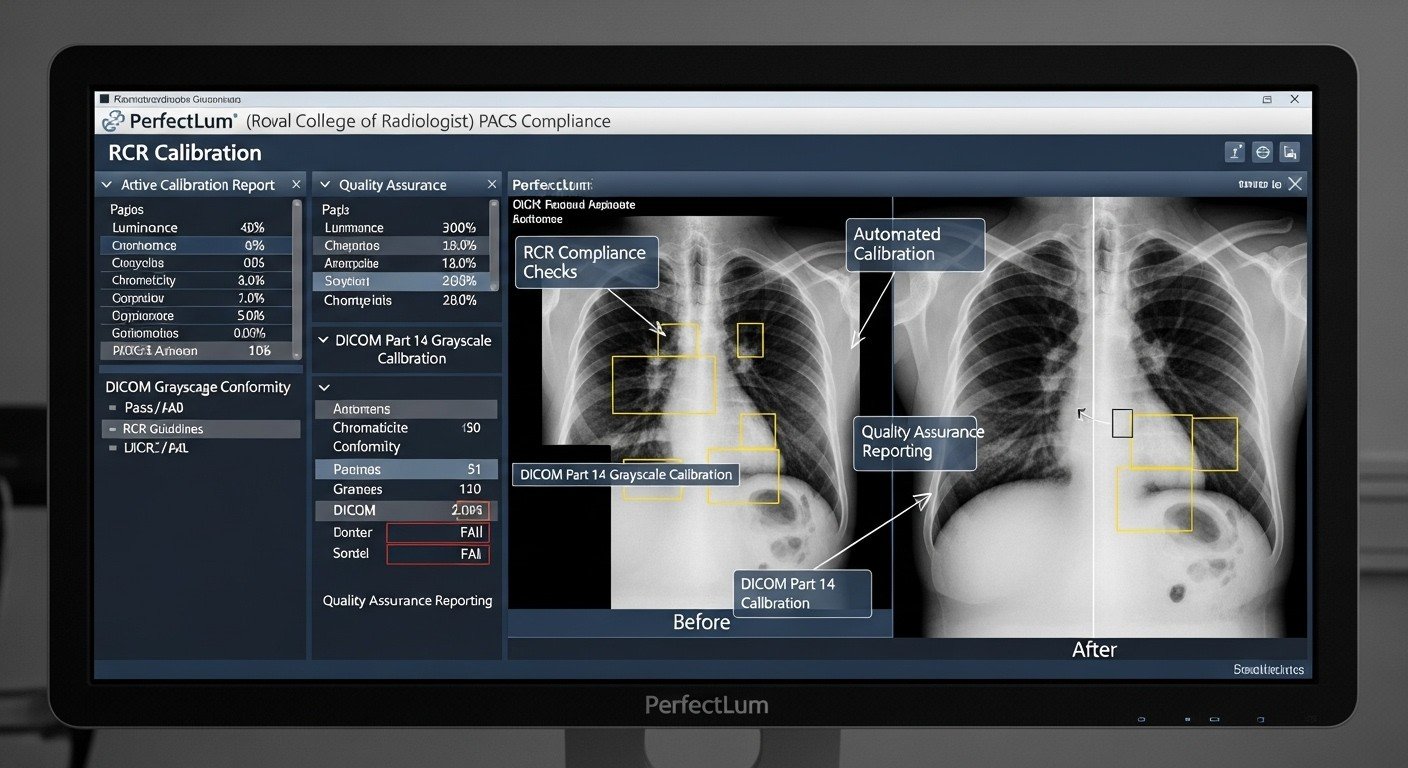
PerfectLum and RCR PACS Compliance for Diagnostic Displays
- November 2, 2025
- QUBYX Team
QUBYX PerfectLum Compliance with RCR PACS Guidelines for Diagnostic Display Devices
Meta title (≤60 chars):
Meta description (~160 chars): See how QUBYX PerfectLum helps radiology teams meet RCR PACS guidelines for diagnostic display devices with DICOM GSDF, routine QA, audit trails, and remote oversight.
SEO keywords: RCR PACS guidelines, diagnostic display devices, DICOM Part 14 GSDF, medical display QA, PerfectLum, NHS PACS compliance, teleradiology QA, AAPM TG18, TG270, DIN 6868-157, IEC 62563-1
Why RCR PACS Guidance Matters—And Where PerfectLum Fits
The Royal College of Radiologists’ (RCR) guidance for PACS and diagnostic display devices sets the bar for safe, consistent image interpretation across NHS Trusts and independent providers. These expectations include calibration to DICOM Part 14 (GSDF), documented routine QA, ambient light controls, display performance monitoring, and auditable records—not just on-site, but for teleradiology and home reading as well.
QUBYX PerfectLum is purpose-built to operationalise those requirements. It brings standardised calibration, scheduled acceptance and constancy tests, automated reporting, and a Remote QA Server for multi-site oversight—so physics, PACS, and IT teams can demonstrate compliance with confidence while keeping operations lean.
Core RCR Expectations—Mapped to PerfectLum Capabilities
Below is a practical mapping of common RCR expectations to PerfectLum features. (Exact wording can vary across editions and local Trust policy; always align with your medical physics department.)
1) Calibration & Display Performance
-
RCR intent: Diagnostic workstations should be calibrated to DICOM Part 14 GSDF, achieving stable luminance response and consistent grayscale perception across the enterprise (including remote locations).
-
PerfectLum response:
-
Automated DICOM GSDF calibration using internal or external sensors.
-
Verification charts and ΔE/contrast metrics to prove calibration accuracy.
-
Luminance/contrast trending over time to catch drift early.
-
2) Routine QA & Test Schedules
-
RCR intent: Acceptance testing on install/commissioning, followed by periodic constancy tests with documented frequencies (daily/weekly/monthly/annual tasks) and clear accept/reject criteria.
-
PerfectLum response:
-
Pre-built AAPM TG18/TG270, DIN 6868-157, and IEC 62563-1-aligned test patterns and procedures.
-
Scheduler for daily quick checks (visual), monthly constancy (instrumented), and annual physics-level performance tests.
-
Pass/Fail dashboards, automated notifications, and custom tolerances aligned with local physics protocols.
-
3) Ambient Conditions & Use Case Controls
-
RCR intent: Ambient light and reflections must be controlled; reporting displays used only in appropriate environments and configurations (e.g., primary reporting vs clinical review distinctions).
-
PerfectLum response:
-
Ambient sensor integration (where supported) and test prompts to validate room illuminance parameters.
-
Role-based profiles: different QA criteria for primary diagnostic, mammography, surgical, or clinical review monitors.
-
On-screen prompts and policy reminders for readers (e.g., ambient light guidance at launch).
-
4) Asset Management & Fleet Visibility (Including Remote Reading)
-
RCR intent: PACS administrators and medical physics require enterprise oversight—especially for teleradiology and home workstations—with clear evidence that every active display meets diagnostic standards.
-
PerfectLum response:
-
Remote QA Server: a central console for monitor inventory, version control, test status, drift alerts, and exception handling.
-
Multi-site, multi-vendor coverage (no vendor lock-in), ideal for mixed fleets across hospital sites and remote radiologists.
-
Policy enforcement (e.g., block reporting if key constancy tests are overdue, per governance).
-
5) Documentation, Audit, and Governance
-
RCR intent: Traceable records of calibration, QA results, remedial actions, and authorisation for audits, governance committees, and regulators.
-
PerfectLum response:
-
Tamper-evident logs with user, device ID, date, test name, results, and any corrective actions.
-
One-click PDF/CSV reports for audits, QMS, and board-level assurance.
-
API/export options for integration with Trust QMS or ITSM tools.
-
A Practical QA Schedule That Aligns with RCR Principles
Use the following as a template and refine with your medical physics team.
On Installation / Commissioning
-
Acceptance testing per physics protocol (resolution, luminance response, uniformity, color/gray, pixel defects).
-
Full DICOM GSDF calibration; baseline report archived.
Daily (Reader Quick Check)
-
Visual QC (e.g., TG18-QC pattern) before reporting sessions.
-
PerfectLum prompts and records pass/fail with screenshots and comments.
Monthly (Constancy Testing)
-
Instrumented luminance response and uniformity spot checks.
-
Review trend graphs in PerfectLum for drift; initiate recalibration if thresholds exceeded.
Quarterly (Environment & Usability)
-
Room illuminance verification and reflection check.
-
Verify workstation ergonomics (viewing distance, angle) and GPU output settings.
Annual (Physics-Level)
-
Comprehensive performance testing per IEC 62563-1 / DIN 6868-157 / local policy.
-
Full recalibration and re-acceptance if hardware changes or panel ageing flags appear.
Teleradiology & Home Workstations: Closing the Governance Gap
RCR stresses that remote reporting must meet the same diagnostic quality as on-site. PerfectLum’s Remote QA Server enables:
-
Zero-touch policy enforcement: If a home display misses required constancy tests or falls out of tolerance, the system can flag or block reporting until issues are resolved.
-
Automated guidance: Readers get step-by-step on-screen workflows for calibration, visual checks, and documentation.
-
Fleet-wide reports: Physics and PACS teams can filter by location, user, modality use-case (e.g., CT/MR vs. mammo), and export evidence for audits.
Interoperability & Standards Coverage
While RCR guidance is the North Star in the UK, most Trusts also reference international technical standards. PerfectLum supports your governance stack with:
-
DICOM Part 14 GSDF calibration and verification
-
AAPM TG18/TG270 patterns and procedures (constancy & acceptance)
-
DIN 6868-157 (particularly useful for Europe-aligned specifications)
-
IEC 62563-1 testing framework alignment
-
Vendor-neutral approach—works across multi-brand monitors and sensors
This multi-standard approach helps physics teams harmonise local policies with global best practices and prepares you for evolving guidance without vendor lock-in.
Implementation Blueprint for NHS Trusts
-
Baseline & Inventory
-
Discover all diagnostic and clinical review displays (including remote).
-
Ingest into PerfectLum with device IDs, reader roles, locations, and modality tags.
-
Policy & Profiles
-
Define profiles (e.g., Diagnostic Primary, Mammography, Clinical Review) with distinct tolerances, test batteries, and schedules mapped to RCR expectations.
-
Calibration & Acceptance
-
Perform full DICOM GSDF calibration and acceptance tests.
-
Archive baseline reports and enable remediation workflows for any failures.
-
Constancy & Scheduling
-
Automate daily visual checks, monthly constancy tests, and annual physics reviews.
-
Configure threshold alerts (e.g., luminance drift ±X%, uniformity variance, ambient light exceedance).
-
Training & Change Management
-
Provide one-page SOPs for readers and remote radiologists; embed guidance in PerfectLum prompts.
-
Align with PACS governance and IT service desks for incident routing.
-
Audit-Ready Reporting
-
Standardise PDF/CSV exports and dashboards for QA committees and external audits.
-
Use trend analytics to forecast replacements and plan budgets proactively.
Risk Reduction & Cost Control
-
Risk reduction: Continuous constancy testing and drift alerts reduce the chance of sub-optimal reporting, supporting clinical safety cases and medico-legal defensibility.
-
OPEX efficiency: Centralised, automated QA reduces physics “truck rolls,” shortens turnaround for remediation, and enables right-sizing of premium panels (use mammography-grade only where policy requires).
-
Lifecycle planning: Trend data drives predictive replacement rather than calendar-based swaps—cutting waste while maintaining compliance.
Frequently Asked Questions
Is PerfectLum suitable for mixed fleets (different vendors, ages, and sensors)?
Yes. PerfectLum is vendor-neutral and works with a wide range of panels and sensors, ideal for Trusts that have grown through phased upgrades or mergers.
Can we enforce different standards for different roles?
Absolutely. Create role-specific profiles (e.g., primary diagnostic, mammo, clinical review) with unique tolerances, tests, and test intervals.
How do we prove compliance during an audit?
Use PerfectLum’s tamper-evident logs and one-click reports showing test history, calibration files, pass/fail outcomes, remediation notes, and sign-offs by named users.
What about home reporting environments?
PerfectLum supports remote QA, including ambient prompts, schedule enforcement, and policy-based blocking if a device falls out of compliance—aligned with RCR’s quality expectations for teleradiology.
Sample SOP Snippet (Adapt to Local Policy)
-
Scope: All diagnostic and review displays used for PACS image interpretation, on-site and remote.
-
Standards: RCR guidance; DICOM Part 14 GSDF; AAPM TG18/TG270; IEC 62563-1; DIN 6868-157 (as applicable).
-
Calibration: DICOM GSDF via PerfectLum at commissioning and after panel/GPU changes.
-
Testing: Daily visual check; monthly constancy; annual physics-level acceptance/recert.
-
Ambient: Verify room illuminance and reflections; document with PerfectLum prompts where supported.
-
Governance: Non-compliance triggers remediation; reporting may be paused per policy until resolved.
-
Records: PerfectLum logs and reports retained per Trust retention schedule.
Key Takeaways
-
RCR PACS guidance expects calibrated, monitored, and auditable diagnostic displays across all reporting locations.
-
PerfectLum operationalises compliance with DICOM GSDF calibration, scheduled QA, and remote governance to keep every display within tolerance.
-
Vendor-neutral tooling, audit-ready reports, and enterprise scheduling help physics, PACS, and IT teams prove and sustain compliance—efficiently.
Ready to Align With RCR—Everywhere You Report
If you’re planning a fleet refresh, tightening teleradiology controls, or preparing for an audit, we can map your current estate to a PerfectLum-powered QA program in days—not months.
Get a compliance walk-through and demo: We’ll build a pilot profile for your primary and remote displays and show you the audit reports you can export tomorrow.
In a world where every pixel matters, PerfectLum proves that innovation can deliver clinical precision without financial compromise. It’s not just calibration—it’s the democratization of diagnostic imaging.
To secure Medical Display Calibration with precision while reducing the recurring costs of proprietary hardware, the answer is clear: transition to a Calibration Software platform like QUBYX OS Tools (Free) and PerfectLum today. Now, you easily pay less for Radiology.
Tags:
RCR PACS guidelines, diagnostic display devices, DICOM Part 14 GSDF, medical display QA, PerfectLum, NHS PACS compliance, teleradiology QA, AAPM TG18, TG270, DIN 6868-157, IEC 62563-1
Related Posts


- May 24, 2026
- News

- May 16, 2026
- News
- May 14, 2026
- News